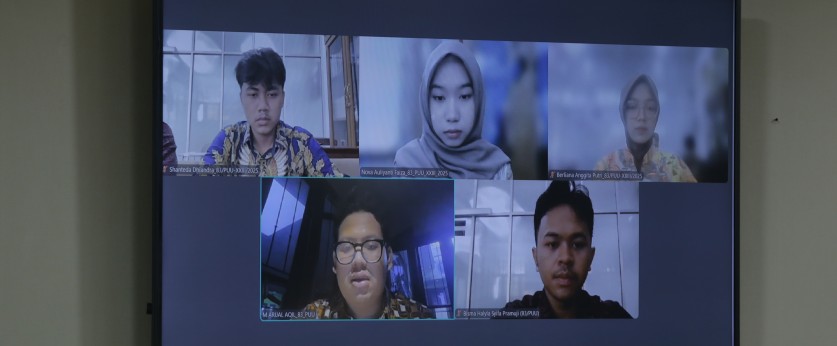
The Petitioners attending the Petition Revision Hearing of Case No. 83/PUU-XXIII/2025 on the formal judicial review of Law No. 3 of 2025 on the Amendment to Law No. 34 of 2004 on the Indonesian National Armed Forces, Tuesday (17/6/2025). Photo by MKRI/Bay.
Jakarta (MKRI) – Petitioners of Case No. 83/PUU-XXIII/2025 delivered a revised petition for judicial review of Law No. 3 of 2025 on the Indonesian National Armed Forces (Army Law). The Petitioners consisted of five students of Universitas Muhammadiyah Surakarta. They added several articles from the 1945 Constitution of the Republic of Indonesia, which became the touchstones or basis of testing. These articles are Article 1 paragraph (2), Article 27 paragraph (1), Article 28C, Article 28D paragraph (1) and paragraph (3), Article 28F, and Article 28J.
In addition, the Petitioners also inserted the Constitutional Court Decision No. 91/PUU-XVIII/2020, which firmly stated that “Lawmakers must carry out the lawmaking process as stipulated in the 1945 Constitution and Law No. 12 of 2011 (Law on Lawmaking).” Hence, the Petitioners argued that the President, as the initiator of the Army Law, failed to carry out his duty in accordance with the procedure regulated in Law No. 12 of 2011. Therefore, since the lawmaking formally violated the law and was contrary to the principles of lawmaking, it could be categorized as having a formal flaw.
The Petitioners also argued that the making of the army law did not fulfill three aspects: human dignity, accuracy, and protecting legitimate expectations. It resulted in the violation of the Petitioners’ constitutional rights.
In their petitions, the Petitioners requested the Court to declare the Army Law did not satisfy the lawmaking requirements based on the 1945 Constitution. The Petitioners also requested that the Court declare the Army Law to be in contradiction to the 1945 Constitution and, therefore, to lack legally binding force.
Also read:
Army Law Reduces Job Opportunities for Civilians
The case was heard by Deputy Chief Justice Saldi Isra (chair), Justice Ridwan Mansyur, and Justice Arsul Sani. The Petitioners considered that the legislation process of the Army Law was carried out exclusively without public participation. Hence, if the Army Law becomes effective and military personnel can work in the civil sector, it will reduce the petitioners’ job opportunities.
“The petitioners who are currently students are afraid that in the future, if the law is effective, the job opportunities for the petitioners will be limited, even though, even before the law, job opportunities for civilians are very limited. Suppose the military personnel are allowed to work in the civil sector. In that case, it will be harder for the Petitioner to get a job,” Petitioner Nova Auliyanti Faiza stated during the hearing of Case No. 83/PUU-XXIII/2025 on Tuesday, May 27, 2025.
In addition to Nova, the Petitioners of the case consist of Mohammad Arijal Aqil, Shanteda Dhiandra, Bisma Halyla Syifa Pramuji, and Berlliana Anggita Putri. Berliana, a law graduate, admitted that she found it challenging to secure a job due to the limited job opportunities and a high number of job seekers. This results in a high number of unemployed people and competition. Moreover, if a supposed civil position based on a specific skill is occupied by military personnel who lack the necessary skills, it presents a problem.
The Petitioners further argued that the Army Law did not fulfill the category as an emergency and urgent bill to be enacted as stipulated in the Lawmaking Law. There was no extraordinary situation, conflict, natural disaster, or national urgency that was real and could not be postponed, which could serve as the reason to justify the Army Law revision outside the standard mechanism of the prolegnas.
The Army Law could also not be qualified as a carryover bill, as provided by the Lawmaking Law. Based on the documents and legislative facts, during the Legislative Period of 2019-2024, the Army Law Bill was not included in the Problem Inventory List discussion because the President did not send a letter or the list as required constitutionally to initiate the conversation with the House of Representatives. According to the Petitioners, the planning and establishment process of the Army Law demonstrated hasty planning and a neglect of the precautionary principle, which should be the foundation of all legislative processes.
Also read:
Revised petition No. 83/PUU-XXIII/2025
Author: Mimi Kartika.
Editor: N. Rosi
Translator: Rizky Kurnia Chaesario
Disclaimer: The original version of the news is in Indonesian. In case of any differences between the English and the Indonesian versions, the Indonesian version will prevail.
Tuesday, June 17, 2025 | 17:12 WIB 169