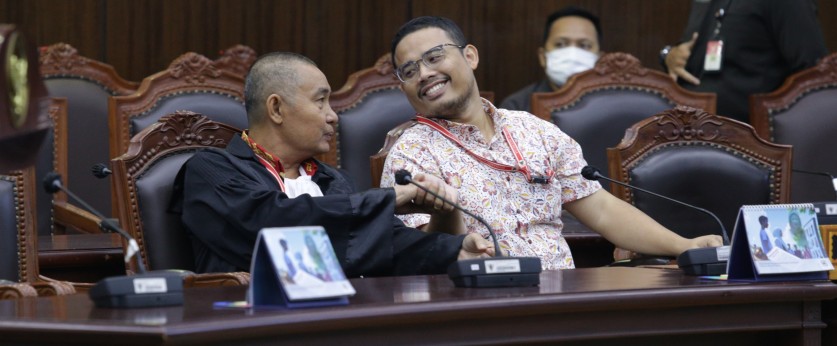
Principal Petitioner attending the ruling hearing of case No. 62/PUU-XXIII/2025 on the Judicial Review of Law No. 18 of 2003 on Advocates, Thursday (6/26/2025). Photo by MKRI/Bayu.
JAKARTA (MKRI) — The Constitutional Court (MK) rejected in its entirety the judicial review petition of Law No. 18 of 2003 on Advocates filed by Ericko Wiratama Sinuhaji. The ruling hearing for case No. 62/PUU-XXIII/2025 was held on Thursday, June 26, 2025.
In its legal considerations, the Court asserted that there is no compelling reason to alter its stance established in previous rulings regarding the implementation of internships for prospective advocates. The Court deemed the Petitioner’s experience, which he believed should allow him to serve an internship outside of an advocate’s office, as unjustified. According to the Court, such experience lacks the comprehensive nature typically provided by a legal institution.
“In this context,” said Constitutional Justice Arsul Sani reading the Court’s legal opinion, “the Petitioner’s factual circumstance—having worked in a corporation, which he claimed was equivalent to serving as a transaction lawyer in an advocate’s office—cannot be a valid basis to deem the phrase ‘advocate’s office’ in Article 3(1)(g) of the Advocates Law unconstitutional if not interpreted to include legal institutions, corporations, organizations, or other workplaces.”
The Court found that the legal reasoning in prior rulings remains relevant to assess the constitutionality of the phrase “advocate’s office” in Article 3(1)(g) of the Advocates Law. Accordingly, that reasoning applies mutatis mutandis to the present case.
Consequently, the Petitioner’s arguments regarding the phrase “advocate’s office” in Article 3(1)(g) of the Advocates Law were legally groundless. The same applied to the Petitioner’s arguments concerning the explanation of Article 3(1)(g) and Articles 29(5) and 29(6) of the Advocates Law, which essentially raised the same constitutional issue. These, too, were deemed unsubstantiated.
The Petitioner also requested that the Court instruct advocate organizations to define competencies that should result from internships conducted not only in advocate offices, but also in legal institutions, companies, organizations, or other workplaces. He further sought an obligation for such entities to provide supervision, training, and practical experience, and to issue internship certificates.
The Court responded that such arguments might have been relevant had the Court found the provisions in Article 3(1) and its elucidation, as well as Articles 29(5) and 29(6), unconstitutional. However, since the Court found them constitutional, these arguments were irrelevant. Moreover, the Petitioner’s demands concerned the implementation of norms, not their constitutionality. Matters concerning the execution of internships fall under the supervision of each respective advocate organization or law office, which must ensure that prospective advocates gain the professional experience, skills, and ethics required for the profession, as mandated in the explanation of Article 3(1)(g) of the Advocates Law.
Also read:
Internship Requirement Only in Advocate Office Challenged
Advocate Candidates in the Netherlands May Intern in Government Institutions
Full Decision: Decision No. 62/PUU-XXIII/2025
Author: Utami Argawati
Editor: Nur R.
PR: Andhini SF.
Translator: Yuanna Sisilia
Disclaimer: The original version of the news is in Indonesian. In case of any differences between the English and the Indonesian versions, the Indonesian version will prevail.
Thursday, June 26, 2025 | 17:48 WIB 167