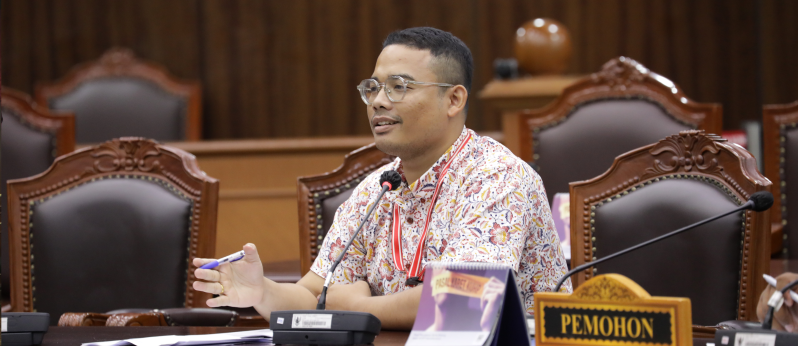
Petitioner Ericko Wiratama Sinuhaji during the preliminary hearing of Case No. 62/PUU-XXIII/2025 on Advocate Law at the Plenary Courtroom. Photo by MKRI/Fauzan.
Jakarta (MKRI)—Ericko Wiratama Sinuhaji, an Indonesian citizen who graduated from law school, filed a material judicial review petition of Law No. 18 of 2003 on Advocates (Advocates Law) to the Constitutional Court. The Petitioner of Case No. 62/PUU-XXIII/2025 questioned the provision that required law school graduates to intern in the “Advocate Office” as a prerequisite to becoming advocates.
During the panel hearing presided over by Chief Justice Suhartoyo, Ericko considered that the provision is no longer relevant and contrary to the real design of the Advocates Law. He stated that the requirement of an internship to be carried out only in an Advocate’s Office had harmed his constitutional right because it is discriminatory, does not provide equality, and restricts opportunities for self-development to contribute to society, the nation, and the state.
“Internships should aim to give practical experiences that support the capacity, skills, and ethics of advocate candidates. The experiences can be gained not only from the advocate’s office, but also from other relevant law institutions,” Ericko stated in the Courtroom.
Ericko also shared his experience in several law firms in Jakarta. Then, he became a legal professional in the corporate and banking sectors. He emphasized that he acquired in-depth experience and skills in these environments, especially in corporate, banking, insurance, and cross-national financial transactions law.
Ericko further stated that the Advocates Law provision, which limits the internship location only to the Advocate’s office, has become a restriction, treating its citizens unequally and discriminating against those who have experience outside of the Advocate’s office, such as legal, in-house counsel, or paralegal.
“If seen objectively on the intention of the internship requirement, then, supposedly, the internship requirement does not limit its scope, where all advocate candidates may hone their capacity, skills, and prove their ethics and integrity in applying their knowledge as advocate candidates. It may apply to civil servant lecturers having functional positions, paralegals in legal aid organizations, litigations, or in-house legal from a company such as the petitioner or having other internship experiences, as long as the advocate candidates can get working experience and practice to practice their knowledge and skills relevant to the function and nature of advocates according to the Advocates Law, then these experiences should be accepted and considered also to fulfill the internship requirement as advocate candidates,” Ericko stated.
He also highlighted that the focus on the formal internship requirement in the Advocate’s office is not balanced with a strict control system and ethical standards from professional organizations. This causes legal uncertainty and does not support the creation of advocates who are professional, have integrity, and are competent.
For these reasons, Ericko requested the Court review the phrase “advocate’s office” in the provision of internships for advocate candidates and reinterpret the norm to be more inclusive and align with the spirit of the Advocates Law.
Petition systematics
Responding to the petition, Justice Daniel Yusmic P. Foekh stated that the petitioner should take a closer look at the petition’s systematics because it is stipulated in Article 10 of Law No. 2 of 2023. “Later, no more introduction and closing. It is not necessary,” Justice Daniel said.
In addition, Justice Daniel added that the petition had been filed to the Court. So the petitioner must peruse the past decision on the same issue. “If this norm according to the Court is constitutional, surely Iko has your own perspective. How to build the argumentation in the posita, so that the Court can change the norm that it is unconstitutional. It can be strengthened by doctrine, theory, principle, or comparison,” Justice Daniel stated.
Before adjourning the session, the Panel of Justices gave the petitioner 14 days to revise the petition. The petition should be submitted to the Court no later than May 28, 2025.
Author: Utami Argawati.
Editor: Nur R.
PR: Fauzan F.
Translator: Rizky Kurnia Chaesario
Disclaimer: The original version of the news is in Indonesian. In case of any differences between the English and the Indonesian versions, the Indonesian version will prevail.
Thursday, May 15, 2025 | 18:37 WIB 300