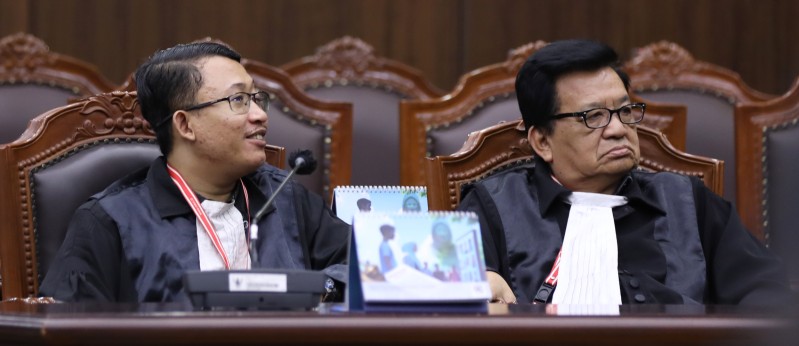
Petitioners’ legal counsel attending the pronouncement hearing of the material judicial review of Law No. 37 of 2004 on Bankruptcy and Debt Payment Postponement, Thursday (26/6). Photo by MKRI/Ifa.
Jakarta (MKRI) – The Constitutional Court rejected the entirety of the material judicial review petition of Law No. 37 of 2004 on Bankruptcy and Debt Payment Postponement (Bankruptcy Law). Aniek Trisolawati, Idha Achira Handajanti, Indri Marini Akbar, and Donny filed Case No. 112/PUU-XXII/2024, which decision was pronounced on Thursday, June 26, 2026.
The petitioners challenged several articles in Bankruptcy Law because they felt wronged by the bankruptcy process of PT Crown Porcelain and PT Cakrawala Bumi Sejahtera, developers of Apartment Point 8. They requested the implementation of a clear time limit for the settlement of bankruptcy assets to improve transparency and accountability of the curator and to avoid prolonged legal uncertainty.
In legal consideration delivered by Justice Ridwan Mansyur, the norm provision of Article 74 paragraph (3) of the Bankruptcy Law, which states that the extension made by the supervising judge for the curator to provide a report is not intended to be carried out within the period of the bankruptcy asset settlement. It only applies to extend the period for the curator to submit a report. In this context, the extension for the curator's quarterly report is not related directly to the delay in the curator’s duties in managing and settling the bankruptcy assets.
“Thus, the Petitioners misconstrued the reporting period as a part of managing and settling, which the curator carries out periodically, as the period of managing and settling as the final part of the curator's duties as a whole,” Justice Ridwan stated.
According to the Court, the absence of a statutory time limit for the completion of bankruptcy proceedings can be interpreted as the law providing room for debtors, creditors, curator, supervising judges, and other third parties acting in bad faith to exploit the situation by unnecessarily prolonging the process and using it as a means to secure personal gain. This is particularly concerning given the complexity of the issues involved and the significant value of the bankrupt debtor’s estate, although, in reality, some creditors’ claims have already been managed and are merely awaiting settlement. In practice, many bankruptcy cases remain unresolved for decades, demonstrating the persistent problem of stalled proceedings.
However, the Court also recognizes that imposing a strict time limit on the completion of bankruptcy proceedings could risk leaving unresolved legal issues related to the administration and settlement of the estate, particularly when interested parties are still pursuing legal remedies or other actions. This is especially relevant in cases involving numerous legal complexities and substantial assets under the curator’s management. Therefore, the legislature, in amending the Bankruptcy Law, must ensure balanced protection for all parties, which should be reflected in the formulation of any revised statutory norms.
Based on the legal considerations, the Petitioners’ arguments regarding the unconstitutionality of Article 74 paragraphs (1) and (3) of Law No. 37 of 2004 are legally unfounded.
Regarding the sale of assets that cannot be settled immediately or ever, the curator is not authorized to conduct such sales unilaterally; prior approval from the supervising judge is required. The sale is a measure taken by the curator to prevent the bankruptcy estate from being damaged, lost, or depreciated, which could harm creditors. In carrying out the sale, the receiver must first fulfill specific requirements and conditions, then submit a formal request accompanied by evidence and logical reasons. The supervising judge will consider the curator’s application, and if the reasons are deemed appropriate and in the interests of both creditors and the debtor, the judge will grant approval through a formal order. Only after such an order is issued may the curator proceed with the settlement process, thereby enabling creditors to promptly exercise their rights.
The supervising judge’s role is to oversee the administration and settlement of the bankruptcy estate as carried out by the receiver. The judge assesses the extent to which the receiver’s actions can be accounted for to both the debtor and the creditors. The supervising judge may also propose replacing the receiver, appoint a new receiver, and/or appoint an additional receiver if the current receiver is found to lack independence or has a conflict of interest. Furthermore, the Bankruptcy Law already provides clear regulations and sanctions in cases of violations by the receiver. Creditors are entitled to submit written objections to the supervising judge regarding the receiver’s conduct, or to request that the judge issue an order requiring or prohibiting specific actions by the curator. The supervising judge is obliged to issue a ruling on such objections.
If the delay in settling the bankruptcy estate is due to arbitrary or unprofessional conduct by the curator, legal remedies are available, including: (i) requesting the supervising judge to order the curator to act or refrain from acting, and (ii) holding the receiver civilly or criminally liable for such conduct. Complaints may also be lodged with the Ethics Council of the receiver’s professional organization.
Regarding the Petitioners’ request to impose a maximum two-year period for the curator to decide on actions concerning assets that cannot be immediately or ever settled, the Court finds that this request is not relevant to the constitutionality of the statutory norm, as it would only apply to the specific circumstances of the Petitioners as concurrent creditors. In other words, such a request cannot be generalized to all ongoing or future bankruptcy cases, which may present greater complexity and require longer resolution times, particularly concerning other creditors whose claims remain unsettled.
Moreover, the determination of time limits for the curator’s duties, as previously discussed, falls within the legislative domain and should be formulated to ensure fair legal protection for all parties, especially in the context of any planned amendments to the Bankruptcy Law
Also read:
Apartment Buyers Challenges Time Limit for Bankruptcy Assets Settlement
Apartment Buyers Revise Petition on Deadline for Bankruptcy Estate Liquidation
House and Govt Not Ready to Testify at Bankruptcy Law Judicial Review Hearing
House and Govt's Responses on the Review of Bankruptcy Estate Settlement Deadline
Curators Association denies violation of constitutional rights in bankruptcy law
Supreme Court and Expert Not Ready to Testify on Bankruptcy Law
Supreme Court: Time Limit on the Bankruptcy Assets Settlements Deemed Rational
Hadi Subhan: No Time Limit on Execution Settlement
Several apartment buyers challenged Article 74 paragraph (1) and (3) juncto Article 185 paragraph (3) of Law No. 37 of 2004 on Bankruptcy Debt Payment Postponement (Bankruptcy Law). Petitioners felt harmed due to the bankruptcy of PT Crown Porcelain and PT Cakrawala Bumi Sejahtera, as developers of Point 8 Apartment, located in Jalan Daan Mogot KM 14, Cengkareng, West Java. They asked that the bankruptcy process could be carried out faster and transparently.
At the preliminary hearing on Monday, September 2, legal counsel Heriyanto said the Petitioners hadn’t been made aware of the deadline set for the curator team of the bankrupt debtors of PT Crown Porcelain and PT Cakrawala Bumi Sejahtera to liquidate bankruptcy assets. They believe the certainty of the time frame in the liquidation of a bankrupt assets should start with a predetermined time limit for every stage of the bankruptcy process.
The strict deadline would prevent ambiguous interpretations and provide clear guidance for all parties involved. The lack of such a time frame could lead to confusion, anxiety, and even prolong the financial stress that the debtor may face, especially if there is a delay in the selling or division of assets.
In the revised petitums, the Petitioners request that the Court declare Article 74 paragraph (1) of the Bankruptcy and PKPU Law (“The Curator shall submit to the Supervisory Judge its report concerning the condition of bankruptcy estate and the performance of its duties once every 3 (three) months”) unconstitutional and not legally binding if not interpreted as “The Curator shall submit to the Supervisory Judge its report concerning the condition of bankruptcy estate and the performance of its duties once every 3 (three) months and shall complete the liquidation of bankruptcy estate and the performance of all of its duties at the latest within 3 (three) years since the bankruptcy decision is pronounced.”
They also ask the Court to declare Article 74 paragraph (3) of the Bankruptcy and PKPU Law (“The Supervisory Judge may extend the report period as referred to in paragraph (1)”) unconstitutional and not legally binding if not interpreted as “The Supervisory Judge may only extend the reporting period as referred to in paragraph (1) for a maximum of 1 (one) month.”
They also request that Article 185 paragraph (3) of the Bankruptcy and PKPU Law (“Concerning all goods that are not immediately or cannot be completely liquidated, the Curator shall take a decision in the manner which is approved by the Supervisory Judge”) be declared unconstitutional and not legally binding if not interpreted as “Concerning all goods that are not immediately or cannot be completely liquidated within a maximum of 2 (two) years, the Curator shall take a decision in the manner which is approved by the Supervisory Judge.”
Author: Utami Argawati
Editor: N. Rosi.
PR: Fauzan F.
Translators: Rizky Kurnia Chaesario/Yuniar Widiastuti
Disclaimer: The original version of the news is in Indonesian. In case of any differences between the English and the Indonesian versions, the Indonesian version will prevail.
Thursday, June 26, 2025 | 16:39 WIB 353