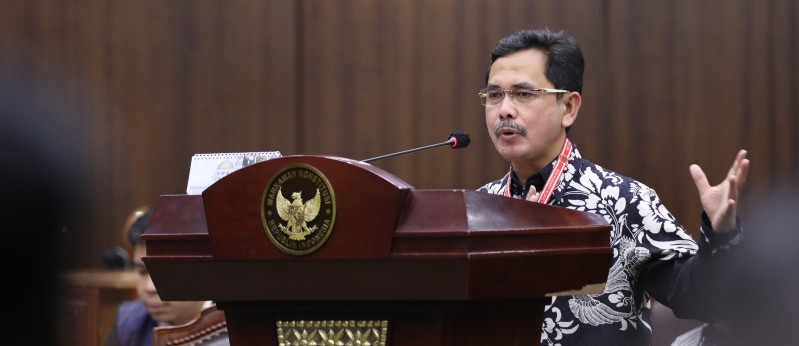
Hadi Subhan, an expert presented by the Government, giving his testimony during the continued material judicial review hearing of Law No. 37 of 2004 on Bankruptcy and Debt Payment Postponement (Bankruptcy Law), Wednesday (23/04), at the Courtroom. Photo by MKRI/Ifa.
Jakarta (MKRI) – The Constitutional Court held another material judicial review hearing on Law No. 37 of 2004 on Bankruptcy and Debt Payment Postponement (Bankruptcy Law), Wednesday, April 23, 2025, at the Plenary Courtroom. Case No. 112/PUU-XXII/2024 was filed by Aniek Trisolawati, Idha Achira Handajanti, Indri Marini Akbar, and Donny.
The Petitioners questioned several articles in Bankruptcy Law that felt harmed in the bankruptcy process of PT. Crown Porcelain and PT. Cakrawala Bumi Sejahtera, developer of Apartement Point 8. They requested a clear time limit on the settlement of the bankruptcy process to improve the curator’s transparency and accountability, and to avoid prolonged legal uncertainty.
Also read:
Apartment Buyers Challenges Time Limit for Bankruptcy Assets Settlement
Apartment Buyers Revise Petition on Deadline for Bankruptcy Estate Liquidation
House and Govt Not Ready to Testify at Bankruptcy Law Judicial Review Hearing
This time, the hearing was to hear the president/government’s expert testimony. During the hearing led by Deputy Chief Justice Saldi Isra, the government presented a legal expert, Hadi Subhan, who explained that curators served as executors of court decisions regarding bankruptcy.
“Bankruptcy is a court decision. Because of that, it needs an executing agency that will execute [the decision] called bankruptcy curators. Hence, essentially, the curator’s duty is to execute the court decision as well as executing prosecutor that will execute criminal case decision,” he explained.
Hadi explained that, as an executor in the criminal case system, common civil cases, and others, there is no time limit on the settlement of the execution. The time limit on the bankruptcy process is only possible in the early stages, such as making the bankruptcy assets list, media announcements, and periodic reports to the supervising judge. According to him, this is because all the stages are under the curator's control. In several countries, the time limit for settling bankruptcy is not determined.
Subsequently, Hadi stated that the petition of the Petitioners was an error in object or misdirected. The Petitioner tested Article 74 paragraphs (1) and (3) and Paragraph 185 paragraph (3), despite the articles not regulating the time limit for settlement. Instead, the articles mention periodic reports and the method of selling bankruptcy assets.
Regarding Article 185, Hadi added, the law has regulated three stages of the sale of bankruptcy assets in sequence: public auction, sale under hand, and sale based on discretion in special situations. According to him, this provision aims to speed up the process, not slow it down. In addition, he also emphasized that a supervisory system for curators is already in place, both preventively through the supervision of supervisory judges and repressively through sanctions if violations are found.
Also read:
House and Govt's Responses on the Review of Bankruptcy Estate Settlement Deadline
Curators Association denies violation of constitutional rights in bankruptcy law
Supreme Court and Expert Not Ready to Testify on Bankruptcy Law
Supreme Court: Time Limit on the Bankruptcy Assets Settlements Deemed Rational
Several apartment buyers challenged Article 74 paragraph (1) and (3) juncto Article 185 paragraph (3) of Law No. 37 of 2004 on Bankruptcy and Suspension of Debt Payment Obligations (Bankruptcy and PKPU Law). Petitioners felt harmed due to the bankruptcy of PT Crown Porcelain and PT Cakrawala Bumi Sejahtera, as developers of Point 8 Apartment, located in Jalan Daan Mogot KM 14, Cengkareng, West Java. They asked that the bankruptcy process could be carried out faster and transparently.
At the preliminary hearing on Monday, September 2, legal counsel Heriyanto said the Petitioners hadn’t been made aware of the deadline set for the curator team of the bankrupt debtors of PT Crown Porcelain and PT Cakrawala Bumi Sejahtera to liquidate bankruptcy estate. They believe the certainty of the time frame in the liquidation of a bankrupt estate should start with a predetermined time limit for every stage of the bankruptcy process.
The firm deadline would prevent ambiguous interpretations and provide clear guidance for all parties involved. The lack of such a time frame could lead to confusion, anxiety, and even prolong the financial stress that the debtor may face, especially if there is a delay in the selling or division of assets.
In the revised petitums, the Petitioners request that the Court declare Article 74 paragraph (1) of the Bankruptcy and PKPU Law (“The Curator shall submit to the Supervisory Judge its report concerning the condition of bankruptcy estate and the performance of its duties once every 3 (three) months”) unconstitutional and not legally binding if not interpreted as “The Curator shall submit to the Supervisory Judge its report concerning the condition of bankruptcy estate and the performance of its duties once every 3 (three) months and shall complete the liquidation of bankruptcy estate and the performance of all of its duties at the latest within 3 (three) years since the bankruptcy decision is pronounced.”
They also ask the Court to declare Article 74 paragraph (3) of the Bankruptcy and PKPU Law (“The Supervisory Judge may extend the report period as referred to in paragraph (1)”) unconstitutional and not legally binding if not interpreted as “The Supervisory Judge may only extend the reporting period as referred to in paragraph (1) for a maximum of 1 (one) month.”
They also request that Article 185 paragraph (3) of the Bankruptcy and PKPU Law (“Concerning all goods that are not immediately or cannot be completely liquidated, the Curator shall take a decision in the manner which is approved by the Supervisory Judge”) be declared unconstitutional and not legally binding if not interpreted as “Concerning all goods that are not immediately or cannot be completely liquidated within a maximum of 2 (two) years, the Curator shall take a decision in the manner which is approved by the Supervisory Judge.”
Author: Utami Argawati
Editor: N. Rosi.
PR: Fauzan F.
Translators: Rizky Kurnia Chaesario/Yuniar Widiastuti
Disclaimer: The original version of the news is in Indonesian. In case of any differences between the English and the Indonesian versions, the Indonesian version will prevail.
Wednesday, April 23, 2025 | 14:45 WIB 179