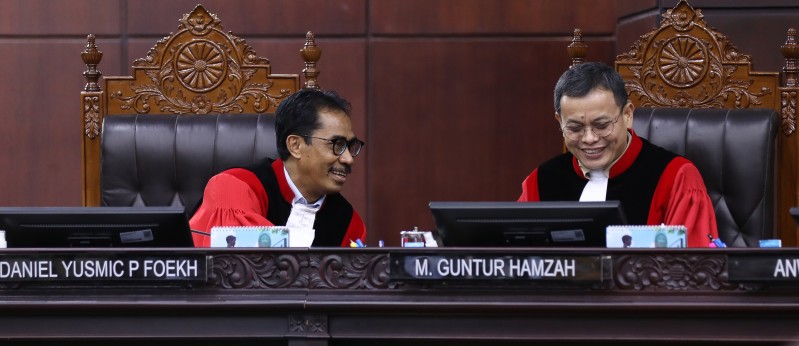
Constitutional Justice M. Guntur Hamzah at the ruling hearing for the judicial review of the Law on the Legislative Branch for case No. 42/PUU-XXIII/2025, Thursday (6/26/2025). Photo by MKRI/Ifa.
JAKARTA (MKRI) — The Constitutional Court (MK) has rendered a decision in Case No. 42/PUU-XXIII/2025, declaring the judicial review petition of Article 347 paragraph (1) of Law No. 7 of 2017 on General Elections inadmissible. The Court rejected the remainder of the Petitioner’s claims concerning the judicial review of Article 171 paragraph (1) letter b and Article 229 of Law No. 17 of 2014 on the People’s Consultative Assembly (MPR), House of Representatives (DPR), Regional Representatives Council (DPD), and Regional Legislative Council (DPRD), also known as the MD3 Law, as well as Article 347 paragraph (1) and Article 426 paragraph (1) letter c of the Election Law.
Constitutional Justice M. Guntur Hamzah explained that the Court found Article 229 of the MD3 Law to regulate the nature of House meetings, not their location. Therefore, the Petitioner’s request to reinterpret the phrase “all meetings in the DPR” in Article 229 to include a specific requirement regarding location was deemed inappropriate. The provision clearly outlines the nature of House meetings—fundamentally open to the public except for those explicitly declared closed—not where such meetings must be held.
The Court reiterated that Article 229 of the MD3 Law expressly states that “All meetings in the DPR shall essentially be open, except for certain meetings that are declared closed.” This implies that wherever the House meeting is held, the principle of openness must remain the fundamental guideline. The closed nature of a meeting is the exception and must be based on specific reasons disclosed publicly prior to the meeting.
“With regard to the venue of House meetings, the Court held that such matters do not constitute an issue of the constitutional validity of a legal norm. Accordingly, the Court found the Petitioner’s argument in the a quo case legally unfounded,” stated Justice Guntur at the ruling hearing on Thursday, 26 June 2026 in the plenary courtroom.
The Petitioners also challenged Article 171 paragraph (1) of the MD3 Law. The Court clarified that the provision does not prohibit or eliminate the possibility for House members to express views either in alignment with or contrary to their respective party factions. Thus, the article allows both factions and individual members of the House to approve or reject a draft bill during the second-level deliberations in a plenary session.
With regard to Article 347 paragraph (1) of the Election Law, the Court emphasized that the provision no longer appears in the form challenged by the Petitioner. Therefore, the petition must be deemed moot. The Court had already partially granted a similar petition in Decision No. 135/PUU-XXII/2024, delivered earlier today, wherein it ruled the provision conditionally unconstitutional and assigned it a revised interpretation.
The Court ruled that Article 347 paragraph (1) of the Election Law is unconstitutional and not legally binding unless interpreted to mean: “Voting shall be conducted simultaneously to elect members of the House of Representatives (DPR), members of the Regional Representatives Council (DPD), and the President/Vice President, and subsequently, within a minimum of two (2) years and a maximum of two years and six (6) months following the inauguration of the DPR and DPD members or the President/Vice President, voting shall be conducted simultaneously to elect members of the Provincial and Regency/City Regional Legislative Council (DPRD), and Governors/Vice Governors, Regents/Vice Regents, and Mayors/Vice Mayors.”
The Petitioners further questioned the lack of specific provisions regarding legal remedies for elected DPR or DPRD candidates who are replaced before inauguration, particularly in relation to whether such remedies can suspend the replacement process under Article 426 paragraph (1) letter c of the Election Law. The Court, however, held that the absence of such regulation does not automatically render the provision unconstitutional.
The Court observed that elected candidates may still seek legal remedies by filing lawsuits in competent courts. In several cases, candidates have utilized civil and/or administrative court proceedings to contest such issues. This indicates that legal mechanisms are available to protect the rights of elected candidates who have not yet been sworn in.
The Court acknowledged that the inclusion of specific legal provisions as sought by the Petitioner is within the authority of the legislature. It is for lawmakers to determine the detailed legal framework governing whether an appeal can suspend the replacement of elected DPR or DPRD candidates. The crucial point, according to the Court, is whether the current absence of such specific regulation completely bars access to judicial remedies.
“Even if such a legal remedy is pursued, the affected candidate may request a provisional ruling or interim injunction to suspend their replacement pending final adjudication,” Justice Guntur concluded.
Also read:
House Convenes at Hotel, Advocate Challenges Law on Legislative Branch
Petitioner Insists One-Man-One-Vote Applies in House’s Ratification of Bills of Law
Advocate Zico Leonard Djagardo Simanjuntak questioned the controversial discussions of the TNI Law, which the House had discussed at a five-star hotel, instead of the parliament complex that is full of facilities.
He saw this as a waste of budget amid budget slashes for the government and state institutions for the sake of a more optimal use of the state budget. The state budget must be prioritized for interests of utmost urgency and benefit for the people, he asserted.
Therefore, the Petitioner challenged Article 229 of the MD3 Law, which reads, “All meetings in the DPR shall essentially be open, except for certain meetings that are declared closed.” He would like the Constitutional Court to reinterpret the norm by requiring that meetings be hold in the parliament complex. Therefore, in his petitums, he requested that the Court interpret Article 229 as, “All meetings in the DPR shall be hold in the DPR buildings, unless there are certain circumstances preventing the facilities in all meeting rooms in the DPR building from being used or functioning properly.”
Author : Mimi Kartika
Editor : Lulu Anjarsari P.
PR : Andhini Sayu Fauzia
Translator : Yuniar Widiastuti (NL)
Disclaimer: The original version of the news is in Indonesian. In case of any differences between the English and the Indonesian versions, the Indonesian version will prevail.
Thursday, June 26, 2025 | 16:25 WIB 243