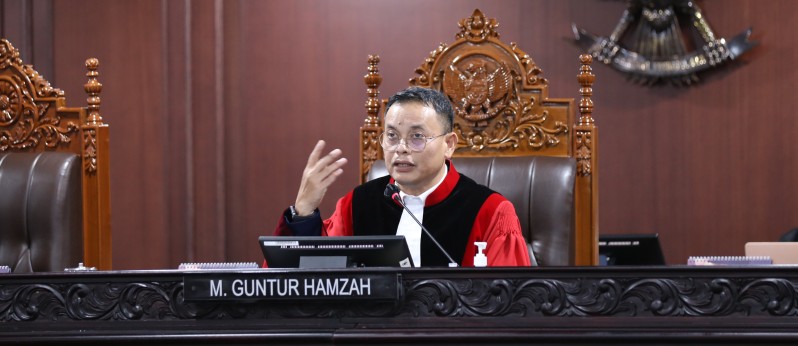
Constitutional Justice M. Guntur Hamzah chairing the panel preliminary hearing for the material judicial review of the Law on the Legislative Branch, Monday (5/5/2025). Photo by MKRI/Ifa.
JAKARTA (MKRI) — Zico Leonard Djagardo Simanjuntak, an advocate, has filed a material judicial review petition of Law No. 17 of 2014 on the People’s Consultative Assembly (MPR), House of Representatives (DPR), Regional Representatives Council (DPD), and Regional Legislative Council (DPRD), also known as the MD3 Law, as well as Law No. 7 of 2017 on General Elections. He questions the controversial discussions of the TNI Law (Law of the Indonesian National Armed Forces), which the House had discussed at a five-star hotel, instead of the parliament complex that is full of facilities.
“As a citizen, [I] feel that there is injustice, given that the parliament complex has conference rooms build from state coffers. It is an injustice to not use the available buildings as intended only because the DPR preferred meeting at a hotel, especially amid budget slashes for other institutions,” said the Petitioner’s legal counsel Putu Surya Permana Putra at the preliminary hearing for case No. 42/PUU-XXIII/2025 on Monday.
The Petitioner saw this as a waste of budget amid budget slashes for the government and state institutions for the sake of a more optimal use of the state budget. The state budget must be prioritized for interests of utmost urgency and benefit for the people.
Therefore, the Petitioner challenges Article 229 of the MD3 Law, which reads, “All meetings in the DPR shall essentially be open, except for certain meetings that are declared closed.” He would like the Constitutional Court to reinterpret the norm by requiring that meetings be hold in the parliament complex. Therefore, in his petitums, he requests that the Court interpret Article 229 as, “All meetings in the DPR shall be hold in the DPR buildings, unless there are certain circumstances preventing the facilities in all meeting rooms in the DPR building from being used or functioning properly.”
The Petitioner also challenges the word “faction” in Articles 12 and 82 of the MD3 Law as well as the phrase “their duties as representatives of the people” in Articles 12 paragraph (4) of the MD3 Law. Article 12 reads in full: “(1) Faction is a grouping of members of the MPR that reflects the configuration of political parties. (2) Faction can be formed by the political parties that meet the threshold of votes in the determination of the DPR seats. (3) Each member of the MPR from members of DPR must be a member of one of the factions. (4) Faction shall be formed to optimize the performance of the MPR and its members in carrying out their duties as representatives of the people. (5) Internal settings of the factions shall entirely be a matter for each faction. (6) The MPR provides a means to smooth the implementation of the factions’ duties.”
In his other petitums, the Petitioner asks the Court to declare the word “faction” and the phrase “their duties as representatives of the people” in Article 12 unconstitutional if not interpreted as “their duties as representatives of the people to express opinions as individual representatives of the people, not on behalf of the factions.” He also asks the Court to declare the phrase “the rights and obligations of DPR members” in Article 82 unconstitutional and not legally binding if not interpreted as “the rights and obligations of DPR members to express their personal opinions without influence from and on behalf of their faction.” He also asks that the Court declare the phrase “proposed by political parties” in Article 239, Article 239 paragraph (2), Article 239 paragraph (2) letters d and g, and Article 167 paragraph (3) conditionally unconstitutional and not legally binding.
The hearing was presided over by Constitutional Justices M. Guntur Hamzah (panel chair), Daniel Yusmic P. Foekh, and Asrul Sani. Justice Guntur commented that the Petitioner’s petitums were unclear and could lead to legal uncertainty, since if it was granted it would lead to legal vacuum. “[You request] interpretation that [the norms] are unconstitutional if not interpreted the way you wish,” he said.
Before adjourning the session, Justice Guntur announced that the Petitioner would have 14 days to revise the petition. The revised petition must be received by the Court by Monday, May 19, 2025.
Author : Mimi Kartika
Editor : Lulu Anjarsari P.
PR : Andhini Sayu Fauzia
Translator : Yuniar Widiastuti (NL)
Disclaimer: The original version of the news is in Indonesian. In case of any differences between the English and the Indonesian versions, the Indonesian version will prevail.
Monday, May 05, 2025 | 16:22 WIB 195