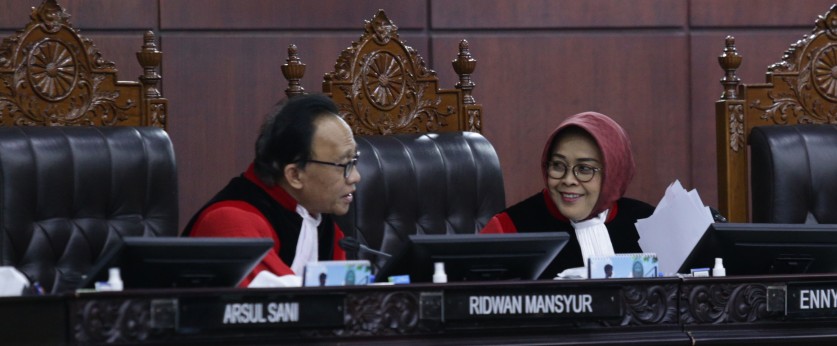
Constitutional Justice Enny Nurbaningsih during the Ruling Hearing for Case Number 51/PUU-XXIII/2025 material judicial review of Law Number 19 of 2016 Amendments to Law Number 11 of 2008 concerning Electronic Information and Transactions, Thursday (26/6/2025). Photo by Public Relations/Bay
JAKARTA (MKRI) - The Constitutional Court (MK) decided to reject all petition filed by Zidane Azharian Kemalpasha, Kaila Juliana Rifalda, and Ilhan Julian Rifaldo. The Petitioners questioned the absence of specific provisions in Article 5 paragraph (3) and Article 7 of Law Number 11 of 2008 concerning Electronic Information and Transactions (UU ITE) as last amended by Law 1/2024, which regulates digital heritage. According to the Petitioners, the absence of this regulation creates legal uncertainty in terms of the management and distribution of assets.
“[The Court] adjudicated, to reject the petition in its entirety,” said Chief Justice Suhartoyo at the ruling hearing on Thursday, June 26, 2025 in the plenary courtroom.
In the legal considerations, Constitutional Justice Enny Nurbaningsih said that the norm of Article 5 paragraph (3) of the ITE Law is part of the general provisions in regulating information, documents, and electronic signatures. This article is intended as a limitation on the validity of electronic information and/or electronic documents, namely that it is declared valid if it uses an electronic system in accordance with the previous ITE Law.
"According to the Court, when an article in a law is formulated in general, it is intended that its substance covers broader aspects so that it does not mean that the article is unconstitutional. Meanwhile, the Petitioners argue that Article 5 paragraph (3) of Law 1/2024 is not adaptive to technological developments and has limited legal recognition of the existence of digital assets," explained Enny.
However, the Petitioners' petition that Article 5 paragraph (3) of Law 1/2024 be interpreted as electronic information and/or electronic documents also includes proof of ownership, existence, and transactions of digital assets, such as cryptocurrencies, digital tokens, social media accounts, and other forms of digital assets will actually narrow and limit the scope of the article. According to the Court, such a petition also results in the unclear norm of Article 5 paragraph (3) of Law 1/2024 because the boundaries of electronic information and/or electronic documents are unclear due to the mixing of regulations regarding the validity of electronic information and/or electronic documents with provisions regarding digital financial assets.
Furthermore, in relation to the Petitioners' argument questioning the norm of Article 7 of Law 11/2008, the Court observed that the formulation of the norm was intended to regulate electronic information and/or electronic documents so that they can be used as a reason for the emergence of a right. That information and/or documents can be categorized as electronic information and/or electronic documents shall be proven that the electronic information and/or electronic documents in question originate from an electronic system that meets the requirements based on statutory regulations so that it can then be used as a reason for the emergence of a right.
This means that with the formulation of Article 7, if the digital assets referred to by the Petitioners are electronic information and/or electronic documents originating from an electronic system that meets the requirements based on statutory regulations, then this basically fulfills the reasons for the emergence of a right. The petitum of the Petitioners who want Article 7 of Law 11/2008 to be interpreted as "rights stated, strengthened, or rejected based on electronic information and/or electronic documents also include ownership rights to digital assets, such as social media accounts, cryptocurrencies, digital tokens, and other forms of digital assets", in addition to being inappropriate, this interpretation also creates unclear formulations of norms and even narrows the application of the norms of Article 7 of Law 11/2008 itself. Next, regarding the arguments of the Applicants who question the unclear regulation of inheritance rights to digital assets, the Court first considers it doctrinally.
Inheritance is the transfer of wealth from a deceased person to one or more other people. This means that the elements of inheritance are the presence of a deceased person, the assets left behind, and heirs. If an asset in the form of a digital representation is considered as an asset, then basically the asset can be inherited. However, there are things that make assets in the form of digital representation different from non-digital assets in general. The diversity of forms of digital representation makes inheritance provisions not easy to apply to them.
For example, inheritance of social media accounts becomes difficult because there are different settings for each account in each provider/social media platform as the have the freedom to determine their own settings for their users, including the status of an account whose user has died. In general, the provision of digital representation services is cross-country so that it also includes different regulations in each country, including applicable laws when disputes occur such as inheritance. It could be that one country and another have different policies and legal regulations in assessing an asset in the form of digital representation, where this is also related to the sovereignty of each country.
In relation to the Petitioners’ argument that they want there to be provisions for inheritance of digital assets by testing the norms of Article 5 paragraph (3) of Law 1/2024 and Article 7 of Law 11/2008, the Court is of the opinion that the provisions for inheritance are basically contained in the applicable laws and regulations, including the Civil Code and the Compilation of Islamic Law.
This means that when Law 11/2008 in conjunction with Law 1/2024 as the legal basis for the validity of electronic information and transactions does not regulate the inheritance of digital assets, this does not mean that the articles in Law 11/2008 in conjunction with Law 1/2024 are contrary to the constitution as argued by the Petitioners. Moreover, after the Court read and carefully examined the petition, it turned out that the relationship between the inheritance rights of digital assets and the validity of the norms of Article 5 paragraph (3) of Law 1/2024 and Article 7 of Law 11/2008 was not clearly constructed, so the Court did not find any constitutional problems in these norms as argued by the Petitioners.
Read the full verdict:
Decision No. 51/PUU-XXIII/2025.
Also read:
Petitioners Request EIT Law to Regulate Digital Assets Inheritance
Petitioners Urge to Update Regulations on Digital Assets
For information, the Petitioners in this case were three students of Universitas Jenderal Achmad Yani Yogyakarta, Zidane Azharian Kemalpasha, Kaila Juliana Rifalda, and Ilhan Julian Rifaldo. According to the Petitioners, the absence of specific provisions on digital inheritance in EIT Law created legal uncertainty in the management and division of assets. It made it difficult for inheritors and legal practitioners to decide on a proper method of managing and dividing the assets. The Petitioners argue that a regulation update is needed to accommodate the complexity of inheritance in this digital era.
In the current digital transformation era, digital assets have become inseparable from the life of society, such as the use of digital wallets, crypto assets, and Non-Fungible Tokens (NFTs). Such assets represent legal economic values and wealth in the socio-economic practice, which includes professional and digital industry practitioners and the wider society, such as street vendors, online ride-sharing drivers, and small and medium businesses. They are familiar and use digital assets as transaction tools and investments.
In the petitums, the Petitioners requested the Court to declare Article 5 paragraph (3) of the EIT Law contrary to the 1945 Constitution of the Republic of Indonesia as long as it is not interpreted as “Electronic information and/or electronic documents also include the ownership proof, existence, and transaction of digital assets such as cryptocurrencies, digital tokens, social media accounts, and other forms of digital assets.” They also requested to declare Article 7 of the EIT Law contrary to the 1945 Constitution of the Republic of Indonesia as long as it is not interpreted as “the rights which are declared, strenghten, or rejected based on Electronic Information and/or Electronic Document also include the ownership of digital assets, such as social media accounts, cryptocurrencies, digital tokens, and other forms of digital assets.”
Author: Mimi Kartika.
Editor: Nur R.
PR: Andhini SF.
Translator: SO
Disclaimer: The original version of the news is in Indonesian. In case of any differences between the English and the Indonesian versions, the Indonesian version will prevail.
Also read: Decision No. 51/PUU-XXIII/2025 in original language.
Thursday, June 26, 2025 | 19:00 WIB 355