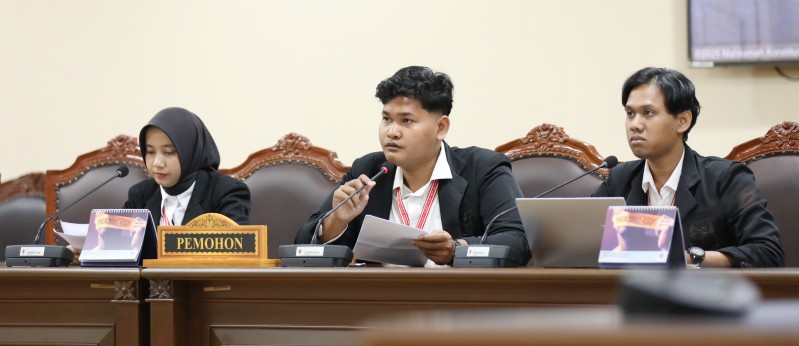
Petitioners Zidane Azharian Kemalpasha, Kaila Juliana Rifalda, and Ilhan Julian Rifaldo, attending the preliminary panel hearing of judicial review petition on Law No. 19 of 2016 on Electronic Information and Transaction, Wednesday (07/05) at the Courtroom. Photo by MKRI/Ifa.
Jakarta (MKRI) – Three university students of Universitas Jenderal Achmad Yani Yogyakarta filed a material judicial review petition of Article 1 letter 4 of Law No. 19 of 2016 on the Amendment to Law No. 11 of 2008 on Electronic Information and Transaction (EIT Law) against the 1945 Constitution of the Republic of Indonesia to the Constitutional Court. According to the Petitioners, the absence of specific provisions on digital inheritance in EIT Law created legal uncertainty in the management and division of assets.
“Digital assets are also an inheritance object, and the regulation accommodating digital assets is not yet available, Your Honor. A specific legal framework is needed to regulate and protect digital assets, including their inheritance mechanisms, Your Honor.” Petitioner Zidane Azharian Kemalpasha stated, alongside other petitioners, Kaila Juliana Rifalda and Ilhan Julian Rifaldo, during the preliminary hearing of Case No. 51/PUU-XXIII/2025, on Wednesday, May 7, 2025, at the Courtroom.
The Petitioner explained that digital assets, such as cryptocurrency, social media accounts, digital files, and virtual property in a virtual world, are often not legally acknowledged in the legal inheritance process. It creates a difficult challenge for the inheritors and legal practitioners to decide a proper method to manage and divide the assets.
The Petitioners argue that a regulation update is needed to accommodate the complexity of inheritance in this digital era. Without proper and comprehensive guidance on the acknowledgement and acquisition of digital and virtual assets, the inheritance process may become complicated and create confusion.
According to the Petitioners, it is essential to review and update the regulations so that they can accommodate technological development and resolve issues related to non-terrestrial inheritance. This step is needed to ensure legal certainty and justice for all parties involved in the process of inheritance in the digital era.
The need for laws and regulations on access to digital assets after death is due to the refusal of service providers to give access to inheritors. The current legal process is not designed to resolve such issues effectively, so there is no clear mechanism to transfer digital assets after the owner's passing.
Article 1 point 4 of the EIT Law reads, “In this Law, what is meant by: 4. Electronic Document is any Electronic Information that is created, forwarded, sent, received, or stored in analog, digital, electromagnetic, optical form, or the like, visible, displayable and/or audible via Computers or Electronic Systems, including but not limited to writings, sounds, images, maps, drafts, photographs or the like, letters, signs, figures, Access Codes, symbols or perforations having certain meaning or definition or understandable to persons qualified to understand them.” The Petitioners hoped that the regulations on digital assets could be accommodated in the norm through the judicial review in the Court.
In their petitum, the Petitioners requested the Court to declare Article 1 point 4 of the EIT Law contrary to the 1945 Constitution of the Republic of Indonesia and has no legally binding force as long as it is not interpreted as, “In this Law, what is meant by: 4a. Digital Assets are all Electronic Information that has economical values and kept in electronic system, including but not limited to balance in digital wallets, crypto assets, digital investment accounts, and other types of asset which are transferable through interitance mechanisms based on existing laws and regulations.” The Petitioners also requested the Court to order lawmakers to create a separate law regulating digital assets within a maximum of three years.
Justices’ Advice
The case was heard by the Panel of Justices presided over by Deputy Chief Justice Saldi Isra, accompanied by Justice Ridwan Mansyur and Justice Arsul Sani. Justice Arsul Sani stated that the Petitioners needed to learn further on whether digital assets such as cryptocurrencies and digital content are currently unregulated at all. According to Justice Arsul, there could be a law on that matter already, for example, related to digital content, which is accommodated under Copyright Law.
“So, don’t you ever think, as a student, that if there is no law, there is no legal framework, it may not be the case, it could be one already, there is no specific law, I mean, so there is no legal certainty, you must look again whether the issue has been covered in other laws or not,” Justice Arsul stated.
Before adjourning the session, Deputy Chief Justice Saldi Isra stated that the Petitioners were given 14 days to revise the petition. The revised petition shall be submitted on Tuesday, May 20, 2025, at the latest.
Read more: Petition No. 51/PUU-XXIII/2025 in Indonesian Language
Author: Mimi Kartika.
Editor: Nur R.
PR: Andhini SF.
Translator: Rizky Kurnia Chaesario
Disclaimer: The original version of the news is in Indonesian. In case of any differences between the English and the Indonesian versions, the Indonesian version will prevail.
Wednesday, May 07, 2025 | 16:18 WIB 227