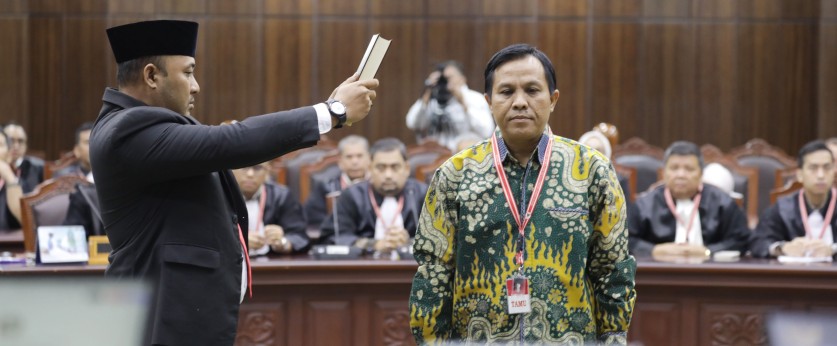
Professor of Constitutional Law from the Universitas Sebelas Maret, Agus Riwanto, attending the judicial review hearing of the Advocate Law to testify representing the president/government, Friday (20/6), at the Plenary Courtroom. Photo by MKRI/Panji.
Jakarta (MKRI) – The Constitutional Court resumed the judicial review hearing of Case No. 183/PUU-XXII/2024 on Article 28 paragraph (3) of Law No. 18 of 2003 on Advocate to hear testimony from related parties, the president, and petitioners’ experts on Friday, June 20, 2025. The Indonesian Advocates Alliance (Ikatan Advokat Indonesia, Ikadin) attended the hearing as a related party.
Professor of Constitutional Law from the Law Faculty of the Universitas Sebelas Maret, Agus Riwanto, as an expert presented by the President, stated that Article 28 paragraph (3) of Law No. 18 of 2003 on Advocate does not prohibit leaders of advocate organizations to hold a position as state officials but they are prohibited from holding a position as the leader of a political party. He argued that conflicts of interest involving state officials originating from leadership positions in advocate organizations are of a lesser degree than those arising from leadership positions in political parties.
“There are not many conflicts of interest involving state officials that are coming from advocates to influence advocate organizations. It differs from an apparent conflict of interest when an advocate organization’s leader is from a political party,” Agus said.
Agus added that the prohibition stipulated in Article 28 paragraph (3) of the Advocate law is based on constitutional law logic that the title of professional organization management is strategic and has the potential to create a conflict of interest if it is held by those who are active in the political parties’ structure. The potential for a conflict of interest is higher when advocate organization leaders have an affiliation with political parties, compared to when they hold concurrent positions as state officials. This is because political parties may inherently carry ideological missions and particular political interests, which can contradict the independence of advocates as a profession.
Leaders of advocate organization who hold positions as state officials, in this case, a minister or at a similar level, including the Chairman of the National Leadership of the Indonesian Advocates Association (Dewan Pimpinan Nasional Perhimpunan Advokat Indonesia, DPN Peradi). According to Agus, the person in question did not act as the sole authority of the DPN Peradi. It is because Article 28 paragraph (3) of the Advocate Law states that leadership of advocate organizations is collegial; hence, all management of DPN Peradi carries out all decisions and activities of the organization.
In addition, Law No. 39 of 2008, as amended by Law No. 61 of 2024 on State Ministries, does not prohibit state officials from holding positions as board members of professional organizations. Advocate organizations are not established or funded from the state or regional budget, but are instead independently financed by their members.
Meanwhile, Ikadin was represented by their legal counsel, I Made Agus Rediyudana. He said that the advocate organization's leadership positions are not subject to any conflict of interest with the position of state officials, in this case, the Deputy Coordinating Minister of Law, Human Rights, Immigration, and Correction, Otto Hasibuan, because the duties and authorities of advocate organizations are different from those of state officials. Advocates serving as leaders of advocate organization who are appointed by the President as state officials do not carry out their duties as advocates during their tenure.
Despite that, advocates who are appointed state officials do not strip their status as advocates. They are required to submit a leave of absence as advocates during their tenure.
Chief Justice Suhartoyo stated that the Petitioners called off presenting an expert. The hearing was the last one before the Court decides on the case.
Also read:
Advocate Law Review: Conflict of Interest Potential of Otto Hasibuan’s Position
Constitutional Harm Due to the Absence of a Prohibition on Dual Positions for Leaders of Advocate Organizations
House’s Response on Advocate Organization Leader Doubling as Deputy Minister
Peradi Does Not Forbid Their Leaders to Become State Officials
An Advocate, Andri Darmawan, filed a material judicial review of Article 28 paragraph (3) of Law No. 18 of 2003 on Adcovates against Article 27 paragraph (1), 28D paragraph (1), 28E paragraph (3), and 28J paragraph (2) of the 1945 Constitution of the Republic of Indonesia. The Petitioner questioned the absence of a prohibition for the leaders of the organization from having dual positions with state officials in the article tested.
Article 28 paragraph (3) of the Advocates law, as interpreted by the Court through Decision No. 91/PUU-XXII/2022, pronounced on October 31, 2022, reads “The leadership of an advocate organization holds a term of office for 5 (five) years and can only be re-elected 1 (one) time in the same position, either consecutively or non-consecutively, and cannot be concurrent with the leadership of a political party, both at the central and regional levels.”
According to Andri, leaders of a advocate organization who hold another position as state officials render the advocate organization non-free and non-independent due to the government's intervention in the organization. Additionally, there is a tendency for individual or group domination in some advocate organizations, which may lead to the abuse of power. He mentioned that Prof. Otto Hasibuan, chairman of Peradi (the Association of Indonesian Advocates), was appointed Deputy Coordinating Minister of Law, Human Rights, Immigration, and Corrections on October 21, 2024.
Moreover, as chairman, he delivered his recommendation at Peradi’s National Working Meeting of 2024 in Bali on December 5-6, 2024, in which, among other things, he urged the Supreme Court to revoke its Circular Letter No. 73 of 2015 on the Swearing-In of Advocates. Hasibuan suggested that all advocates who have taken their oaths join Peradi and requested the Supreme Court to swear in all advocate candidates proposed by Peradi.
The Petitioner, who is affiliated with the Congress of Indonesian Advocates (KAI), has made it clear that Hasibuan’s recommendation as Peradi chairman cannot be separated from his position as Deputy Coordinating Minister. He stated that the recommendation could be interpreted as a recommendation from the Coordinating Ministry of Law, Human Rights, Immigration, and Correction.
He added that the action did not comply with Constitutional Court Decision No. 112/PUU-VII/2014, which declared Article 4 paragraph (1) of the Advocate Law unconstitutional as long as it is not interpreted as “The Court of Appeal is obliged by law to take oaths for advocates before exercising their profession without associating them with membership of existing organizations, namely PERADI and KAI.”
The Petitioner also questioned Hasibuan’s action, which did not comply with Constitutional Court Decision No. 91/PUU-XX/2022 because he led Peradi for three periods even though the Court had set the limit for the advocate organization leadership for two periods. He believes for leaders of advocate organization to also serve as state officials would lead to a conflict of interest because they cannot separate their individual or organizational interest and their duties as state officials.
Therefore, in his petitums, the Petitioner requested the Court to grant the petition in its entirety, to declare Article 28 paragraph (3) of Advocate Law as has been interpreted in the Constitutional Court Decision No. 91/PUU-XX/2022 conditionally unconstitutional and not legally binding as long as it is not interpreted as “The leadership of an advocate organization shall hold a term of office for 5 (five) years and can only be re-elected 1 (one) time in the same position, either consecutively or non-consecutively, and cannot simultaneously serve as state officials or leaders of political parties, both at the central and regional levels.”
Read more: Petition No. 183/PUU-XXII/2024 in Indonesian language
Author : Mimi Kartika
Editor : N. Rosi
PR : Raisa Ayuditha Marsaulina
Translator : Rizky Kurnia Chaesario (NL)
Disclaimer: The original version of the news is in Indonesian. In case of any differences between the English and the Indonesian versions, the Indonesian version will prevail.
Friday, June 20, 2025 | 10:33 WIB 370