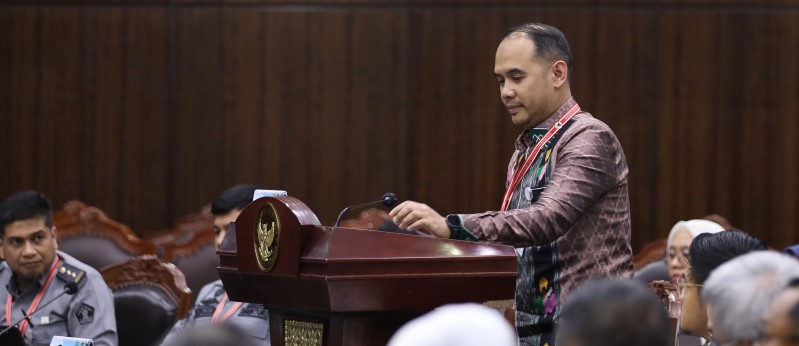
Head of the Ministry of Law’s Policy Strategy Agency, Andry Indady, representing the government to testify in the judicial review hearing of Law No. 18 of 2003 on Advocates, Tuesday (4/6). Photo by MKRI/Ifa.
Jakarta (MKRI) – The Constitutional Court held another hearing on Case No. 183/PUU-XXII/2024 on the material judicial review of Article 28 paragraph 3 of Law No. 18 of 2003 on Advocates (Advocates Law). The session to hear testimony from the President and Related Parties was held on Tuesday, June 3, 2025. One of the Related Parties, the Indonesian Advocate Association (Perhimpunan Advokat Indonesia – Peradi), stated that there is no regulation prohibiting leaders of Peradi from becoming state officials, as per its articles of association and bylaws.
Peradi’s articles of association and bylaws do not forbid Peradi leaders from becoming state officials because those who become state officials are expected to serve as bridges for Peradi to fight for the interests of the advocate organization regarding government policies,” legal counsel Sapriyanto Refa said in the Plenary Courtroom.
He explained that state officials are not prohibited from holding dual positions, such as serving as the chairman of a political party and another professional organization. President Prabowo Subianto is also the chairman of the Gerindra Party. Some ministers are also chairmen of political parties, such as Minister of ESDM Bahlil Lahadalia, who is the Chairman of the Golkar Party, and Coordinating Minister of Food Zulkifli Hasan, who is the Chairman of PAN.
Article 23 of Law No. 39 of 2008 on the State Ministries mentions that ministers, as state officials, are only prohibited from holding dual positions as other state officials based on laws and regulations, commisioners, or directors of state-owned enterprises or private companies, or leaders of organizations funded by the state or regional budget. Meanwhile, Sapriyanto said, political parties and professional organizations are not funded by the state or regional budget. Hence, there is no prohibition for ministers or state officials to lead political parties or professional organizations that are not funded by the state or regional budget.
He further stated that advocate organizations are not funded by the state or regional budget, so there is no prohibition on the leaders of advocate organizations becoming state officials. State officials cannot intervene in or influence advocate organizations because they have articles of association and bylaws that serve as guidelines for management and members to carry out their activities.
He added that the assignment of leaders of organizations as state officials, as long as it is not contrary to Article 23 of the State Ministries Law, is considered an honor and a mandate to manage the state alongside the President. The trust is a mandate that has to be carried out well for the sake of the nation and the state.
Sapriyanto said that the Petitioner must understand the Advocates Law comprehensively so they can differentiate between a prohibition for an advocate as an individual and the prohibition for the leaders of advocate organizations. Article 20 of the Advocate Law strictly regulates the prohibition of advocates who become state officials from doing their job as advocates and requires them to take a temporary leave.
Meanwhile, the prohibition on leaders of advocate organizations, which is separately regulated in Article 28 paragraph (3) of the Advocates Law, is only limited to the case where the dual position is to become a leader of a political party at the central or regional level. Sapriyanto stated that, out of the prevailing laws and regulations, ministers or deputy ministers, as state officials, are not prohibited from becoming leaders of advocate organizations because they are not state organs that are free and independent and do not receive funding from the state or regional budget.
“The petitioner’s concerns on the government intervention regarding advocates' supervision and enforcement are baseless and illusory,” he said.
Not Norm Constitutionality Issue
The head of the Policy Strategy Agency from the Ministry of Law, Andry Indrady, conveyed the President’s testimony. He explained that the Advocates Law has provided protection and guarantees to all advocates, including the tenure limit and periodisation of its advocate organization leaders. Currently, the interpretation of the tenure limit and periodization of advocate organization leaders, as well as the prohibition on dual positions from becoming state officials, is stipulated in Article 28, paragraph (3), of the Advocates Law, as decided by Constitutional Court Decision No. 91/PUU-XX/2022.
“Based on the decision, if it is related to the Petitioner’s arguments, which mentioned a concrete case of a advocate organization leader who exceeded his periodization as stipulated in Article 28 paragraph (3) of the Advocates Law and the MK Decision No. 91/PUU-XX/2022, it is not a norm constitutionality issue,” Andry stated.
He added that the Court asserted that the limit on the tenure and periodization of advocate organization leaders is based on the practice commonly used by other advocate organizations and organizations. Meanwhile, the arrangement of the two periods of tenure and the prohibition on dual positions for advocate organization and political party leaders aim to remove the potential for or prevent the violation or abuse of power within the advocate organization and maintain the neutrality of advocates in carrying out their duties as law enforcers. It is so that there is no political interest that may challenge an advocate's professionalism.
Andry stated that a professional organization must avoid management practices that may undermine its dignity in the presence of its members, so that it may maintain their professionalism, dignity, and solidity. For these reasons, the government deemed that no constitutional right was violated or potentially violated due to the enactment of the article, as it aligns with the goals that the Petitioner aimed to prevent fraud or abuse of power within the advocate organizations and maintain neutrality.
As the holder of the executive power with the weight of its duties, responsibilities, and obligations to carry out the authority of government administration, the President is given the right to establish other organizations as part of the bureaucracy. Terms of specific types of duties with special responsibilities, the President may appoint deputy ministers in several ministries (vide Article 10 of the State Ministries Law). As the leader of the ministry, the Minister is assisted by the Deputy Minister and structural organizations, such as the Secretariat General, the Inspectorate General, and the Directorate General, to work together in carrying out their duties of governance.
Also read:
Advocate Law Review: Conflict of Interest Potential of Otto Hasibuan’s Position
Constitutional Harm Due to the Absence of a Prohibition on Dual Positions for Leaders of Advocate Organizations
House’s Response on Advocate Organization Leader Doubling as Deputy Minister
An Advocate, Andri Darmawan, filed a material judicial review of Article 28 paragraph (3) of Law No. 18 of 2003 on Adcovates against Article 27 paragraph (1), 28D paragraph (1), 28E paragraph (3), and 28J paragraph (2) of the 1945 Constitution of the Republic of Indonesia. The Petitioner questioned the absence of a prohibition for the leaders of the organization from having dual positions with state officials in the article tested.
Article 28 paragraph (3) of the Advocates law, as interpreted by the Court through Decision No. 91/PUU-XXII/2022, pronounced on October 31, 2022, reads “The leadership of an advocate organization holds a term of office for 5 (five) years and can only be re-elected 1 (one) time in the same position, either consecutively or non-consecutively, and cannot be concurrent with the leadership of a political party, both at the central and regional levels.”
According to Andri, leaders of a advocate organization who hold another position as state officials render the advocate organization non-free and non-independent due to the government's intervention in the organization. Additionally, there is a tendency for individual or group domination in some advocate organizations, which may lead to the abuse of power. He mentioned that Prof. Otto Hasibuan, chairman of Peradi (the Association of Indonesian Advocates), was appointed Deputy Coordinating Minister of Law, Human Rights, Immigration, and Corrections on October 21, 2024.
Moreover, as chairman, he delivered his recommendation at Peradi’s National Working Meeting of 2024 in Bali on December 5-6, 2024, in which, among other things, he urged the Supreme Court to revoke its Circular Letter No. 73 of 2015 on the Swearing-In of Advocates. Hasibuan suggested that all advocates who have taken their oaths join Peradi and requested the Supreme Court to swear in all advocate candidates proposed by Peradi.
The Petitioner, who is affiliated with the Congress of Indonesian Advocates (KAI), Hasibuan’s recommendation as Peradi chairman cannot be separated from his position as a deputy coordinating minister. He stated that the recommendation could be interpreted as a recommendation from the Coordinating Ministry of Law, Human Rights, Immigration, and Correction.
He added that the action did not comply with Constitutional Court Decision No. 112/PUU-VII/2014, which declared Article 4 paragraph (1) of the Advocate Law unconstitutional as long as it is not interpreted as “The Court of Appeal is obliged by law to take oaths for advocates before exercising their profession without associating them with membership of existing organizations, namely PERADI and KAI.”
The Petitioner also questioned Hasibuan’s action, which did not comply with Constitutional Court Decision No. 91/PUU-XX/2022 because he led Peradi for three periods even though the Court had set the limit for the advocate organization leadership for two periods. He believes for leaders of advocate organization to also serve as state officials would lead to a conflict of interest because they cannot separate their individual or organizational interest and their duties as state officials.
Therefore, in his petitums, the Petitioner requested the Court to grant the petition in its entirety, to declare Article 28 paragraph (3) of Advocate Law as has been interpreted in the Constitutional Court Decision No. 91/PUU-XX/2022 conditionally unconstitutional and not legally binding as long as it is not interpreted as “The leadership of an advocate organization shall hold a term of office for 5 (five) years and can only be re-elected 1 (one) time in the same position, either consecutively or non-consecutively, and cannot simultaneously serve as state officials or leaders of political parties, both at the central and regional levels.”
Read more: Petition No. 183/PUU-XXII/2024 in Indonesian language
Author : Mimi Kartika
Editor : N. Rosi
PR : Raisa Ayuditha Marsaulina
Translator : Rizky Kurnia Chaesario (NL)
Disclaimer: The original version of the news is in Indonesian. In case of any differences between the English and the Indonesian versions, the Indonesian version will prevail.
Tuesday, June 03, 2025 | 16:27 WIB 863