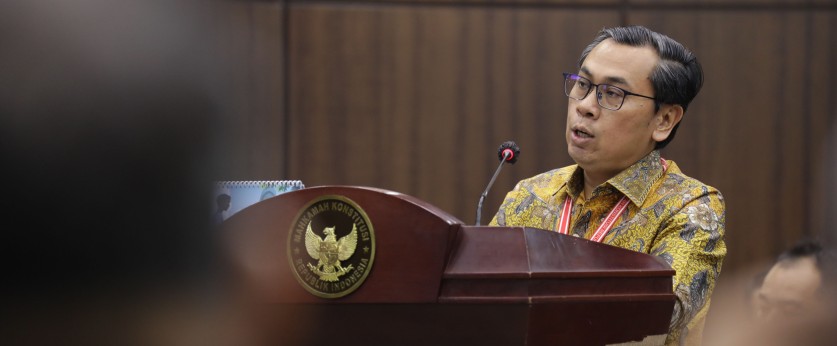
Special Advisor of the Minister of Finance Yustinus Prastowo as an Expert presented by the Government in the judicial review hearing of Law No. 36 of 2008 on Income Tax (UU PPh) and Law No. 42 of 2009 on Value Added Tax (UU PPN), on Thursday (6/5/2025) in the courtroom. Photo by MKRI/Panji
JAKARTA (MKRI) – The Court (MK) held an evidentiary hearing for Case No. 188/PUU-XXII/2024 on the judicial review of Law No. 36 of 2008 on Income Tax (UU PPh) and Law No. 42 of 2009 on Value Added Tax (UU PPN), on Thursday, June 5, 2025. This petition was filed by PT Gemilang Prima Semesta and CV Belilas Permai.
The Plenary Hearing was chaired directly by the Chief Justice Suhartoyo along with eight other constitutional justices. The government presented the Special Advisor of the Minister of Finance Yustinus Prastowo as an expert to provide testimony in the hearing. In his statement, Yustinus emphasized that the tax collection system in Indonesia has a strong constitutional basis. This refers to Article 23A of the 1945 Constitution (UUD) which states that "taxes and other compulsory levies for state needs are regulated by law."
"This is in accordance with Article 23A of the 1945 Constitution (third amendment) which states that "taxes and other compulsory levies for the needs of the State are regulated by law". Article 23A of the 1945 Constitution takes the "coercive" characteristics of taxes as they are, and emphasizes 'regulated by law' as an affirmation that compulsory tax collection is prone to falling into acts of injustice and arbitrariness, so it must be formulated by law through the control and approval of the House of Representatives (DPR). This law is what then becomes the legal basis that regulates the implementation of policies, such as tax subjects (who is taxed); tax objects (what is taxed); when tax is owed/tatbestand; and tax rates (how much is levied). Meanwhile, administrative procedures regarding how taxes are collected, how to calculate and report are regulated in legal instruments under the law," said Yustinus.
In the context of this case, the petitioner questions Article 4 paragraph (1) of the Income Tax Law and Article 4 paragraph (1) of the VAT Law which regulates the definition of income and tax objects. Yustinus explained that these provisions refer to the concept of income from the Schanz-Haig-Simons theory, which defines income as any additional economic capacity without distinguishing its source or utility.
According to Yustinus, a broad approach to the definition of income is intended to create horizontal justice in the taxation system. "All individuals with the same level of income must bear the same tax burden, without unfounded exceptions," he said.
He also emphasized that this broad definition does not mean that the state can act arbitrarily. Article 4 paragraph (3) of the Income Tax Law has provided exceptions for certain types of income, such as grants, inheritances, or donations, in order to guarantee aspects of justice and social justice.
In the hearing, Yustinus also delivered on the Highest Retail Price (HET) or what is known as the ceiling price which is part of the government's price policy. Different from the objectives of the Income Tax Law and the VAT Law as fiscal instruments for redistribution, the objective of HET is a stabilization and allocation function through price control if the market price is considered too high beyond the purchasing power of the people. To ensure the availability of goods in sufficient quantities and smooth distribution that can affect market prices, the government regulates the control of basic necessities and/or important (strategic) goods in Article 25 of Law No. 7 of 2014 concerning Trade. According to him, these provisions are the basis for the government's price policy in determining different HETs in each region.
In addition, he also mentioned that the regional government has the authority to regulate price control in its region through a Regional Regulation, but with the note that the HET provisions do not conflict with higher laws and regulations or the HET provisions have not been regulated by the central government. It can be interpreted that the purpose of the Regional Regulation limiting the highest retail price is to regulate and control the agent's selling price so that there is no price spike or price disparity of 3kg LPG between regions so that the sales margin of 3kg LPG is set fairly by the Agent/Distributor, and in turn the selling price of 3kg LPG can be affordable by people.
Thus, the Regional Regulation regulating HET is not issued in order to accompany or expand the basis for imposing income tax objects in Article 4 paragraph (1) of the Income Tax Law, but rather becomes a separate regional regulation. Both run side by side with different meanings and objectives, although they can be complementary. The provisions of Article 4 paragraph (1) of the Income Tax Law which regulate additional economic capacity as a tax object include the profits received by Agents/Distributors from the sale of 3kg LPG from the sales margin.
Also read:
LPG Distributors to Test Articles on Income and Value-Added Tax
Two LPG Agents Improve to Challenge Value Added Tax
Government Affirms 3 Kg LPG Tax Based on Law, Not Regional Regulations
For information, at the Preliminary hearing (3/4/2025) the Petitioner experienced specific and actual constitutional losses due to the legal uncertainty caused by Article 4 paragraph (1) of the Income Tax Law and Article 4 paragraph (1) of the VAT Law. According to him, both those articles contradict Article 23A of the 1945 Constitution which stipulates that taxes and other compulsory levies must be based on laws.
Tax collection by the Directorate General of Taxes is carried out based on a decision that determines the tax object, not only based on laws. This can be seen from the issuance of the Tax Underpayment Assessment Letter (SKPKB) to the Petitioners.
Furthermore, the Petitioners argue that the provisions in Article 4 paragraph (1) of the Income Tax Law and Article 4 paragraph (1) of the VAT Law create legal uncertainty because they do not explicitly state that the tax object must be determined based on the law. As a result, tax is imposed on transportation costs, the amount of which is determined by the decision of the governor, mayor, or regent. Taxation of these transportation costs is considered detrimental to taxpayers, especially for those who transport 3 kg LPG gas from agents to bases.
On that basis, the Petitioners hope that the Court can declare that the phrase "... received or obtained by Taxpayers..." in Article 4 Paragraph (1) of the Income Tax Law is contrary to the 1945 Constitution and does not have binding legal force as long as it is not interpreted as "... received or obtained by Taxpayers directly based on actions based on legislation...".
Read the full version of the petition revision in Indonesian: Case No. 188/PUU-XXII/2024
Author : Utami Argawati.
Editor : N. Rosi.
PR : Andhini SF.
Translator : Donny Yuniarto
Disclaimer: The original version of the news is in Indonesian. In case of any differences between the English and the Indonesian versions, the Indonesian version will prevail.
Thursday, June 05, 2025 | 15:42 WIB 720