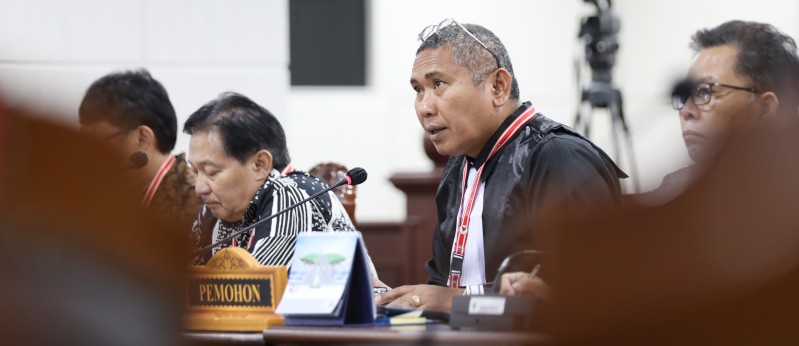
The Petitioners’ legal counsel, Cuaca, delivering the subject matter of the petition on the Preliminary Judicial Review Hearing of Law on Value-Added Tax on Goods and Services, Tuesday (4/3) at the Courtroom. Photo by MKRI/Ifa.
Jakarta (MKRI)—The Constitutional Court held a preliminary hearing in Case No. 188/PUU-XXII/2024 on the judicial review of Law No. 36 of 2008 on Income Tax (PPh Law) and Law No. 42 of 2009 on Value-Added Tax (VAT Law). PT Gemilang Prima Semesta and CV Belilas Permai submitted the petition. The hearing, led by Justice Arsul Sani, proceeded on Tuesday, March 4, 2025.
At the hearing, the petitioners’ legal counsel, Cuaca, stated that his clients suffered specific and actual constitutional losses due to legal uncertainty caused by Article 4 paragraph (1) of the PPh Law and Article 4 paragraph (1) of the VAT Law. According to him, the two articles contradict Article 23A of the 1945 Constitution, which regulates that taxes and other coercive levies must be based on laws and regulations.
“The enactment of Article 4 paragraph (1) of PPh Law and Article 4 paragraph (1) of the VAT Law, which contradicts Article 23A of the 1945 Constitution, harms the petitioners’ constitutional rights. If this provision is not interpreted as our proposed petitum, the petitioners will not get fair legal guarantees provided by Article 28D paragraph (1) of the 1945 Constitution,” Cuaca asserted in the hearing.
He also explained that the Directorate General of Taxes collects taxes based on the assessment that determines tax objects, not only on laws and regulations. It is based on the issuance of Tax Assessment Letters for Underpayment (Surat Ketetapan Pajak Kurang Bayar, SKPKB) to the Petitioners.
Moreover, the Petitioners also opined that the provisions in Article 4 paragraph (1) of PPh Law and Article 4 paragraph (1) of the VAT Law create legal uncertainty because they do not explicitly state that the tax object must be determined by laws and regulations. As a result, a tax is imposed on transportation costs, the amount of which is determined by a decree of the governor, mayor, or regent. This taxation of transportation costs is considered detrimental to taxpayers, especially those transporting 3 kg LPG gas from agents to bases.
“Article 4 paragraph (1) of the PPh Law and Article 4 paragraph (1) of the VAT Law contain taxation on transportation costs, the amount of which is determined by the Governor/Mayor/Regent Decree. The taxation, which should only be considered as reimbursement of transportation costs, harms the taxpayers required to transport 3kg LPG gas from the Agent to the Bases,” he explained.
On that basis, the Petitioners hoped that the Constitutional Court could declare the phrase “... received or obtained by the Taxpayer ...” in Article 4 Paragraph (1) of the PPh Law is contrary to the 1945 Constitution and has no binding legal force as long as it is not interpreted as “... received or obtained by the Taxpayer directly by an act based on laws and regulations ...”.
The Petitioners also requested the Court to declare Article 4 paragraph (1) of the VAT Law contradicts the 1945 Constitution and has no legally binding power as long as it is not interpreted as “Value Added Tax is imposed on:
a. delivery of Taxable Goods within the Customs Area made by an Entrepreneur;
b. import of Taxable Goods;
c. delivery of Taxable Service within the Customs Area performed by Entrepreneur;
d. utilization of Intangible Taxable Goods from outside the Customs Area within the Customs Area;
e. utilization of Taxable Service from outside the Customs Area within the Customs Area;
f. export of Tangible Taxable Goods by Taxable Entrepreneur;
g. export of Intangible Taxable Goods by Taxable Entrepreneur;
Jutices’ Advice
Responding to the petition, Justice Arief Hidayat requested the Petitioners to elaborate on the constitutional losses of legal entities due to the enactment of the articles being tested. “The descriptions are more in the direction of economic losses. If it is granted, not only these two legal entities will not be harmed. Judicial review applies to all legal entities because it is universal. If the explanation is like this, I still consider the eliminated losses only affect these two companies in this review. However, judicial review is erga omnes; it affects all, not only the Petitioners,” Arief explained.
Meanwhile, Justice Arsul Sani advised the Petitioners to move the legal standing description to the petition’s reasonings. “So, it is enough even though there are overlaps, it can be mentioned briefly in the legal standing and then further elaborated more comprehensively in the reasonings,” he stated.
At the end of the hearing, the panel of justice provided the petitioner to revise the petition within 14 days. The revision must be submitted to the Court on March 17, 2025, at the latest.
Read the full version of the petition in Indonesian: Perkara Nomor 188/PUU-XXII/2024
Author: Utami Argawati.
Editor: N. Rosi.
PR: Andhini SF.
Translator: Rizky Kurnia Chaesario
Disclaimer: The original version of the news is in Indonesian. In case of any differences between the English and the Indonesian versions, the Indonesian version will prevail.
Tuesday, March 04, 2025 | 15:35 WIB 215