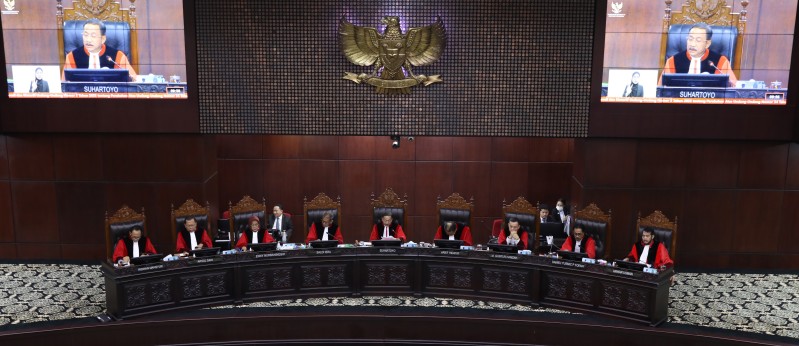
The ruling hearing for the judicial review of Law No. 3 of 2025 on the Armed Forces for case No. 66/PUU-XXIII/2025, Thursday (6/5/2025). Photo by MKRI/Ifa.
JAKARTA (MKRI) — The Constitutional Court (MK) decided not to accept the formal judicial review petition of Law No. 3 of 2025 on the Amendment to Law No. 34 of 2004 on the Indonesian Armed Forces (TNI Law). The Decision No. 66/PUU-XXIII/2025 was delivered on Thursday, June 5, 2025 in the plenary courtroom.
“[The Court] declares the Petitioner’s petition inadmissible,” said Chief Justice Suhartoyo delivering the verdict.
In its legal consideration, delivered by Deputy Chief Justice Saldi Isra, the Court stated that the Petitioners could not elaborate their legal standing clearly or the relation between specific and actual constitutional loss and the enactment of the TNI Law. It held that the Petitioners only alleged that the Law had been formed in a closed and non-transparent process and that they had not been involved to participate in it.
“The Petitioners should have been more active in responding to the lawmaking process of the a quo Law, whether in the form of participating in discussions, making a study or writing an essay on it, or expressing their objection publicly. Mere objection is not enough to prove that constitutional interests have been violated,” Justice Saldi said.
The Court also held that the Petitioners’ evidence such as screenshots of online media articles as well as articles on the Ministry of State Secretariat’s and the House of Representatives’ (DPR) websites were irrelevant in proving constitutional loss. Therefore, the Court concluded that there was no causality (causal verband) between the formation of the TNI Law and the Petitioners’ alleged loss.
Also read:
Validity of Formation of Army Law Challenged
Petition to Review Army Law Legality Revised
The petition was filed by four students: Masail Ismad Mawaqif, Reyhan Roberkat, Muh Amin Rais Natsir, and Aldi Rizki Khoiruddin. They questioned the lack of meaningful public participation in the formation of the TNI Law, including inputs from academic, civil societies, and the legal community. They also argued that the academic papers and the bill of law had never been made widely accessible. Muh Amin Rais Natsir revealed that after the bill had been approved by the president on March 26, the draft articles were changed without going through the official legislator mechanism. This, he asserted, is in violation of statutory provisions.
Author : Utami Argawati
Editor : N. Rosi
PR : Tiara Agustina
Translator : Yuniar Widiastuti (NL)
Disclaimer: The original version of the news is in Indonesian. In case of any differences between the English and the Indonesian versions, the Indonesian version will prevail.
Thursday, June 05, 2025 | 14:05 WIB 296