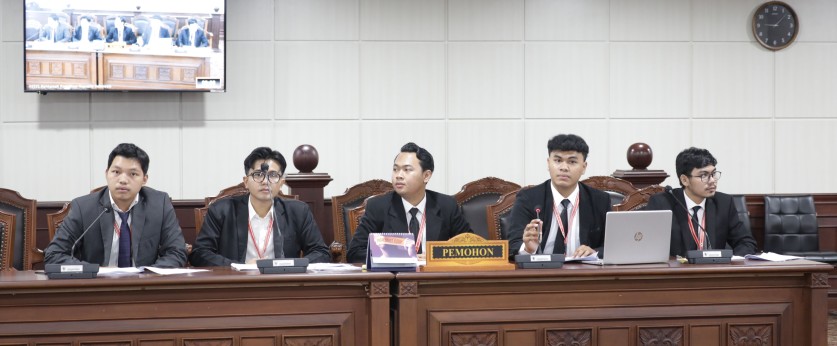
Batam International University law students Risky Kurniawan, Albert Ola Masan Setiawan Muda, Otniel Raja Maruli Situmorang, and Jamaluddin Lobang with legal counsel Respati Hadinata at the preliminary hearing for the formal and material judicial review of the Army Law, Friday (5/9/2025). Photo by MKRI/Panji.
JAKARTA (MKRI) — The Constitutional Court (MK) held preliminary hearings for 11 formal and material judicial review petitions of Law No. 3 of 2025 on the Amendment to Law No. 34 of 2004 on the Indonesian Armed Forces (TNI Law) on Friday, May 9, 2025. The justices sat on three panels. The panel consisting of Constitutional Justices Arief Hidayat (chair), Anwar Usman, and Enny Nurbaningsih examined cases No. 58/PUU-XXIII/2025, 66/PUU-XXIII/2025, and 74/PUU-XXIII/2025.
The three cases were petitioned by students of several universities. They challenge the validity of the formation of the TNI Law, which they believe had flouted procedure and lacked public participation.
Flouting Lawmaking Principles
The case No. 58/PUU-XXIII/2025 was filed by four law students of Batam International University: Risky Kurniawan, Albert Ola Masan Setiawan Muda, Otniel Raja Maruli Situmorang, and Jamaluddin Lobang. Their legal counsel, Respati Hadinata, asserted that the formation of the TNI Law had disregarded lawmaking procedure under the legislation.
Respati argued that the formation of laws shall follow Law No. 12 of 2011, Law No. 15 of 2019, and Law No. 13 of 2022. He stressed that the 1945 Constitution only laid out principle guidelines, to procedural guidelines. “If the judicial review criteria are only based on the 1945 Constitution, it is almost impossible to review, because the Constitution only contains basic norms,” he said.
The Petitioners also highlighted the inclusion of the TNI Bill into the 2025 National Legislative Program (Prolegnas) priority list without following the legal procedure. They argued that the House of Representatives (DPR) plenary meeting on February 18, which passed the bill, had violated Article 27 paragraph (1) and Article 28D paragraph (1) of the 1945 Constitution, as well as a number of provisions of the House’s Rules of Procedure, such as Article 290 paragraph (2) and Article 291 paragraph (1).
Not only that, they emphasized that there were no emergency conditions that could justify the acceleration of discussions as interpreted in Constitutional Court Decision No. 138/PUU-VIII/2009. Data from the Ministry of Defense in 2019 also shows that Army soldiers can still carry out their duties without regulatory obstacles.
Lack of Public Participation
The case No. 66/PUU-XXIII/2025 was filed by four students: Masail Ismad Mawaqif, Reyhan Roberkat, Muh Amin Rais Natsir, and Aldi Rizki Khoiruddin. They question the lack of public participation in the formation of the TNI Law, including inputs from academic, civil societies, and the legal community. They also believe that the academic papers and the bill of law were never made widely accessible.
Muh Amin Rais Natsir revealed that after the bill was approved by the president on March 26, the draft articles were changed without going through the official legislator mechanism. This, he asserted, is in violation of Law No. 13 of 2022 and the lawmaking rules.
Next, case No. 74/PUU-XXIII/2025 was filed by four law students of the Islamic University of Indonesia (UII): Abdur Rahman Aufklarung, Satrio Anggito Abimanyu, Irsyad Zainul Mutaqin, and Bagus Putra Handika Pradana. Similarly, they question the lack of transparency, the lack of public participation, and the academic papers not following the guidelines under the Lawmaking Law.
Justices’ Advice
In response, Justice Enny Nurbaningsih advised the petitioners to study several Court decisions on formal judicial review. She also urged them to observe the petition format under the Constitutional Court Regulation (PMK) No. 2 of 2021 on the procedure for judicial review.
Meanwhile, Justice Arief Hidayat stressed the importance to explain whether the TNI Law was formed by the authorized institutions. “You must elaborate that,” he said.
The panel gave the petitioners 14 workdays to revise the petition, which must be submitted by Thursday, May 22, 2025.
Also read:
Petition for case No. 58/PUU-XXIII/2025 66/PUU-XXIII/2025
Petition for case No. 66/PUU-XXIII/2025
Petition for case No. 74/PUU-XXIII/2025
Author : Utami Argawati
Editor : N. Rosi
PR : Tiara Agustina
Translator : Yuniar Widiastuti (NL)
Disclaimer: The original version of the news is in Indonesian. In case of any differences between the English and the Indonesian versions, the Indonesian version will prevail.
Friday, May 09, 2025 | 14:36 WIB 272