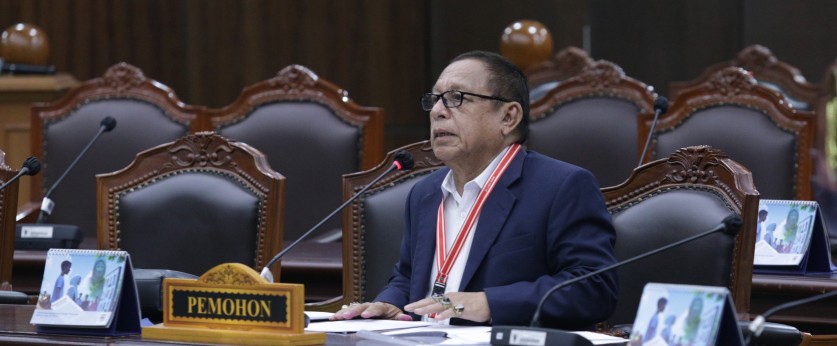
The Petitioner attending the petition revision hearing of case No. 72/PUU-XXIII/2025 on authentic deeds categorization, Tuesday (6/3/2025). Photo by MKRI/Bayu.
JAKARTA (MKRI) — The Constitutional Court (MK) held the second hearing of the judicial review of Article 15 paragraph (2) letter f of Law No. 30 of 2004 on Notary Office as amended by Law No. 2 of 2014 (Notary Law), Article 1 paragraph (4) of Law No. 4 of 1996 on Mortgage Rights over Land and Land-related Objects (Mortgage Law), and Article 44 paragraph (1) and its elucidation of Law No. 20 of 2011 on Apartment Units (Apartment Law).
The session for case No. 72/PUU-XXIII/2025 convened on Tuesday, June 3, 2025, and was designated to examine the principal points of the revised petition submitted by Anisitus Amanat, a notary by profession. In his revision, he underscored the Court’s jurisdiction to adjudicate the case and asserted that the challenged provisions contravene Article 28D paragraph (1) of the 1945 Constitution, particularly with regard to the constitutional mandate and entitlement of notaries to draw up land-related deeds. He also added that he and two other notaries had been harmed after their requests to renew their PPAT licenses were denied. He made some improvements to his legal arguments as well.
In the revised petitum, Anisitus asked the Court to declare that Article 15 paragraph (2) letter f of the Notary Law is unconstitutional unless it is understood to also allow notaries to make land deeds, such as deeds of sale and purchase, land exchanges, and joint land ownership. He said these documents are important and should be accepted by land offices to process land ownership transfers, except for cases based on court rulings or auction reports.The hearing was presided over by Chief Justice Suhartoyo, with Constitutional Justices Daniel Yusmic P. Foekh and M. Guntur Hamzah sitting as panel members.
Also read: Notary Questions Notary’s Authority to Make Land Deeds
At the preliminary hearing on Wednesday, May 21, 2025, the Petitioner argued that the article above implicitly affirms the right and responsibility of notaries to produce all types of land-related deeds, unless expressly regulated otherwise by the Notary Law or sectoral laws. However, he contended that in practice, this authority has been undermined as the government favors Land Deed Officials (PPAT) in performing such tasks. This preference, he said, is problematic given that the legal authority of PPATs derives merely from government regulations and not from statutory law.
The Petitioner further cited Article 43 paragraph (1) of the Apartment Law, which stipulates that the pre-construction sale of apartment units (sarusun) may be executed through a binding sale and purchase agreement (PPJB) before a notary. He emphasized that under Article 44 paragraph (1) and its elucidation, the transfer of ownership for completed apartment units must be conducted through a deed of sale and purchase prepared by a notary acting concurrently as a PPAT, as regulated under Government Regulation No. 37 of 1998 in conjunction with Government Regulation No. 24 of 2016. He maintained that no other statutory provision substantiates the PPAT position beyond those regulations. Therefore, in his view, the exclusive delegation of authority to PPATs limits the constitutional rights of notaries to fulfill their official duties related to land affairs.
Author: Sri Pujianti
Editor: Lulu Anjarsari P.
PR: Tiara Agustina
Translator: Yuanna Sisilia
Disclaimer: The original version of the news is in Indonesian. In case of any differences between the English and the Indonesian versions, the Indonesian version will prevail.
Tuesday, June 03, 2025 | 16:18 WIB 256