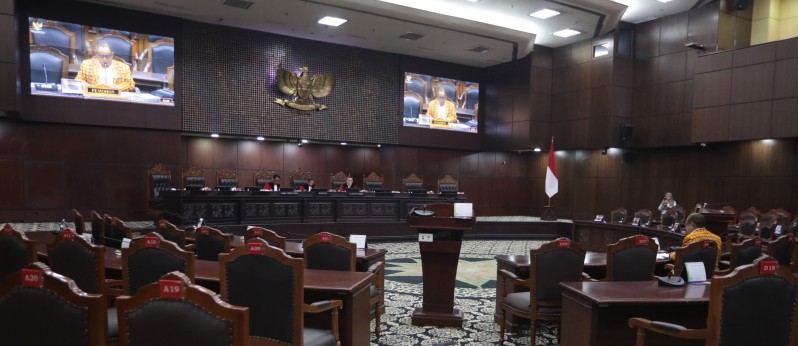
The preliminary hearing for the judicial review of the Notary Law, the Mortgage Law, and the Condominium Law, filed by notary Anisitus Amanat, Wednesday (5/21/2025). Photo by MKRI/Ilham W.M.
JAKARTA (MKRI) — Anisitus Amanat, a notary public, has filed a judicial review petition of three laws: Article 15 paragraph (2) letter f of Law No. 30 of 2004 on the Notary Profession as amended by Law No. 2 of 2014 on the Amendment to Law No. 30 of 2004 on the Notary Profession; Article 1 paragraph (4) of Law No. 4 of 1996 on Land Mortgage and Objects Related to the Land (Mortgage Law); and Article 44 paragraph (1) of Law No. 20 of 2011 on Condominiums and its elucidation. The preliminary hearing for case No. 72/PUU-XXIII/2025, taking place on Wednesday, May 21, 2025 in the plenary courtroom, was presided over by Chief Justice Suhartoyo (panel chair) and Constitutional Justices Daniel Yusmic P. Foekh and M. Guntur Hamzah.
Article 15 paragraph (2) letter f of the Notary Law reads, “A Notary Public shall be authorized to: draw up deeds relating to agrarian affairs.” The Petitioners believe it means notaries have the right and obligation to draw up all deeds relating to agrarian affairs, as long as the Notary Law or any other laws do not make exceptions for any other officials. However, such authority cannot be implemented as the Government/State prefer that land deed officials (PPAT) implement it, even though their authority to do so is only based on a government regulation, not a Law.
Meanwhile, based on Article 43 paragraph (1) of the Condominium Law, the sale and purchase of a condominium unit prior to construction can be done through a sale and purchase agreement (PPJB) before a notary. Then, Article 44 paragraph (1) and its elucidation stipulates that the sale and purchase of a fully-constructed condominium unit is done through a sale and purchase deed made before a notary who is also a land deed official, as regulated under the Government Regulation (PP) No. 37 of 1998 in conjunction with the Government Regulation No. 24 of 2016. The Petitioner believes that no other regulations exist as a basis for land deed officials in the Indonesian legal system other than those two. With the granting of the authority to land deed officials, he argued, the Government/State has restricted notaries from exercising their constitutional right and obligation to make deeds relating to agrarian affairs. In other words, they do not recognize this specific right of notaries.
“Temporary and special PPAT tasked with making land deeds, [I] believe, is a legal norm, government regulations whose material has been regulated under Article 15 paragraph (2) letter f of the Notary Law. So far, the legal norm cannot be implemented purely and consequently by Indonesian notaries due to unclear and uncertain legal norms regulating the types of deeds on agrarian affairs. So, [my] goal through this petition is so that the a quo articles be formulated clearly and certainly in law and be easily comprehensible and implemented by notaries throughout Indonesia, the Petitioner explained.
Justices’ Advice
Constitutional Justice Daniel Yusmic P. Foekh urged the Petitioner to simplify the petition despite the review of three laws. “In addition, please clarify the touchstone Article 28 of the 1945 Constitution on which the review of all articles are based or some articles relating to [your] constitutional impairment,” he said.
Next, Constitutional Justice M. Guntur Hamzah said the Petitioner need to elaborate the reason behind the petition consistently. “Also, for the petitum and its elaboration, study Article 51 paragraphs (3) and (4) of the Constitutional Court Law, which relates to how to write good petitums,” he explained.
Meanwhile, Chief Justice Suhartoyo said that as a non-active notary and land deed official, the Petitioner should strengthen his legal standing by explaining his correlation with the enforcement of the norms. “As [you are] questioning the land deed officials’ authority, the theoretical bases must be clarified—what is the difference with notaries who can also make land deeds,” he advised.
After delivering his advice, Chief Justice Suhartoyo (panel chair) gave the Petitioner 14 days to revise the petition, which must be submitted by Tuesday, June 3, 2025 to the Registrar’s Office. The Court will then schedule the second hearing to examine the revisions to the petition.
Author : Sri Pujianti
Editor : Lulu Anjarsari P.
PR : Tiara Agustina
Translator : Yuniar Widiastuti (NL)
Disclaimer: The original version of the news is in Indonesian. In case of any differences between the English and the Indonesian versions, the Indonesian version will prevail.
Wednesday, May 21, 2025 | 16:31 WIB 846