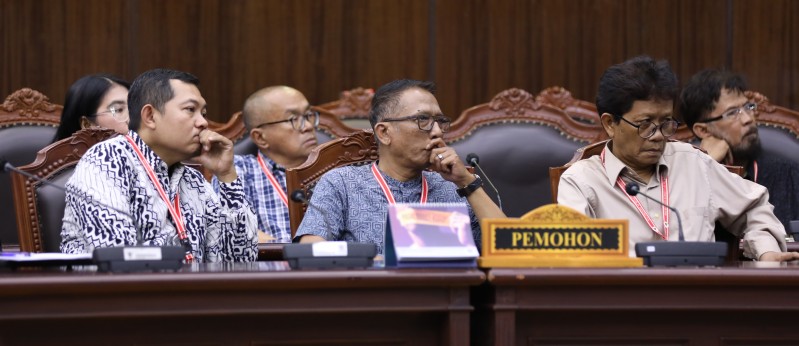
The principal petitioners during the ruling hearing on the judicial review of Law No. 28 of 2014 on Copyright, Tuesday (05/27) in the Constitutional Court’s courtroom. Photo by the PR Bureau/Ifa.
JAKARTA (MKRI). The Constitutional Court (MK) ruled the petition for the judicial review of Article 89 paragraphs (1), (2), (3), and (4) of Law No. 28 of 2014 on Copyright (Copyright Law), filed by musicians under the Indonesian Music Lovers Alliance (APMI), inadmissible. The ruling hearing was held on Tuesday (5/27/2025) in the plenary courtroom of the Court.
“On the verdict, the Court rules: the petition filed by the Petitioners is declared inadmissible,” said Chief Justice Suhartoyo as he read out the verdict of Decision No. 30/PUU-XXIII/2025.
The musicians acting as the Petitioners were M. Ali Akbar (Petitioner I), Ento Setio Wibowarno (Petitioner II), Pamungkas Narashima Murti (Petitioner III), Sugiyatno (Petitioner IV), Muhammad Gusni Putra (Petitioner V), and Anton Setyo Nugroho (Petitioner VI).
In the Court’s legal consideration, Deputy Chief Justice Saldi Isra stated that the Petitioners failed to articulate arguments indicating a clear conflict of norms, rendering the petition’s rationale unclear. Furthermore, there was an ambiguous petitum that blurred the Petitioners’ intentions when claiming conditional constitutionality regarding the existence of the National Collective Management Institute (LMKN). In addition, the petitum’s wording was vague and did not conform to the usual form of petitum in judicial review cases.
“Based on these legal considerations, the Court believes that the Petitioners’ petition is unclear or obscure,” Deputy Chief Justice Saldi read out the Court’s legal reasoning.
Related Articles:
As additional information, Petitioners I–IV are songwriters, Petitioner V is a singer, and Petitioner VI is a book writer and music lover who also initiated the formation of APMI. During the preliminary hearing on Thursday (4/24/2025), Anton Setyo Nugroho argued that the norms being reviewed had failed to provide legal certainty regarding the distribution and management of songwriters’ royalties.
The regulatory ambiguity, he claimed, has enabled arbitrary interpretations that led to the emergence of the National Collective Management Institute (LMKN). As a result, this has deviated from existing rules through the issuance of Government Regulation No. 56/2021 on the Management of Copyright Royalties for Songs and Music, which has harmed songwriters and related rights holders, and created injustice in royalty management practices as guaranteed by the 1945 Constitution in Article 28D paragraph (1) regarding the principle of legal certainty and justice.
According to the Petitioners, the norms in question also violate individual property rights protected by Article 28H paragraph (4) of the 1945 Constitution. The economic rights of creators, which should be protected, have become vulnerable to being taken over by non-transparent and unfair mechanisms. The norms grant LMKN extensive authority to collect and manage royalties without strict control mechanisms, which could constitute a form of economic rights expropriation that contradicts the 1945 Constitution.
Moreover, the norms are considered to violate the principle of people’s sovereignty as guaranteed in Article 1 paragraph (2) of the 1945 Constitution. The centralization of royalty management through LMKN, without direct involvement of songwriters, potentially infringes on democratic principles. Songwriters have no space to participate in determining the amount and mechanism of royalty distribution, thus ignoring the principle of people’s sovereignty in the management of the creative economy. From several perspectives, the norms also appear to have exceeded the authority granted by the law, as Article 89 paragraphs (1), (2), (3), and (4) of the Copyright Law, which serves as the basis for the formation of LMKN, contains no explicit mandate for its establishment.
Article 1 item 22 of the Copyright Law defines a Collective Management Organization (LMK) as a non-profit legal entity authorized by creators, copyright holders, and/or related rights holders to manage their economic rights by collecting and distributing royalties. This institution is given the authority to manage economic rights over a creation, such as songs, music, books, and films, or related rights like performances, recordings, or broadcasts, on behalf of and representing the rights holders.
Meanwhile, Article 1 of the Copyright Law does not regulate the existence of LMKN, leaving this institution without a clear legal basis for its establishment and authority. LMKN’s existence has caused social uncertainty for creators and copyright holders. In practice, Collective Management Organizations (LMK) have long served as a platform for creators to independently manage their economic rights. However, LMKN lacks legal legitimacy in the Copyright Law, creating a confusing dualism of authority that leaves many creators struggling to receive their economic rights due to delays in royalty payments.
Author: Sri Pujianti
Editor: Nur R.
PR: Fauzan
Translator: Siti Rosmalina Nurhayati
Disclaimer: The original version of this news article is in Indonesian. In the event of any discrepancies between the English and Indonesian versions, the Indonesian version prevails.
Tuesday, May 27, 2025 | 15:35 WIB 277