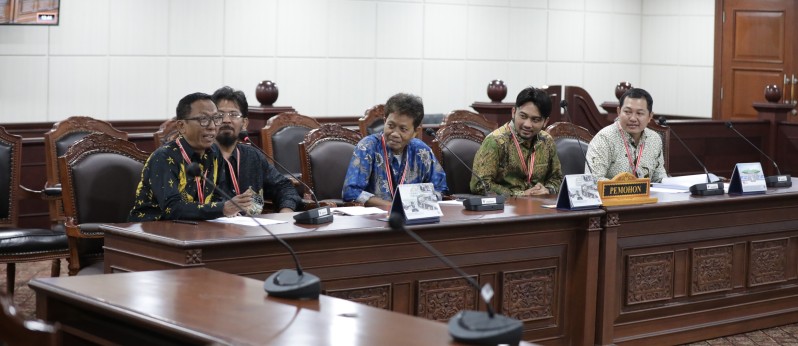
Songwriters and book authors delivering their petition at the preliminary hearing for the material judicial review of the Copyright Law, Thursday (4/24/2025). Photo by MKRI/Ilham W.M.
JAKARTA (MKRI) — Musicians under the Alliance of Indonesian Music Enthusiasts (APMI) have filed a material judicial review petition of Article 89 paragraphs (1), (2), (3), and (4) of Law No. 28 of 2014 on Copyright to the Constitutional Court (MK). M. Ali Akbar, Ento Setio Wibowarno, Pamungkas Narashima Murti, Sugiyatno, Muhammad Gusni Putra, and Anton Setyo Nugroho (Petitioners I-VI) attended the preliminary hearing for case No. 30/PUU-XXIII/2025 on Thursday, April 24, 2025.
Article 89 paragraphs (1), (2), (3), and (4) of the Copyright Law reads, “(1) To manage Copyright Royalties in the field of songs and/or music, 2 (two) national Collective Management Organizations are established that each represents: a. interests of Creators; and b. interests of holders of Relevant Rights. (2) Both the Collective Management Organizations as referred to in paragraph (1) have the authority to collect and distribute Royalties from commercial Users. (3) To collect as referred to in paragraph (2), the two Collective Management Organizations coordinate and determine the amount of Royalties that is the right of each Collective Management Organization in accordance with the prevailing best practice. (4) The provisions concerning guidelines for determining the amount of royalties are established by the Collective Management Organizations as referred to in paragraph (1) and endorsed by the Minister.”
Petitioners I-IV are songwriters; Petitioner V is a singer; while Petitioner VI is a book author, an Indonesian music enthusiast, and the initiator of the Alliance of Indonesian Music Enthusiasts (APMI). Before Constitutional Justice M. Guntur Hamzah and members of the panel, Anton Setyo Nugroho stated that the petitioned norm has failed to provide legal certainty on the distribution and management of songwriter royalties as its vagueness has allowed for inaccurate interpretations that has led to the emergence of institutions such as the National Collective Management Institution (LMKN). As a result, the issuance of the Government Regulation (PP) No. 56 of 2021 on the Management of Copyright Royalties for Songs and Music has distorted the legislation, thus is detrimental to songwriters and holders of relevant rights and creates injustice in royalty management, which is guaranteed under Article 28D paragraph (1) of the 1945 Constitution on the principles of legal certainty and justice.
The Petitioners believe that the norm has also violated individual property rights guaranteed under Article 28H paragraph (4) of the 1945 Constitution. Indeed, the creator’s economic rights, which should be protected, are vulnerable to takeover by opaque, unfair mechanisms. The norm is used to give the LMKN broad authority to collect royalties without any strict control. This could potentially lead to deprivation of economic rights, which is contrary to the 1945 Constitution.
In addition, the Petitioners asserted, the norm is also a violation against the principle of popular sovereignty guaranteed under Article 1 paragraph (2) of the 1945 Constitution because the centralization of royalty management through the LMKN without the creators’ direct involvement could potentially violate the principle of democracy. There is no room for songwriters to participate in determining the amount and mechanism of royalty distribution, thus ignoring the principle of popular sovereignty in the management of creative economy. On several aspects, the norm has also exceeded the authority granted by the law, because it was used as the basis for establishing the LMKN despite not mandating it.
“The norm only regulates the authority of one entity called the Collective Management Institution (LMK) and does not mention other entities. Therefore, the establishment of the LMKN is ultra vires beyond the authority granted by the parent law,” Anton explained onsite in a panel courtroom.
Article 1 point 22 of the Copyright Law defines the Collective Management Institution (LMK) as a non-profit legal entity authorized by the Creator, Copyright Holder, and/or Relevant Rights Holders to manage their economic rights by collecting and distributing royalties. The institution is given the right to manage the economic rights to works, such as songs, music, books and films, and or relevant rights such as performance works, recording works, broadcast works, and to represent rights holders. Meanwhile, Article 1 of the Copyright Law does not regulate the LMKN, so there is no clear legal basis for the institution’s formation and authority. The LMKN has led to social uncertainty for creators and copyright holders. In practice, it has long been a forum for creators to manage their economic rights independently. Meanwhile, the LMKN has no legitimacy under the Copyright Law, thus creating a dualism of authority that confuses creators. Uncertainty in royalty distribution due to the duality between the LMK and the LMKN has made it difficult for many creators to obtain economic rights due to delays in royalty distribution.
“The Petitioners request that the Court declare the phrase ‘national’ in Article 89 paragraph (1) of Law No. 28 of 2014 cannot be interpreted as the basis for the establishment of a new institution called the National Collective Management Institution (LMKN); state that the royalty management mechanism shall be carried out by the Collective Management Institution (LMK) as has been previously, without intervention from unnecessary intermediary entities; order the legislators to revise Law No. 28 of 2014 as a result of its contradiction with the 1945 Constitution to be more in line with the development of social, scientific, and technological dynamics; and order in the revision of Law No. 28 of 2014 the establishment of a special institution as a communication forum for stakeholders in the music and culture industry, but not as a royalty collector,” said Anton reading out the Petitioners’ petitums.
Constitutional Impairment
Delivering his advice, Constitutional Justice Daniel Yusmic P. Foekh said that the Petitioners need to elaborate further on the constitutional losses associated with the enforcement of the article and to emphasize the posita or their wishes out of the petitioned norm.
He added that the Petitioners must take a good look at their petitums to the Court. “What does it mean that it cannot be interpreted as the basis for this new institution? This seems like spoken language, if you look at petitums 2 and 3, they show contradiction. Try to look closely, whether [you wish the norm] be declared unconstitutional or conditionally constitutional,” he asked.
Meanwhile, Constitutional Justice M. Guntur Hamzah said it is necessary for the Petitioners to pay attention to several parts of the petition, including the format, which consists of the Petitioners’ profile, the petition’s subject matter, the reasons for the petition, and the petitums. “Explanation of the legal standing contains the connection between the Petitioners’ loss and the enforcement of this norm. What you lose due to the enforcement of this norm, it can be factual or potential, as an entry point to this petition. This explanation can vary; singers, songwriters, book authors, try to explain your losses,” he explained.
At the end of the hearing, Justice Guntur announced that the Petitioners have 14 days until Wednesday, May 7 to revise the petition and resubmit it to the Registrar’s Office, which will schedule the second hearing to examine the revisions to the petition.
Read the revised petition No. 30/PUU-XXIII/2025 here.
Author : Sri Pujianti
Editor : Nur R.
PR : Fauzan F.
Translator : Yuniar Widiastuti (NL)
Disclaimer: The original version of the news is in Indonesian. In case of any differences between the English and the Indonesian versions, the Indonesian version will prevail.
Thursday, April 24, 2025 | 16:12 WIB 2880