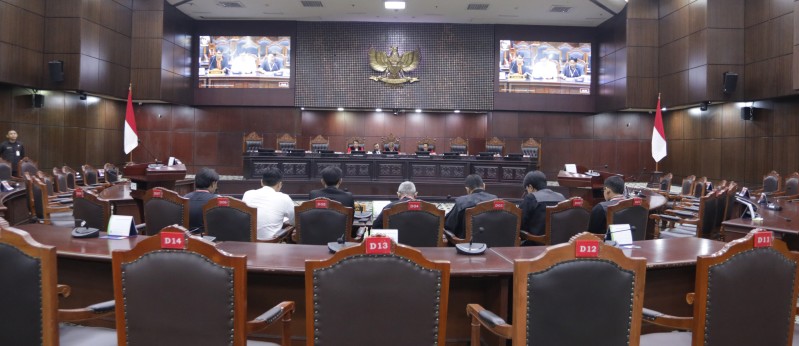
Petition revision hearing for two judicial review cases of the SOE Law, Monday (5/19/2025). Photo by PR/Ilham WM.
JAKARTA (MKRI) — The Constitutional Court (MK) held a petition revision hearing for the judicial review of Law No. 1 of 2025 on State-Owned Enterprises (SOE Law) on Monday, May 19, 2025. Case No. 43/PUU-XXIII/2025 was filed by three university students: A. Fahrur Rozi, Dzakwan Fadhil Putra Kusuma, and Muhammad Jundi Fathi Rizky.
The Petitioners challenged Article 3H paragraph (2), Article 3X paragraph (1), Article 4B, Article 9G, and Article 87 paragraph (5) of the SOE Law. They argued that the provision stipulating that any loss incurred by the Anagata Nusantara Investment Management Agency (BPI Danantara) does not constitute a state loss is contrary to the principle of state control under Article 33 paragraph (2) of the 1945 Constitution.
“This contradicts the principle of state ownership enshrined in Article 33 paragraph (2),” said Petitioner A. Fahrur Rozi before the panel of justices at the Constitutional Court's courtroom in Jakarta.
The Petitioners emphasized that the 1945 Constitution mandates that branches of production vital to the state and controlling the livelihood of the people must be under the state’s control. They also cited Article 28D paragraph (1), which guarantees legal certainty and equal treatment before the law. As students, they stressed that their right to benefit from state-provided education is safeguarded under Article 31 paragraph (4) of the Constitution.
They contended that the education budget, essential to higher education institutions, is subject to state policies. Since early 2025, the government’s budget efficiency policy has led to a freeze on several higher education allocations. The Petitioners linked this austerity measure to the diversion of educational funds for the financing of BPI Danantara.
In light of this, the Petitioners oppose the management of SOEs or their affiliated agencies using frameworks that lack transparency and accountability, which could foster corruption or embezzlement. They believe such practices would ultimately reduce education allocations, thereby violating their constitutional right to proper education.
Accordingly, they requested that the Court declare the challenged provisions unconstitutional and not legally binding unless interpreted as follows: losses and benefits of BPI Danantara must be deemed state losses and benefits, and its organs and personnel must be classified as state officials.
Also read:
Petitioners Question State Loss Definition in BUMN Law
The hearing was presided over by Deputy Chief Justice Saldi Isra, alongside Constitutional Justices Anwar Usman and Ridwan Mansyur. Concurrently, the panel also examined Case No. 44/PUU-XXIII/2025, filed by private entrepreneurs Heri Hasan Basri and Solihin.
They challenged the constitutionality of Article 3X paragraph (1) and Article 3Y letters a and b of the SOE Law, arguing that these provisions deprived them of their constitutional right to report corruption involving ministers, SOE officials, and related agencies to law enforcement.
The Petitioners of Case No. 44 requested the Court to declare the articles unconstitutional and not legally binding.
Read more:
Case Petition No. 43/PUU-XXIII/2025
Case Petition No. 44/PUU-XXIII/2025
Author: Mimi Kartika
Editor: N. Rosi
PR: Fauzan
Translator: Yuanna Sisilia
Disclaimer: The original version of the news is in Indonesian. In case of any differences between the English and the Indonesian versions, the Indonesian version will prevail.
Monday, May 19, 2025 | 18:04 WIB 1036