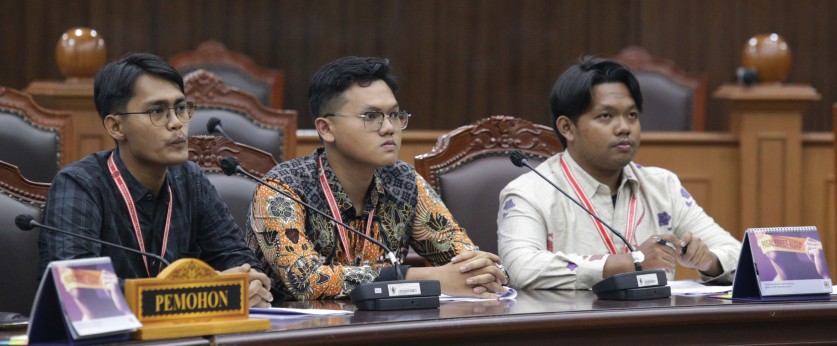
Petitioners presenting their argument at the preliminary hearing of the judicial review of Law No. 1 of 2025 on State-Owned Enterprises, Monday (5/5/2025). Photo by MKRI/Bay.
JAKARTA (MKRI) — Three university students filed a judicial review petition of several provisions in Law No. 1 of 2025 on the Third Amendment to Law No. 19 of 2003 on State-Owned Enterprises (SOEs). The provisions under review include Article 3H paragraph (2), Article 3X paragraph (1), Article 4B, Article 9G, and Article 87 paragraph (5). The Petitioners contested the constitutionality of these norms, which exclude the profits and losses of the state investment agency Danantara (Daya Anagata Nusantara Investment Agency) from the state’s finances and exempt its employees from being classified as state officials.
“The Petitioners believe these provisions may allow corruption to thrive in SOEs,” Jundi said at the preliminary hearing of case No. 43/PUU-XXIII/2025 on Monday, May 5, 2025, in the Constitutional Court’s courtroom.
He explained that state officials can be charged with receiving bribes, but only if the law recognizes them as state officials. If Danantara employees are not considered state officials, they might avoid legal punishment. The Petitioners said this goes against the system of government and harms their rights as students.
They cited the following provisions as problematic: Article 3H(2): “Profits or losses incurred by the Agency in carrying out investments as referred to in paragraph (1) shall be the Agency’s profits or losses.” Article 3X(1): “The organs and employees of the Agency are not state officials.” Article 4B: “Profits or losses incurred by an SOE shall be the SOE’s profits or losses.” Article 9G: “Members of the Board of Directors, Board of Commissioners, and Board of Supervisors of SOEs are not state officials.” Article 87(5): “Employees of SOEs as referred to in paragraph (2) are not state officials.”
The Petitioners argued these rules wrongly protect SOEs and Danantara from legal responsibility. Deciding whether a loss is a state loss should depend on the case and be handled by law enforcement, not written into law.
Danantara’s Legal Status
The Petitioners also highlighted the exclusion of Danantara officials and employees from the category of state officials, even though Danantara’s capital is entirely sourced from state assets and SOE dividends, and its operations are state-funded.
This, they argued, creates a legal loophole that allows unchecked power and unaccountable investment management. Such exclusion, they said, discriminates against other state institutions, invites opacity, and violates the public interest. The Petitioners asserted that this contradicts Article 27 paragraph (1) and Article 28D paragraph (1) of the 1945 Constitution.
In their petitum, they requested the Court to declare Article 3H(2), Article 3X(1), Article 4B, Article 9G, and Article 87(5) unconstitutional and not legally binding. They expressed hope that if these provisions were annulled, law enforcement agencies, such as the Corruption Eradication Commission (KPK), could continue combating corruption in SOEs effectively.
Legal Responsibility
The hearing was presided over by Deputy Chief Justice Saldi Isra, alongside Justices Anwar Usman and Ridwan Mansyur. The Court also heard case No. 44/PUU-XXIII/2025 filed by entrepreneurs Heri Hasan Basri and Solihin, who challenged Article 3X(1) and Article 3Y letters a and b of the SOE Law.
The Petitioners claimed they lost their constitutional right to report and seek criminal accountability for ministers and Danantara officials suspected of corruption due to the prevailing norms. In their petitum, they asked the Court to declare the phrase “not state officials” in Article 3X(1) and Article 3Y letters a and b unconstitutional and to interpret it instead as “state officials.”
Justices’ Advice
During the session, Deputy Chief Justice Saldi Isra questioned the Petitioners’ legal standing, stating that they had yet to sufficiently explain how their constitutional rights were impaired by the contested norms.
He added that the Petitioners must present strong causal arguments linking the articles under review to the corruption issues they raised. The justices also found no clear legal basis explaining how the contested provisions violate the Constitution.
“There’s no solid argument showing how these norms contradict the constitutional articles cited. You need to demonstrate the contradiction clearly,” Saldi emphasized.
Before adjourning the hearing, he gave the Petitioners 14 days to revise their petition. The revision must be submitted no later than Monday, May 19, 2025.
Also read:
Author: Mimi Kartika
Editor: N. Rosi
PR: Fauzan
Translator: Yuanna Sisilia
Disclaimer: The original version of this news article is in Indonesian. In case of any differences between the English and Indonesian versions, the Indonesian version shall prevail.
Monday, May 05, 2025 | 16:23 WIB 226