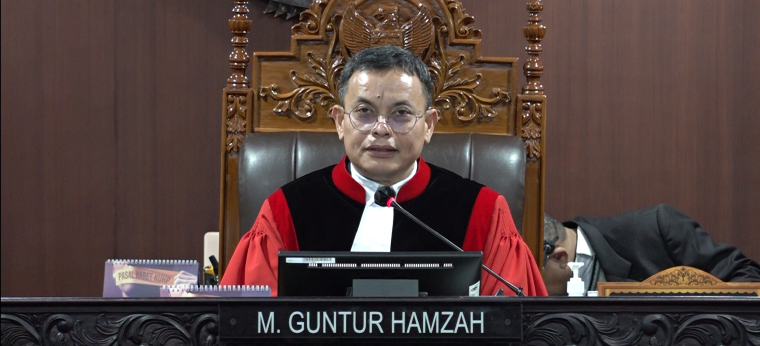
Constitutional Justice M. Guntur Hamzah chairing the second judicial review hearing of the Law on the Legislative Branch, Monday (5/19/2025). Photo by MKRI.
JAKARTA (MKRI) — Advocate Zico Leonard Djagardo Simanjuntak, the Petitioner of case No. 42/PUU-XXIII/2025, said the faction and House of Representatives (DPR) member’s verbal express approval or rejection requested by the plenary meeting chair should be under the one-man-one-vote system. This is because, he argued, House members are obliged to exercise their voting rights as representatives of the people during second-level discussion for decision-making by the House and the Government in the House plenary meetings.
“We also emphasize the importance of the one-man-one-vote system,” said legal counsel Putu Surya Permana Putra at the petition revision hearing on Monday, May 20, 2025.
Jenderal Achmad Yani University student Zidane Azharian Kemal Pasha was added as the Petitioner II in this case. The Petitioners also changed the articles to be reviewed. They now challenge Article 171 paragraph (1) letter b of Law No. 17 of 2014 on the People’s Consultative Assembly (MPR), House of Representatives (DPR), Regional Representatives Council (DPD), and Regional Legislative Council (DPRD), also known as the MD3 Law, which reads, “(1) Level-II discussion shall be a decision-making by the DPR and the Government in a DPR plenary meeting with the following activities: verbal statements of approval or rejection by each faction and member of the DPR requested by the chair of the plenary meeting.”
The Petitioners argued that the decision-making system as stipulated in the article, which authorizes factions to express approval for bills, should be directed towards the application of the one-man-one-vote principle. Each House member has and is required to use their individual vote as a representative of the people.
This principle reflects the principle of democratic and responsible representation. This is because House members are not merely extensions of factions or political parties, but rather act on the mandate of the people who elected them directly in general elections.
The one-man-one-vote system in the legislature is the main prerequisite to ensure that the votes produced in the legislative process truly reflect the representation of the plural people. When a collective system based on factions is dominant, there is a concentration of authority in the internal party structure that disregards the dynamics and diversity of views in parliament.
The dominance of factions in legislative decision-making creates a distance between House members and their voters. As a result, they no longer feel directly responsible to the people, but are more loyal to the interests of the party or faction elite. This is very dangerous for the sustainability of substantial democracy because it weakens the principles of accountability and representation.
Therefore, in the peitums, the Petitioners request that the Court declare the phrase “statements of approval or rejection by each faction and member of the DPR” in Article 171 paragraph (1) letter b of the MD3 Law unconstitutional and not legally binding if not interpreted as “each faction may provide their opinion, while the approval and rejection shall be expressed by all DPR members through voting (one-man-one-vote) at the plenary meeting for the discussion of a bill of law.”
In addition, they requested that Article 229 of the MD3 Law, which reads “All meetings in the DPR shall essentially be open, except for certain meetings that are declared closed,” be reinterpreted to mean “All DPR meetings shall be hold in the DPR buildings, unless there are certain circumstances preventing the facilities in all meeting rooms in the DPR buildings from being used or functioning properly and if they are hold for hearing meetings in certain regions for the sake of meaningful public participation and in the event that the meetings take place outside of the DPR buildings, the DPR shall inform the public the reasons for it.”
Also read: House Convenes at Hotel, Advocate Challenges Law on Legislative Branch
The Petitioners question the controversial discussions of the TNI Law (Law of the Indonesian National Armed Forces), which the House had discussed at a five-star hotel, instead of the parliament complex that is full of facilities.
They also challenge the phrase “simultaneously” in Article 347 paragraph (1) of Law No. 7 of 2017 on General Elections. They wish that it be interpreted to mean that election voting take place simultaneously according to the type of election, i.e. legislative and executive elections, each of which is held every five years, and at different times with an interval of 2.5 (two and a half) years between the legislative and executive election. They argued that the concept of simultaneity does not have to be interpreted as on the same day and date, but in a balanced cycle of power.
Constitutional Justices M. Guntur Hamzah chaired the session alongside Constitutional Justices Daniel Yusmic P. Foekh and Asrul Sani. Justice Guntur stated that the addition to the petitioner would be reported to the other constitutional justices at a deliberation meeting.
Author : Mimi Kartika
Editor : Lulu Anjarsari P.
PR : Andhini Sayu Fauzia
Translator : Yuniar Widiastuti (NL)
Disclaimer: The original version of the news is in Indonesian. In case of any differences between the English and the Indonesian versions, the Indonesian version will prevail.
Monday, May 19, 2025 | 16:17 WIB 259