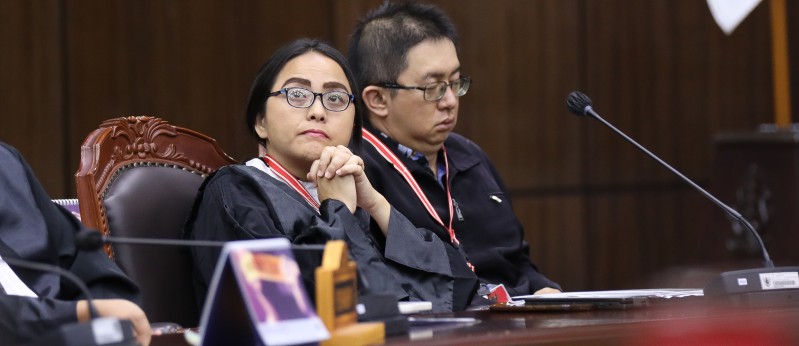
Fransisca Jeane, legal counsel, and Andy Savero, Principal Petitioner, during the ruling hearing on the judicial review of Law No. 33 of 2014 on Halal Product Assurance, Wednesday (5/14/2025). Photo by MKRI/Ifa.
JAKARTA (MKRI) — The Constitutional Court (MK) has ruled that the petition for Case No. 17/PUU-XXIII/2025 on the judicial review of Law No. 33 of 2014 on Halal Product Assurance (UU JPH) against the 1945 Constitution of the Republic of Indonesia (UUD NRI) cannot be accepted (inadmissible). According to the Court, the Petitioner did not outline clear legal arguments regarding the conflict between the norms of the JPH Law and the constitution.
"Declaring that the Petitioner's petition for Case No. 17/PUU-XXIII/2025 inadmissible," said Chief Justice Suhartoyo in the ruling hearing on Wednesday, May 14, 2025 in the Plenary Courtroom of the Court, Jakarta.
Constitutional Justice Saldi Isra said that there was a delay in submitting the revised petition so that the Court used the initial petition to be examined and reviewed. In the Court's legal considerations, the Petitioner in his petition did not outline clear and adequate legal arguments regarding the conflict between the norms of the articles in Law 33 of 2014 and the articles in the 1945 Constitution of the Republic of Indonesia which were used as the basis for the judicial review. In addition, the formulation of the petitum is unusual and does not comply with the provisions stipulated in Constitutional Court Regulation No. 2 of 2021 on Procedures in Judicial Review Cases.
Also read:
Petitioners Want Halal Assurance Law Annulled
Halal Product Assurance Law Said to Harm Petitioner's Constitutional Rights
For information, the Petitioners are self-employed Kiki Supardji (47) and a healer named Andy Savero (41). They said that the provisions of Article 4 of the JPH Law regarding products entering, circulating, and traded in the territory of Indonesia must be halal certified are discriminatory because they have limited the rights of non-Muslim consumers to choose products according to their beliefs.
According to the Petitioners, the provision burdens business actors, especially MSMEs, because there are administrative sanctions for business actors who do not comply with halal certification obligations. The Petitioners consider that the Halal Product Assurance Law is implicitly implemented by submitting to Islamic law so that it is not in accordance with the practices they adhere to and results in violations of constitutional rights, especially Article 28D point 1, Article 28E points 1 and 2, Article 28I point 2, Article 29 point 2 of the 1945 Constitution of the Republic of Indonesia.
In the revision of his petition, the Petitioner focused on the issue of Article 4 and Article 26 paragraph (2) of the JPH Law as amended by Law No. 6 of 2024 on Government Regulation in Lieu of Law No. 2 of 2022 on Job Creation. Article 4 reads "Products that enter, circulate, and are traded in the territory of Indonesia must be halal certified." Article 26 paragraph (2) reads "Business Actors as referred to in paragraph (1) are required to include a statement that the Product is not halal."
Meanwhile, Article 1 paragraph (2) of the JPH Law defines Halal Products as products that have been declared halal in accordance with Islamic law. Meanwhile, the Petitioners, namely entrepreneur Kiki Supardji (47) and a healer named Andy Savero (41), claim to be Christian goods and services business actors whose understanding and practice of faith or creed regarding the implementation of halal/haram differs from Islamic law.
The Petitioners consider the phrase “mandatory” in Article 4 of the JPH Law and Article 26 paragraph (2) of the JPH Law which implicitly fully submits to Islamic law will cause the Petitioners to be disobedient to their Christian faith. The two provisions are considered discriminatory because they have limited the rights of non-Muslim consumers to choose products according to their beliefs. According to the Petitioners, these provisions burden business actors, especially MSMEs, because there are administrative sanctions for business actors who do not comply with the obligation to halal certification.
In their petitum, the Petitioners requested the Court to grant the petition in its entirety. They also requested the Court to declare that the phrase "mandatory" in Article 4 and Article 26 paragraph (2) of the JPH Law as amended by the Job Creation Law is contrary to the 1945 Constitution of the Republic of Indonesia and has no binding legal force as long as it is interpreted as applying to people of religions other than Islam.(*)
Author : Mimi Kartika
Editor : Lulu Anjarsari P.
PR : Andhini S.F.
Translator : Donny Yuniarto
Disclaimer: The original version of the news is in Indonesian. In case of any differences between the English and the Indonesian versions, the Indonesian version will prevail.
Wednesday, May 14, 2025 | 14:59 WIB 342