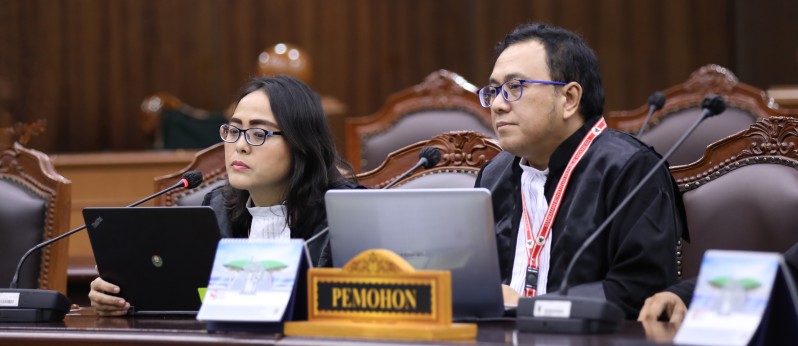
The Petitioners’ legal counsels conveying the subject matter at the preliminary hearing for the judicial review of the Halal Assurance Law, Thursday (3/13/2025). Photo by MKRI/Ifa.
JAKARTA (MKRI) — Two citizens have filed for the material judicial review of Law No. 33 of 2014 on Halal Product Assurance (JPH). They believe the Law should only apply to Muslims as it regulates matters under the Islamic sharia.
“We believe that Law No. 33 of 2014 on Halal Product Assurance should only be imposed on Muslims, who are subject to the creed on halal and haram. While we represent the Petitioners, who are mostly non-Muslims, we object to this Law being applied to entrepreneurs who do have different beliefs,” said legal counsel Yonathan Ambat Eka at the preliminary hearing on Thursday, March 13, 2025.
The Petitioners are entrepreneur Kiki Supardji (47) and healer Andy Savero (41). They argue that Article 4 of the JPH Law—which stipulates that products that enter, circulate, and are traded in the territory of Indonesia must be certified halal—is discriminatory as it has limited the rights of non-Muslim consumers to select products according to their beliefs.
They also argue that the provision has put a burden on business actors, especially MSMEs, due to administrative sanctions for non-compliance with the mandatory halal certification. The provision is contrary to Article 33 of the 1945 Constitution.
They asserted that Article 10 paragraph (1) on the implementation of halal certification controlled by the Halal Certification Agency (BPJPH) in collaboration with the Indonesian Ulema Council (MUI) could potentially lead to monopolistic practices. This, they added, hinders fair business competition and is contrary to Law No. 5 of 1999 on Anti-Monopoly.
The Petitioners also question Article 14 paragraph (1) on halal auditors, Article 17 on raw materials, Article 26 on mandatory non-halal information on products, and Article 48 on the imposition of administrative sanctions on business actors who do not register for halal certification. According to them, the JPH Law contradicts a number of articles in the 1945 Constitution and could potentially violate the principle of social justice, has negative impacts on business actors, and has imposed certain religious standards universally without considering the diversity of beliefs in Indonesian society.
In their petitums, the Petitioners requested the Court to grant the petition in its entirety. They also asked the Court to declare the JPH Law contrary to Pancasila, the Preamble to the 1945 Constitution, the Anti-Monopoly Law, and the Trade Secrets Law, and to revoke or cancel the entire Law.
The hearing for case No. 17/PUU-XXIII/2025 was presided over by Constitutional Justices Arief Hidayat (panel chair), Enny Nurbaningsih, and Asrul Sani. Justice Constitutional Justice Enny Nurbaningsih said that the Petitioners had not followed the petition format set out in the Constitutional Court Regulation (PMK) No. 2 of 2021 on the procedure for judicial review.
“The format of petition for judicial review is actually simple. The key is the Court’s authority, the elaboration of legal standing, and the reasons for the petition or posita, ending with the petitums,” she explained.
Author : Mimi Kartika
Editor : Lulu Anjarsari P.
Translator : Yuniar Widiastuti (NL)
Disclaimer: The original version of the news is in Indonesian. In case of any differences between the English and the Indonesian versions, the Indonesian version will prevail.
Thursday, March 13, 2025 | 14:48 WIB 237