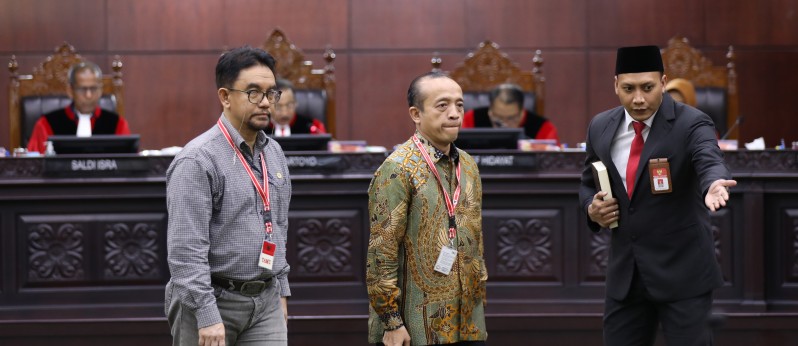
Government witnesses Bambang Hendroyono and Rinekso Soekmadi after being sworn in to testify at the formal judicial review hearing of Law No. 32 of 2024 on the Conservation of Biological Natural Resources and Their Ecosystems, Tuesday (5/6/2025) in the plenary courtroom. Photo by MKRI/Ifa.
JAKARTA (MKRI) — The Constitutional Court (MK) held another judicial review hearing of Law No. 32 of 2024 on the Amendment to Law No. 5 of 1990 on the Conservation of Biological Natural Resources and Their Ecosystems (KSDAHE Law) on Tuesday, May 6, 2025, in the plenary courtroom. The petition was filed by the Indigenous Peoples Alliance of the Archipelago (AMAN) and several other parties. The hearing was scheduled to hear the testimony of a presidential witness.
Case No. 132/PUU-XXII/2024 was presided over by Chief Justice Suhartoyo along with the other eight constitutional justices. Presidential witness Bambang Hendroyono, who currently serves as Senior Advisor to the Minister of Forestry, testified as someone who directly witnessed, observed, and experienced the legislative process of the law, from planning and drafting to deliberation, ratification, and promulgation.
“At the time of the lawmaking, I served as Secretary-General of the Ministry of Environment and Forestry (KLHK) and, for a year, also as Acting Director General of the Conservation of Biological Natural Resources and Their Ecosystems,” he said.
He explained that during the planning stage, he received official documents from the House of Representatives (DPR RI) outlining the national legislative program (Prolegnas), which indicated that the bill to amend Law No. 5 of 1990 had been prioritized on the national legislative agenda.
“All of these decisions formed a legal basis indicating that the planning stage had followed proper procedures. I was directly involved in drafting the academic paper of the bill to amend Law No. 5 of 1990. This process was not carried out solely by the DPR RI, but also involved the government through inter-ministerial coordination, including KLHK, the Ministry of Marine Affairs and Fisheries, the Ministry of Agriculture, the Ministry of Home Affairs, and the Ministry of Law and Human Rights,” Bambang asserted.
He added that the process was supported by documents and official letters, such as a letter from the DPR RI Speaker dated July 7, 2022, submitting the bill to the President, and a letter from the Minister of State Secretariat dated July 25, 2022, requesting a joint discussion of the bill and list of inventory problems (DIM) within 60 days.
“I was also directly involved in several drafting forums, including an expert discussion meeting on April 13, 2022, at the Westin Jakarta Hotel and an FGD at the Ayana Mid Plaza Hotel. Academics, experts, and stakeholders provided feedback and suggestions that were reflected in the DIM. The DIM formulated by the relevant ministers showed strong cross-sectoral commitment and shared understanding,” he explained.
Another government witness, Rinekso Soekmadi, elaborated on his involvement in the first-stage deliberation. “I attended the public hearing (RDPU) with academics organized by the Working Committee of Commission IV of the DPR RI on April 10, 2023, which took place in Commission IV’s hearing room as per the invitation dated April 6, 2023,” he said.
He emphasized that the meeting was also streamed live via YouTube, and was attended by experts in biodiversity and wildlife conservation from IPB University and others.
Also read:
Court Hears Criticism on Biodiversity Law’s Lack of Transparency and Public Participation
Govt, House Confirm Customary Law Communities’ Participation in Biodiversity Law
Court Bans Any Govt Regulations on Biodiversity and Ecosystems Conservation
Petitioners Revise Petition on Biodiversity and Ecosystems Conservation Law
Formation of Conservation of Biodiversity and Ecosystem Law Challenged
The petition for Case No. 132/PUU-XXII/2024 was filed by AMAN, the Indonesian Forum for the Environment (WALHI), the People's Coalition for Fisheries Justice (KIARA), and a farmer named Mikael Ane. They are challenging the formal validity of Law No. 32 of 2024 on the Amendment to Law No. 5 of 1990 on the Conservation of Biological Natural Resources and Their Ecosystems.
At the preliminary hearing on Monday, October 7, 2024, the Petitioners’ legal counsel Gregorius Bruno Djako argued that the law is ineffective and lacks utility, particularly for indigenous peoples and local communities as legal subjects affected by the implementation of the KSDAHE Law. He highlighted several substantive issues that could negatively impact these communities living in and around conservation areas.
The Petitioners claimed that the failure to involve affected parties and environmental stakeholders during the lawmaking process resulted in a law with vague objectives, which failed to take into account the legal subjectivity of indigenous peoples and local communities directly related to biodiversity ecosystems.
On the contrary, the KSDAHE Law opens the door to criminalization, rights violations, discrimination, and neglect of the rights of indigenous peoples and local communities. Therefore, the Petitioners argued that the law violates the principle of clarity of purpose.
In their petitum, the Petitioners requested the Court to declare the KSDAHE Law contrary to the 1945 Constitution and, therefore, not legally binding. They also asked the Court to reinstate Law No. 5 of 1990 and Article 33 and Article 69(c) of Law No. 17 of 2019 on Water Resources.
Read more : The Petition fo case 132/PUU-XXII/2024
Author: Utami Argawati
Editor: N. Rosi
PR: Tiara Agustina
Translator: Yuanna Sisilia
Disclaimer: The original version of this news article is in Indonesian. In case of any differences between the English and Indonesian versions, the Indonesian version shall prevail.
Tuesday, May 06, 2025 | 16:06 WIB 426