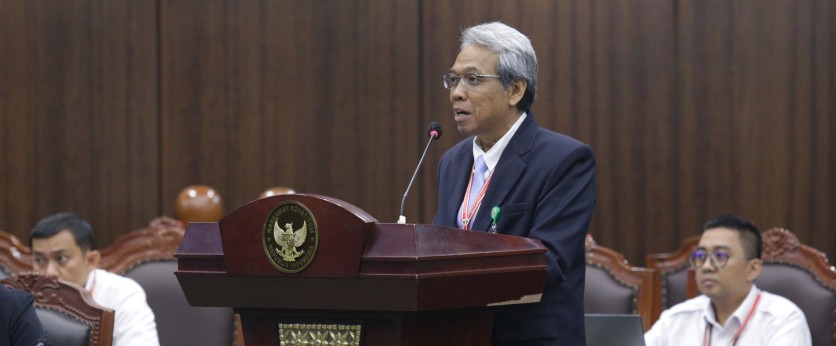
Ministry of Environment and Forestry’s Director-General of Natural Resources and Ecosystem Conservation Satyawan Pudyatmoko at a judicial review hearing of Law No. 32 of 2024 on Biodiversity and Ecosystems Conservation, Monday (4/28/2025). Photo by MKRI/Bayu.
JAKARTA (MKRI) — The Constitutional Court (MK) held another formal judicial review hearing of Law No. 32 of 2024 on the Amendment to Law No. 5 of 1990 on the Conservation of Biodiversity and Their Ecosystems (KSDAHE Law) on Monday, April 28, 2025. The petition was filed by the Indigenous Peoples of the Archipelago (AMAN) and several others. The session was to hear the House of Representatives (DPR) and the President (Government).
The hearing for case No. 132/PUU-XXII/2024 was presided over by Chief Justice Suhartoyo and the other eight constitutional justices. House Commission III member Rudianto Lallo stated that the Biodiversity Law has supported indigenous peoples in the conservation of biodiversity and their ecosystems.
“Article 37 paragraph (3) of the a quo Law stipulates that indigenous peoples are involved in the conservation of biodiversity and their ecosystems. The general provisions of the KSDAHE Law mentions that the a quo Law was formed to increasing the people’s participation in the conservation of biodiversity and their ecosystems, including increasing the participation of indigenous peoples surrounding nature reserves, nature conservation, coastal areas, and small islands,” he said.
Lallo also said that the Petitioners’ argument of the ineffectiveness of the Biodiversity Law was groundless. He explained that any objection should be based on the “consideration” part or the general provisions of the Law, following the Constitutional Court’s legal consideration in Decision No. 25/PUU-XX/2022.
“What the principles of effectiveness and usefulness mean under must be clearly [defined]. Based on the [Constitutional Court] decision, if the Petitioners argue that the formation of the a quo Law is against the principles of effectiveness and usefulness, they should argue based on what is in the consideration [of the Law] and the general provisions. Therefore, the Petitioners’ argument was groundless. This is in line with the legal consideration in Decision No. 25/PUU-XX/2022,” he emphasized.
Lallo further explained that since the Petitioners’ objection is more related to principle of clarity of formulation of the Law, i.e. its drafting, diction, and language clarity. Therefore, the issue falls into the realm of material review, not formal review. This is in accordance with the Constitutional Court’s consideration in Decision No. 91/PUU-XVIII/2020.
At the hearing, the Government, represented by the Director-General of Natural Resources and Ecosystem Conservation (KSDAE) of the Ministry of Environment and Forestry Satyawan Pudyatmoko, also emphasized that the Biodiversity Law has clearly regulated community participation, including indigenous peoples. “The Law has been proven to contain norms that accommodate indigenous peoples, especially those in the vicinity of nature reserves and nature conservation areas,” Satyawan said.
Responding to the Petitioners’ complaint regarding the unavailability of 20 documents relating to the lawmaking meetings, Satyawan explained that those transcripts of the working committee meetings are confidential under Article 282 and Article 302 paragraph (5) of House Regulation No. 1 of 2020 on Rules of Procedure. Therefore, access to those documents can only be granted through a written request in accordance with the applicable laws and regulations.
Also read:
Formation of Conservation of Biodiversity and Ecosystem Law Challenged
Petitioners Revise Petition on Biodiversity and Ecosystems Conservation Law
Court Bans Any Govt Regulations on Biodiversity and Ecosystems Conservation
The case was filed by the Indigenous Peoples of the Archipelago (AMAN), the Indonesian Forum for Living Environment (WALHI), the People’s Coalition for Fisheries Justice (Kiara), and Bernama Mikael Ane, a farmer. They challenge the formation of Law No. 32 of 2024 on the Amendment to Law No. 5 of 1990 on the Conservation of Biodiversity and Their Ecosystems.
At the preliminary hearing on Monday, October 7, legal counsel Gregorius Bruno Djako stated that the Petitioners believe Law No. 32 of 2024 is neither beneficial, effective, nor useful, especially for indigenous peoples and local communities as legal subjects in its implementation. This is because substantive problems will certainly arise and be experienced by indigenous peoples or local communities living in and around conservation areas.
He argued that the exclusion of affected parties and parties concerned with Indonesia’s biodiversity and their ecosystems has caused Law No. 32 of 2024 to not have any clear objectives, such as an understanding of ecosystems that does not touch the level of legal subjects closely related to the ecosystem of Indonesia's biological natural resources in the case of indigenous peoples and local communities living in and around conservation areas designated by the state.
Instead, it opens more loopholes for potential criminalization, deprivation of rights, discrimination, and neglect of the rights of indigenous peoples and local communities living in and around conservation areas. Therefore, it is clear that the clarity of purpose of the formation of Law No. 32 of 2024 is flawed.
In their petitums, the Petitioners request the Court to declare Law No. 32 of 2024 unconstitutional and not legally binding. They also ask the Court to declare Law No. 5 of 1990 as well as Article 33 and Article 69 letter c of Law No. 17 of 2019 on Water Resources valid.
Read the revised petition for case No. 132/PUU-XXII/2024 here.
Author : Utami Argawati
Editor : N. Rosi
PR : Tiara Agustina
Translator : Yuniar Widiastuti (NL)
Disclaimer: The original version of the news is in Indonesian. In case of any differences between the English and the Indonesian versions, the Indonesian version will prevail.
Monday, April 28, 2025 | 15:52 WIB 449