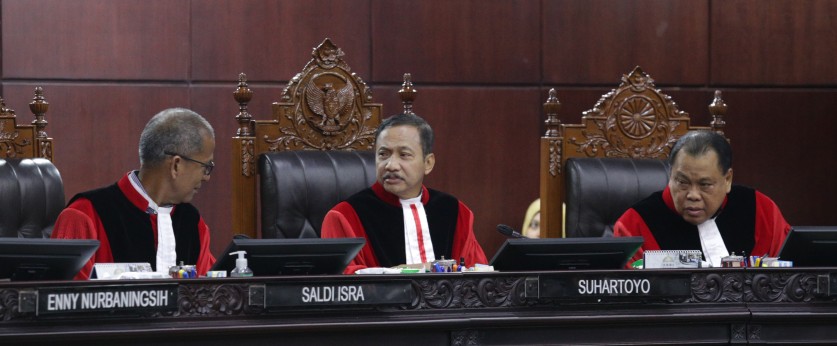
Chief Justice Suhartoyo during the Decision Pronouncement Hearing of Case No. 2/PUU-XXIII/2025, Tuesday (29/4/2025). Photo by MKRI/Bayu.
Jakarta (MKRI) – The Petitioner could not elaborate on clear and proper legal arguments, especially related to the norm contradiction requested in the judicial review. After perusing the Petitioner’s petitions, the description of the interpretation was the stipulation of the norm of the law. Hence, such petitions made it difficult fot the Court to understand the matter requested by the Petitioner.
Such were the legal considerations pronounced by Deputy Chief Justice Saldi Isra regarding material judicial review petition of Article 162 paragraph (3) of Law No. 10 of 2016 on the Second Amendment to Law No. 1 of 2015 on the Stipulation of the Government Regulation in Lieu of Law No. 1 of 2014 on the Election of Governors, Regents, and Mayors into Law (Regional Election Law). The decision pronouncement hearing of Case No.2/PUU-XXIII/2025 was held on Tuesday, April 29, 2025 at the Plenary Courtroom.
Moreover, Deputy Chief Justice Saldi Isra mentioned that the Court considered that the Petitioner’s petition unclear and vague. Despite the Court had the authority to decide on the petition, because the petition was unclear and vauge, regarding the petitioner’s legal standing, the subject matter of the petition, and other was not considered further due to no relevance.
“Decide, the Petitioner’s Petition No. 2/PUU-XXIII/2025 cannot be accepted,” Chief Justice Suhartoyo read out the Ruling of the petition filed by Paber SC Simamora who works as a civil servant.
Also read:
Questioning Six Months Waiting Time for Elected Regional Heads to Inaugurate Regional Officials
Civil Servant Strengthen Legal Standing on Regulation to Appoint Regional Officials
During the preliminary hearing on Wednesday, March 5, 2025, the Petitioner questioned the prohibition on the elected regional heads shuffling regional officials six months after their inauguration and said they must obtain permission from the minister. The Petitioner argued that Article 162 paragraph (3) of the Pilkada Law was contrary to Article 1 paragraph (3), Article 18 paragraphs (2) and (4), Article 28C paragraph (2), and Article 28D paragraphs (1) and (3) of the 1945 Constitution of the Republic of Indonesia.
The Petitioner stated that the existence of the Governors, Regents, and Mayors who acted as superiors as well as heads of the government at the level of provinces, regencies/cities have the same authorities as ministers and other institution leaders as stipulated in Article 29 paragraph (1) of Law No. 20 of 2023 on State Civil Apparatus (ASN Law), Hence, the obligation to obtain permission from the Ministry of Home Affairs to shuffle the officials within their scope of jurisdiction is not in line with Article 18 paragraph (4) of the 1945 Constitution.
Moreover, the position of the Regent as the head of government in the Regency also serves as a supervising official since the inauguration and has the right to conduct supervisory duties to all civil servants in his/her region without needing approval from the Ministry of Home Affairs. The authority as the Supervising Official is stipulated in Article 1 of Law No. 30 of 2014 on the Government Administration. Hence, the Petitioner deemed the provision of Article 162 paragraph (3) of the Pilkada Law has created legal uncertainty for him. The norms can also potentially eliminate the opportunity to improve the welfare of newly appointed officials because they need to wait for six months to obtain written approval from the Ministry of Home Affairs.
Author: Sri Pujianti
Editor: Lulu Anjarsari P.
Humas: Tiara Agustina
Translator: Rizky Kurnia Chaesario
Disclaimer: The original version of the news is in Indonesian. In case of any differences between the English and the Indonesian versions, the Indonesian version will prevail.
Tuesday, April 29, 2025 | 10:10 WIB 151