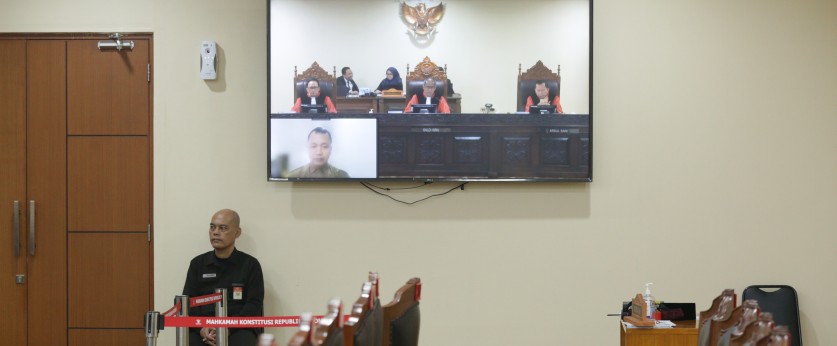
Petitioner during the Petition Revision of Case No. 2/PUU-XXIII/2025, Tuesday (18/3/2025). Photo by MKRI/Bayu.
Jakarta (MKRI) – The Constitutional Court held the second hearing of material judicial review of Article 162 paragraph (3) of Law No. 10 of 2016 on the Second Amendment to Law No.1 of 2015 on the Stipulation of Government Regulation in Lieu of Law No. 1 of 2014 on Elections of Governors, Regents, and Mayors into Law (Pilkada Law). Paber SC Simamora, who is a civil servant, attended the hearing online while delivering the revision of the petition of Case No. 2/PUU-XXIII/2025 on Tuesday, March 18, 2025.
The petitioner amended five points in his petition, among other things, the articles in the 1945 norms, which became the basis of testing, the Court’s authorities, legal standing, petition reasonings, and petitums. The Petitioner explained that initially six articles became the basis of testing, but it was changed to four norms, namely Article 1 paragraph (3), Article 18 paragraph (2), Article 28C paragraph (2), and Article 28D paragraph (3) of the 1945 Constitution. Then, for the legal standing, it was mentioned the Petitioner was an Indonesian citizen and civil servant as stipulated in Article 4 paragraph (2) letter a of the Constitutional Court Regulation No. 2 of 2021, which listed the Petitioner’s constitutional rights provided by the 1945 Constitution. The constitutional losses were specific and actual because the Pilkada Law limited the regulation up until the inauguration of the elected regional heads; meanwhile, Article 162 paragraph (3) of the Law regulated the action taken by inaugurated heads.
“The obligation to obtain written approval from the Minister of Home Affairs resulted in the authorities of Governors, Regents, and Mayors as heads of government in the Provinces, Regencies/Cities becoming incomplete. In this case, the Petitioner in his capacity as a civil servant has the potential to be harmed, and his rights based on Article 28C paragraph (2) and Article 28D paragraph (3) of the 1945 Constitution are not guaranteed due to the obligation to obtain the written approval from the Minister of Home Affairs for governments, regents, and mayors who will reshuffle their officials six months after their inauguration,” Paber mentioned during the hearing led by Deputy Chief Justice Saldi Isra, along with Justice Ridwan Mansyur and Justice Arsul Sani at the Panel Courtroom.
In other words, Paber added, the obligation to obtain written approval from the Minister of Home Affairs not only causes the absence of legal certainty under the law but also results in the loss of the petitioner’s self-improvement opportunity to fight rights collectively to build the nation and state, rights to obtain recognition, guarantee, protection, legal and fair legal certainty as well as equal treatment before the law in the government.
The Petitioner also mentioned the revision in the petitums by requesting the Court to declare Article 162 paragraph (3) of Law No. 10 of 2016 on the Second Amendment to Law No. 1 of 2015 on the Stipulation of Government Regulation in Lieu of Law No. 1 of 2014 on the Elections of Governor, Regens, and Mayor into Law contrary to the 1945 Constitution conditionally and does not have legally binding power as long as it is interpreted as “Governors, Regents, and Mayors who will reshuffle officials in the Provincial or Regency/City government within six months since inauguration must obtain written approval from the Minister.”
Also read: Questioning Six Months Waiting Time for Elected Regional Heads to Inaugurate Regional Officials
During the preliminary hearing on Wednesday, March 5, 2025, the Petitioner questioned the prohibition on the elected regional heads shuffling regional officials six months after their inauguration and said they must obtain permission from the minister. The Petitioner argued that Article 162 paragraph (3) of the Pilkada Law was contrary to Article 1 paragraph (3), Article 18 paragraphs (2) and (4), Article 28C paragraph (2), and Article 28D paragraphs (1) and (3) of the 1945 Constitution of the Republic of Indonesia.
The Petitioner stated that the existence of the Governors, Regents, and Mayors who acted as superiors as well as heads of the government at the level of provinces, regencies/cities have the same authorities as ministers and other institution leaders as stipulated in Article 29 paragraph (1) of Law No. 20 of 2023 on State Civil Apparatus (ASN Law), Hence, the obligation to obtain permission from the Ministry of Home Affairs to shuffle the officials within their scope of jurisdiction is not in line with Article 18 paragraph (4) of the 1945 Constitution.
Moreover, the position of the Regent as the head of government in the Regency also serves as a supervising official since the inauguration and has the right to conduct supervisory duties to all civil servants in his/her region without needing approval from the Ministry of Home Affairs. The authority as the Supervising Official is stipulated in Article 1 of Law No. 30 of 2014 on the Government Administration. Hence, the Petitioner deemed the provision of Article 162 paragraph (3) of the Pilkada Law has created legal uncertainty for him. The norms can also potentially eliminate the opportunity to improve the welfare of newly appointed officials because they need to wait for six months to obtain written approval from the Ministry of Home Affairs.
Based on all the arguments mentioned, the Petitioner asked that the Constitutional Court decide on the petition, with the verdict as follows: to grant the petitioner’s petition in its entirety; to declare Article 162 paragraph (3) of Law No. 10 of 2016 on the Election of Regional Heads contradicts the 1945 Constitution of the Republic of Indonesia, and hence, does not have legally binding power. To rule the Decision to be published in the State Gazette of the Republic of Indonesia as required.(*)
Author: Sri Pujianti
Editor: Lulu Anjarsari P.
Humas: Tiara Agustina
Translator: Rizky Kurnia Chaesario
Disclaimer: The original version of the news is in Indonesian. In case of any differences between the English and the Indonesian versions, the Indonesian version will prevail.
Tuesday, March 18, 2025 | 10:17 WIB 216