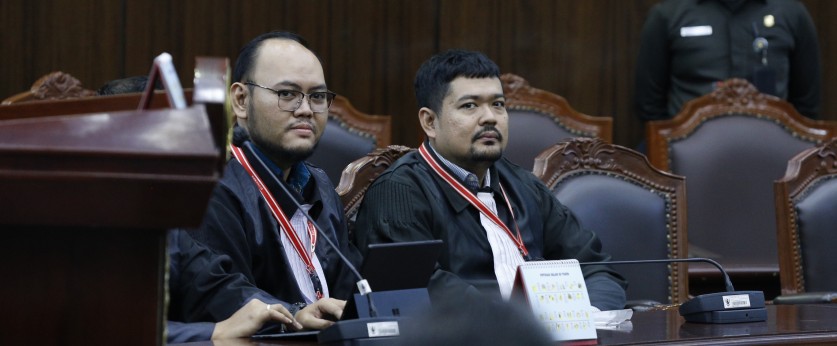
The Petitioners’ legal counsels at the pronouncement of Decision No. 87/PUU-XXI/2023, Friday (11/29/2024). Photo by MKRI/Bayu.
JAKARTA (MKRI) — The Corruption Eradication Commission (KPK) is authorized to coordinate and control the inquiry, investigation, and prosecution of corruption crimes committed jointly by individuals subject to military and general courts, as long as it initiates/discovers the cases. Such is the new interpretation of Article 42 of Law No. 30 of 2002 on the KPK in Decision No. 87/PUUXX/2023. The ruling for the petition filed by Gugum Ridho Putra was delivered at a ruling hearing on Friday, November 29, 2024.
The Court granted part of the Petitioner’s petition. Chief Justice Suhartoyo stated that Article 42 of the KPK Law (“The KPK shall be authorized to coordinate and control inquiry, investigation, and prosecution against corruption committed by individuals who are under the jurisdiction of military and public justice”) is unconstitutional and not legally binding.
“If it is not interpreted as ‘The KPK is authorized to coordinate and control the inquiry, investigation, and prosecution of corruption crimes committed jointly by individuals subject to military and general courts, as long as the law enforcement process is handled from the beginning or initiated/discovered by the KPK,’” said Chief Justice Suhartoyo at the hearing in the plenary courtroom.
In the legal opinion delivered by Constitutional Justice Arsul Sani, the Court affirmed Article 42 of the KPK Law. Therefore, for the sake of legal certainty, the Court stated, the article must be understood as a provision that authorizes the KPK to conduct inquiry, investigation, and prosecution of corruption cases, as long as the case is discovered/initiated by the KPK.
This means, Justice Arsul continued, as long as the case is initiated by the KPK, it will be handled by the KPK until otherwise there is a court decision that has permanent legal force. Conversely, for such cases committed by individuals subject to military justice discovered and initiated by other law enforcement agencies, these agencies has no obligation to refer the cases to the KPK.
“Thus, based on the provision of Article 42 of Law No. 30 of 2002, basically there are no conditions for the provision in question that reduce the KPK’s authority in handling corruption cases committed jointly by individuals subject to military and general justice, as long as the law enforcement process of the case is handled from the beginning or initiated/discovered by the KPK. Therefore, in this case the KPK does not have any obligation to transfer corruption cases to Military Prosecution Office and Military Court,” Justice Arsul explained.
The Court holds that in relation to other articles petitioned for review, Article 42 of the KPK Lawes does not mean hamper the procedural law that applies to connexity trials, especially those regulated in the KUHAP (Criminal Procedure Code). This is because Article 42 of the KPK Law regulates the KPK’s authority in carrying out inquiry, investigation, and prosecution of corruption crimes committed jointly by people subject to military and general courts. This means, it does not interfere with the validity of other norms, which the Petitioner argued. Furthermore, given the principle lex specialis derogat lex generalis and that the KPK Law specializes in corruption crimes, the provisions in the KPK Law be prioritized as the legal basis and reference in handling corruption crimes.
“Therefore, with such affirmation, there should be no more doubt for the KPK to exercise its authority if it handles cases of criminal acts of corruption committed jointly by individuals subject to military and general justice based on the provision of Article 42 of Law No. 30 of 2002 in question, as long as the law enforcement process is handled from the beginning or initiated/discovered by the KPK,” Justice Arsul explained.
He added that the Court has emphasized that Article 42 of Law No. 30 of 2002 must be understood as a provision that gives KPK the authority to inquire, investigate, and prosecute corruption cases, as long as it handles the case from the beginning or initiates/discovers it. Therefore, according to the Court, it is irrelevant to assess the constitutionality of other articles in the Criminal Procedure Code and Law No. 31 of 1997 petitioned for review by the Petitioner, i.e. Article 89 paragraphs (1), (2), and (3); Article 90 paragraphs (1) and (3); Article 91 paragraphs (1), (2), and (3); Article 92 paragraph (1), Article 93 paragraphs (1), (2), and (3); and Article 94 paragraph (5) of the Criminal Procedure Code; and Article 198 paragraphs (1), (2), (3); Article 199 paragraphs (1) and (3); Article 200 paragraphs (1), (2), and (3); Article 201 paragraph (1), Article 202 paragraphs (1), (2), and (3); and Article 203 paragraph (5) of Law No. 31 of 1997.
However, the Court holds that the applicability of these articles refers to the a quo decision. Similarly, the Petitioner’s petitum requesting that Article 26 paragraph (4) of Law No. 30 of 2002 be interpreted as an obligation to establish a special division under the Enforcement Division in charge of handling inquiry, investigation, and prosecution of connexity corruption is not essential to be formed immediately, considering that the KPK can still establish a special division under the Enforcement Division.
However, even if it is required, as argued by the Petitioner, it is under the legislatures’ jurisdiction, considering the KPK’s needs in carrying out its duties and authority. Therefore, it is important for the Court to emphasize that the legislatures would need to immediately amend the KUHAP and the laws regulating the KPK, as well as those regulating military justice. Based on the description of the legal considerations above, the Court is of the opinion that Article 42 of Law No. 30 of 2002 is unconstitutional and not legally binding if not interpreted as, “The KPK shall be authorized to coordinate and control inquiry, investigation, and prosecution against corruption committed by individuals who are under the jurisdiction of military and public justice, as long as the case is handled from the beginning of the law enforcement process or is initiated/discovered by the KPK.”
“However, because the interpretation of the a quo norm of Article 42 of Law No. 30 of 2002 is not as requested by the Petitioner, the Petitioner’s argument is legally grounded in part,” Justice Arsul stressed.
Also read:
Petitioner Wishes KPK’s Authority in Connexity Corruption Offenses Be Strengthened
Petitioner of KPK Law Revises Legal Standing
KPK’s Authority in Coordinating Prosecution of Connexity Corruption Crimes
Expert: Mechanism of Connexity, Case Handling as a Whole
KPK Explains Splitzing and Connexity Mechanisms in Handling Corruption
Govt Expert: Prosecution, Military Court, KPK Coordinate in Handling Corruption Cases
Supreme Court, Prosecutors Association Explain Handling of Connexity Cases
Military Deputy Attorney General’s Role in Corruption Connexity Cases Questioned
The material judicial review petition No. 87/PUUXX/2023 was filed by Gugum Ridho Putra, an advocate. The Petitioner challenged Law No. 30 of 2002 on the Corruption Eradication Commission (KPK Law), as last amended by Law No. 19 of 2019 on the Second Amendment to Law No. 30 of 2002, and Law No. 8 of 1981 on the Criminal Procedure Code (KUHAP).
Specifically, he challenged the phrase “coordinate and control” in Article 42 of the KPK Law as well as the word “Investigator” in Article 89 paragraph (2); the phrase “Minister of Justice” in Article 89 paragraph (1), Article 89 paragraph (3), Article 91 paragraph (2), and Article 94 paragraph (5); the phrase “prosecutor or high prosecutor” in Article 90 paragraph (1), Article 90 paragraph (3), Article 91 paragraph (1), and Article 91 paragraph (3); the phrase “high prosecutor” in Article 93 paragraph (1); the phrase “Attorney General” in Article 90 paragraph (3), Article 93 paragraphs (1), (2), and (3); the phrase “Public Prosecutor” in Article 91 paragraph (1), Article 92 paragraph (1), and Article 93 paragraph (1) of the KUHAP.
The Petitioner cited impairment related to the authority to investigate criminal offenses in connexity or criminal offenses involving both civilians and military officers, especially corruption crimes handled by the KPK. He believed the handling of corruption cases in connexity by the KPK was inclined to prioritize punishment on criminals who are civilians. He believed the KPK’s unprofessionalism in handling connexity cases was due to unclear norms regulating the investigation and prosecution of connexity offenses.
Therefore, in the petitum, the Petitioner requested that the Court grant his petition and declare Law No. 30 of 2002 on the Corruption Eradication Commission and Law No. 8 of 1981 on the Criminal Procedure Code (KUHAP) unconstitutional and not legally binding and, among other things, declare the phrase “coordinate and control” in Article 42 of the KPK Law means that the KPK is obliged to coordinate and control the handling of connexity corruption cases in accordance with Articles 89, 90, 91, 92, 93, and 94 of the KUHAP.
Author : Sri Pujianti
Editor : Lulu Anjarsari P.
PR : Fauzan Febriyan
Translator : Yuniar Widiastuti (NL)
Disclaimer: The original version of the news is in Indonesian. In case of any differences between the English and the Indonesian versions, the Indonesian version will prevail.
Friday, November 29, 2024 | 15:26 WIB 745