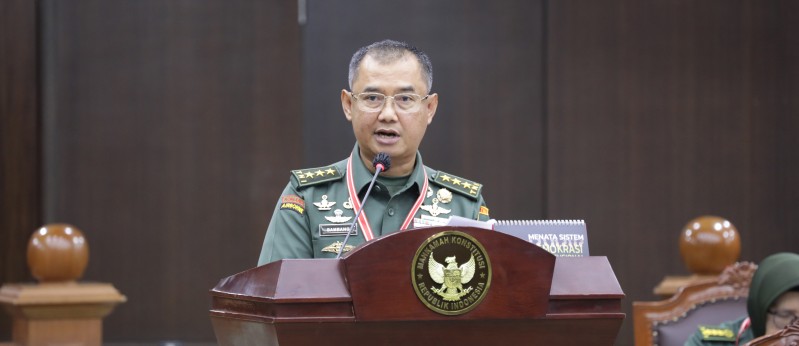
Chief of staff of the armed forces Let. Gen. Bambang Ismawan attending a judicial review hearing of the KPK Law and the Criminal Procedure Code in place of the commander, Thursday (7/4/2024). Photo by MKRI/Panji.
JAKARTA (MKRI) — The military deputy attorney general serves as a connector between the attorney general and the commander of the armed forces (TNI) in an effort to improve coordination and control for the handling of connexity cases. In addition, they can be a catalyst for the implementation of the authority of law enforcement officials in handling corruption cases.
The statement was made by chief of staff of the armed forces Let. Gen. Bambang Ismawan on behalf of the commander as a Relevant Party in the judicial review of case No. 87/PUUXX/2023. The case on Law No. 19 of 2019 on the Second Amendment to Law No. 30 of 2002 on the Corruption Eradication Commission (KPK) and Law No. 8 of 1981 on the Criminal Procedure Code (KUHAP) was filed by Gugum Ridho Putra. The ninth hearing on Thursday, July 4, 2024 had been set to present the commander of the armed forces as a Relevant Party as well as the Indonesian Prosecutors Association (PJI) and an expert for the PJI.
Furthermore, Bambang said, the Petitioner’s argument of the reinforcement of the KPK’s function in handling corruption crimes can be addressed by the KPK by fostering institutional relations by referring connexity corruption cases to the Attorney General’s Office to be resolved with the already-running mechanism. He then elaborated that the Attorney General’s Office Law and the Military Justice Law place the attorney general as the highest public prosecutor. This cannot be separated from the prosecutorial authority of the Military Prosecution Office in connexity cases where it receives part of the authority of the attorney general. Thus, not giving the KPK the authority to investigate certain connexity corruption cases does not mean a violation of the principle of equality before the law.
“Instead, this is a form of state responsibility through the law with an integrated settlement system between military police investigators, military prosecutors, and public prosecutors. Thus, is not possible to answer the discourse on the possibility of establishing a special directorate at the KPK that resembles the deputy attorney general for military crimes at the Attorney General’s Office under the law due to the limited positions that can be occupied by active soldiers based on the TNI Law and the Prosecution Law,” Bambang explained at the hearing chaired by Chief Justice Suhartoyo.
Deputy Attorney General’s Authority
Meanwhile an expert presented by the PJI, Fachrizal Afandi, said that in corruption offenses involving the military and civilians, the KPK has the authority to coordinate and control the inquiry, investigation, and prosecution. However, this authority must be linked to the Attorney General’s Office Law, which establishes the Attorney General as the highest public prosecutor in Indonesia. Due to the principle lex posterior derogat legi priori, which philosophically exists to accommodate changes in a country’s legal politics, the newer Prosecution Law should constitutionally be used as a reference in reading the KPK Law, including in handling connexity cases. In other words, in handling connexity cases the KPK must remain accountable to the attorney general as the highest public prosecutor in Indonesia.
“Thus, the enactment of the Prosecution Law places the attorney general as the highest public prosecutor who controls the prosecution of all criminal cases, including corruption. The establishment of the deputy attorney general for military criminal affairs through Presidential Regulation No. 15 of 2021 is useful in coordinating the technicality of prosecution and handling of connexity cases. Therefore, the deputy attorney general for military criminal affairs serves to bridge the gap between the civilian and military courts, as well as increasing the effectiveness of the management of connexity cases, especially in major cases such as corruption,” Fachrizal explained.
Also read:
Petitioner Wishes KPK’s Authority in Connexity Corruption Offenses Be Strengthened
Petitioner of KPK Law Revises Legal Standing
KPK’s Authority in Coordinating Prosecution of Connexity Corruption Crimes
Expert: Mechanism of Connexity, Case Handling as a Whole
KPK Explains Splitzing and Connexity Mechanisms in Handling Corruption
Govt Expert: Prosecution, Military Court, KPK Coordinate in Handling Corruption Cases
Supreme Court, Prosecutors Association Explain Handling of Connexity Cases
The petition No. 87/PUUXX/2023 was filed by Gugum Ridho Putra, an advocate. The Petitioner challenges Law No. 30 of 2002 on the Corruption Eradication Commission (KPK Law), as last amended by Law No. 19 of 2019 on the Second Amendment to Law No. 30 of 2002, and Law No. 8 of 1981 on the Criminal Procedure Code (KUHAP).
Specifically, he challenges the phrase “coordinate and control” in Article 42 of the KPK Law as well as the word “Investigator” in Article 89 paragraph (2); the phrase “Minister of Justice” in Article 89 paragraph (1), Article 89 paragraph (3), Article 91 paragraph (2), and Article 94 paragraph (5); the phrase “prosecutor or high prosecutor” in Article 90 paragraph (1), Article 90 paragraph (3), Article 91 paragraph (1), and Article 91 paragraph (3); the phrase “high prosecutor” in Article 93 paragraph (1); the phrase “Attorney General” in Article 90 paragraph (3), Article 93 paragraphs (1), (2), and (3); the phrase “Public Prosecutor” in Article 91 paragraph (1), Article 92 paragraph (1), and Article 93 paragraph (1) of the KUHAP.
The Petitioner cited impairment related to the authority to investigate criminal offenses in connexity or criminal offenses involving both civilians and military officers, especially corruption crimes handled by the KPK. He believes the handling of corruption cases in connexity by the KPK is inclined to prioritize punishment on criminals who are civilians. He believes the KPK’s unprofessionalism in handling connexity cases is due to unclear norms regulating the investigation and prosecution of connexity offenses.
Therefore, in the petitum, the Petitioner requests that the Court grant his petition and declare Law No. 30 of 2002 on the Corruption Eradication Commission and Law No. 8 of 1981 on the Criminal Procedure Code (KUHAP) unconstitutional and not legally binding and, among other things, declare the phrase “coordinate and control” in Article 42 of the KPK Law means that the KPK is obliged to coordinate and control the handling of connexity corruption cases in accordance with Articles 89, 90, 91, 92, 93, and 94 of the KUHAP.
Author : Sri Pujianti
Editor : Lulu Anjarsari P.
PR : Fauzan Febriyan
Translator : Yuniar Widiastuti (NL)
Disclaimer: The original version of the news is in Indonesian. In case of any differences between the English and the Indonesian versions, the Indonesian version will prevail.
Thursday, July 04, 2024 | 15:47 WIB 429