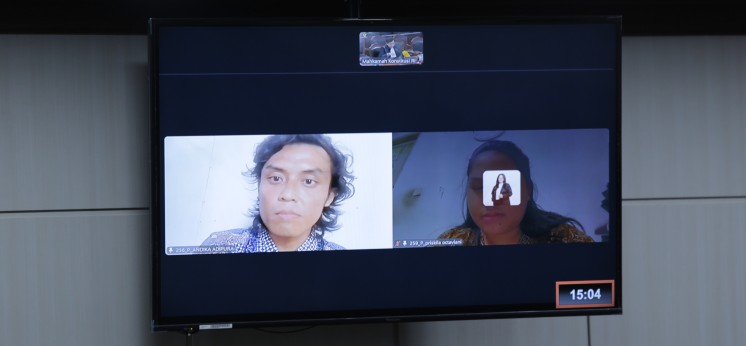
The Petitioner of Case No. 256/PUU-XXIV/2026 presenting the revisions to his petition against Law No. 2 of 2002 on the National Police, Wednesday (7/22/2026). Photo by MKRI/Bayu.
JAKARTA (MKRI) — The Constitutional Court held the second hearing for the material review of Law No. 5 of 2026 on the Third Amendment to Law No. 2 of 2002 on the National Police of the Republic of Indonesia on Wednesday, July 22, 2026. The second hearing for Case No. 256/PUU-XXIV/2026, chaired by Constitutional Justice Enny Nurbaningsih, was to hear the revisions to the petition.
At the hearing, Petitioner Andika Adipura, appearing virtually, informed the Court that he had revised six key aspects of his petition. Among the revisions, he narrowed the object of review to the Elucidation to Article 28A paragraphs (2), (3), and (4) of the Police Law, meaning that Article 28A paragraph (1) is no longer being challenged. He also strengthened his legal standing by including his history of participating in the civil service candidate (CASN) recruitment process and elaborating on the constitutional rights allegedly affected.
“Furthermore, I revised the section on the Constitutional Court’s jurisdiction by adding the relevant legal basis. I also refined the petition’s posita by systematically explaining the constitutional conflict, supported by legal doctrine, Constitutional Court precedents, and arguments for each challenged provision. Finally, I revised the petitums in accordance with the Court’s advice,” the Petitioner stated virtually from Bojonegoro.
In his revised petitums, the Petitioner requests that the Court declare the phrase “among others” in the Elucidation to Article 28A paragraph (2) letters a, b, and c of the Police Law contrary to the 1945 Constitution and without binding legal force insofar as it is interpreted to mean that the phrase expands, without limitation, the government affairs or ministries/agencies included under each respective category, thereby making the categories no longer exhaustive as provided in the body of Article 28A paragraph (2). The Petitioner also requests that the Court declare Article 28A paragraph (3) of Law No. 5 of 2026 on the Third Amendment to Law No. 2 of 2002 on the Indonesian National Police (State Gazette of the Republic of Indonesia of 2026 No. 63, Supplement to the State Gazette No. 7181) contrary to the 1945 Constitution and without binding legal force.
Also read: Petitioner Challenges Lack of Clear Boundaries Between Civil-Police Positions Under Police Law
Appearing virtually at the preliminary hearing, the Petitioner explained that on November 13, 2025, the Constitutional Court, through Decision No. 114/PUU-XXIII/2025, declared the phrase “or not based on an assignment from the Chief of the Indonesian National Police” in the Elucidation to Article 28 paragraph (3) of Law No. 2 of 2002 on the National Police unconstitutional and without binding legal force. The ruling has since been officially cited in the general provisions of the Police Law. Accordingly, the Petitioner argued, its validity is beyond dispute, and the decision is final and binding and has erga omnes effect.
However, the Petitioner contends that, instead of fully complying with the substance of Decision No. 114/PUU-XXIII/2025, the legislature, through the Police Law, enacted the provision a quo, which substantively revives the possibility for active-duty police officers to hold positions outside the Indonesian National Police without first resigning or retiring. He argues this was justified on the ground that the Constitutional Court’s decision applied only to civil offices “that are unrelated to the Police force.” The Petitioner argues that this constitutes a unilateral interpretation that was never stated in the verdict of Decision No. 114/PUU-XXIII/2025.
The Petitioner further argues that Article 28A paragraph (4) of the Police Law grants excessively broad authority to the President and may potentially eliminate the distinction between civil offices and positions within the Indonesian National Police. According to the Petitioner, the provision a quo allows police officers to occupy positions outside the Police based solely on presidential assignment. The provision does not limit the types of positions that may be filled, does not require any connection to policing functions, does not require a request from a ministry or government agency, and provides no limitations regarding the scope of the assignment, placement requirements, or oversight mechanisms. Consequently, the phrase “in the event of an assignment from the President” creates unlimited room for interpretation, allowing active-duty police officers to be assigned to any position outside the police organization solely at the executive’s discretion, without clear normative parameters in the provision a quo.
Explore Case No. 256/PUU-XXIV/2026 (in Indonesian).
Author : Sri Pujianti
Editor : Lulu Anjarsari P.
PR : Raisa Ayuditha M.
Translator : Yuniar Widiastuti (NL)
Disclaimer: The original version of the news is in Indonesian. In case of any differences between the English and the Indonesian versions, the Indonesian version will prevail.
Wednesday, July 22, 2026 | 19:16 WIB 23