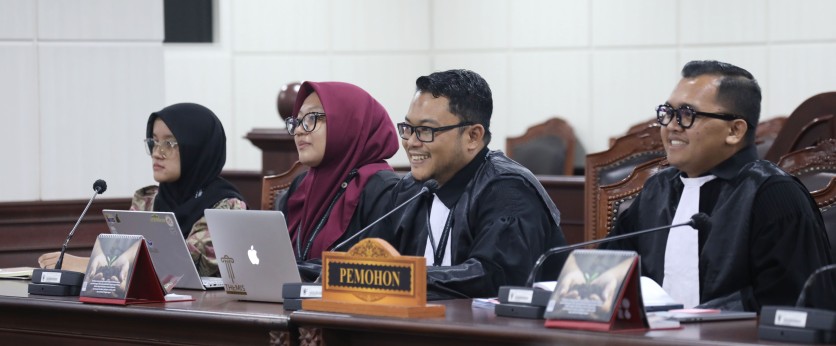
Legal counsel Dudy Agung Trisna attending the preliminary hearing on the judicial review of the P2SK Law on Tuesday (21/7). Photo by MKRI/Panji.
Jakarta (MKRI) - Muhammad Busyro Muqoddas (Petitioner I), Bhima Yudhistira Adhinegara (Petitioner II), Gregah Seira Ilmi (Petitioner III), and the INISIATIF Association (Petitioner IV) filed a petition for judicial review of Law No. 4 of 2026 on the Amendment to Law No. 4 of 2023 on Development and Strengthening of the Financial Sector (P2SK Law) to the Constitutional Court (MK). The preliminary hearing for Case No. 268/PUU-XXIV/2026 was presided over by Justice Enny Nurbaningsih in the Panel Courtroom on Tuesday (July 21, 2026).
Represented by their counsel, Dudy Agung Trisna, the petitioners argued that Article 50A paragraph (5) of the P2SK Law, which provides that, “The State shall guarantee and protect the purchase of special debt instruments as referred to in paragraph (4) from prosecution under general criminal law, special criminal law, including tax crimes, and from civil lawsuits,” and Article 50A paragraph (6), which states that, “Data and information obtained from activities referred to in paragraph (4) may not be used as a basis for tax assessment and may not be admitted as evidence in court,” are inconsistent with Articles 1 paragraph (3), 23A, 24 paragraph (1), 27 paragraph (1), 28D paragraph (1), 28I paragraph (2), and 33 paragraphs (3) and (4) of the 1945 Constitution.
In their petition, the petitioners contended that the two provisions create broad discriminatory treatment against micro, small, and medium enterprises (MSMEs) and lower- to middle-income economic groups. They argued that workers, civil servants, and MSMEs remain obligated to pay taxes and may even face criminal sanctions for defaulting on loans. By contrast, Article 50A paragraph (5) of the P2SK Law grants purchasers of Patriot Bonds and Merah Putih Bonds protection from prosecution under general criminal law, special criminal law, including tax crimes, as well as from civil lawsuits. According to the petitioners, this disparity constitutes discriminatory treatment by creating different legal treatment between purchasers of special debt instruments and all other legal subjects.
The petitioners further argued that the challenged provisions no longer serve to protect investors from market risks or unlawful acts committed by others, but instead shield investors from the possible application of criminal, civil, and tax laws to their own transactions. According to the petitioners, this represents not merely a change in wording but a fundamental shift in legal paradigm, transforming investor protection into absolute legal immunity for a particular category of economic activity.
Another counsel for the petitioners, M. Soleh, argued that Articles 50A paragraphs (5) and (6) of the P2SK Law fundamentally alter the doctrine of investor protection. He maintained that granting immunity from taxation, criminal prosecution, and the use of evidence in judicial proceedings no longer constitutes protection against market risks or arbitrary actions, but instead amounts to absolute legal immunity. According to him, the P2SK Law neither prevents financial or fiscal crimes nor provides mechanisms for imposing sanctions in the event of legal violations. Instead, he argued, the challenged provisions undermine the State’s law enforcement function by turning state financing investment instruments into a shield for problematic capital. He further asserted that if the rationale underlying Article 50A paragraph (5) were deemed constitutional, future lawmakers could extend similar immunity to other economic transactions under the justification of promoting investment or maintaining economic stability. Such a development, he argued, would create classes of legal subjects entitled to privileged treatment outside the generally applicable law enforcement framework.
The petitioners also argued that Articles 50A paragraphs (5) and (6) of the P2SK Law undermine the principle of distributive justice. They contended that exclusive protection based on capital creates a new legal class determined by a person's financial capacity to purchase certain debt instruments, thereby eroding the guarantees enshrined in Articles 27 paragraph (1) and 28I paragraph (2) of the 1945 Constitution.
According to the petitioners, Article 50A paragraph (5) creates unequal legal treatment between purchasers of special debt instruments and all other legal subjects. While individuals engaging in ordinary financial transactions remain subject to investigation, prosecution, taxation, and civil litigation, purchasers of special debt instruments are explicitly protected from all such legal mechanisms. They argued that this distinction is not based on any difference in the constitutional status of the legal subjects, but solely on the type of financial instrument involved. In other words, the privilege is granted not because of the exercise of a public function, but because of participation in a particular financial transaction.
“Declare Article 50A paragraph (5) of Law No. 4 of 2026 on the Amendment to Law No. 4 of 2023 on Development and Strengthening of the Financial Sector contrary to the 1945 Constitution of the Republic of Indonesia and therefore without binding legal force. Declare Article 50A paragraph (6) of Law No. 4 of 2026 on the Amendment to Law No. 4 of 2023 on Development and Strengthening of the Financial Sector contrary to the 1945 Constitution of the Republic of Indonesia and therefore without binding legal force,” Soleh said while reading the petitioners’ petitum.
Legal Standing
During the judicial advice session, Justice Arsul Sani instructed the petitioners to submit documentary evidence identifying the individuals representing the petitioners in order to strengthen their legal standing as parties entitled to file the petition.
“It also needs to be clarified whether the blanket immunity applies to the individual against all forms of legal action. Or, for example, if a single transaction contains indications of a criminal offense while part of it relates to investment in Patriot Bonds or Merah Putih Bonds, please explain how that is intended to operate,” Justice Arsul said.
Justice Ridwan Mansyur further advised the petitioners to elaborate on their alleged constitutional impairment. “Please identify more clearly which of the five requirements for constitutional impairment have actually been violated, and sharpen the causal relationship between those violations and the consequences suffered by the petitioners,” Justice Ridwan stated.
Before adjourning the hearing, Justice Enny Nurbaningsih informed the petitioners that they had 14 days from the conclusion of the hearing to revise their petition. The revised petition may be submitted only once and must be filed with the Registrar’s Office no later than Monday, August 3, 2026, at 12:00 noon Western Indonesian Time. The Court will then schedule the next hearing to hear the revised petition. (*)
Case tracking: Petition No. 268/PUU-XXIV/2026 (in Indonesian)
Author: Sri Pujianti
Editor: Lulu Anjarsari P.
PR: Raisa Ayuditha M.
Translator: Rizky Kurnia Chaesario
Disclaimer: The original version of the news is in Indonesian. In case of any differences between the English and the Indonesian versions, the Indonesian version will prevail.
Tuesday, July 21, 2026 | 16:45 WIB 8