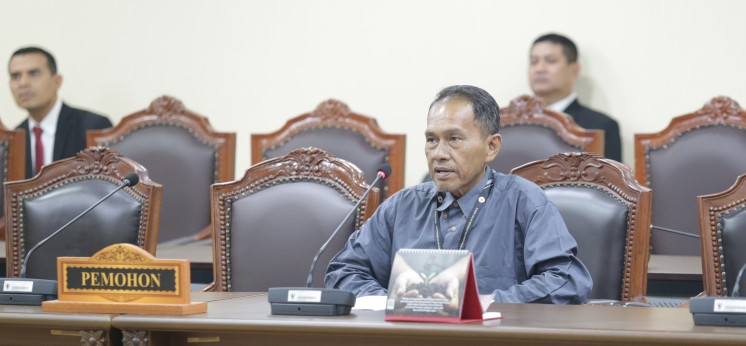
The Petitioner of Case No. 263/PUU-XXIV/2026 presenting his petition against Law No. 37 of 1999 on Foreign Relations, Monday (7/20/2026). Photo by MKRI/Bayu.
JAKARTA (MKRI) — Donaldy Christian Langgar is challenging Law No. 37 of 1999 on Foreign Relations materially to the Constitutional Court. The preliminary hearing for Case No. 263/PUU-XXIV/2026 was chaired by Chief Justice Suhartoyo from one of the Court’s panel courtrooms on Monday, July 20, 2026. The private employee believes that Article 18 paragraph (2) of the Law a quo is in violation of Article 28D paragraph (1) and Article 28J paragraph (1) of the 1945 Constitution. Said article provides that, “The protection referred to in paragraph (1) shall be provided in accordance with international law and international custom.”
According to the Petitioner, the challenged provision embodies the concept of the incorporation of international law, which automatically becomes part of domestic law through ratification without requiring the enactment of new implementing legislation. In this case, he argued that the provision is unclear and ambiguous and is inconsistent with the applicable legal framework. He maintained that an electronic visa should be recognized as admissible evidence in judicial proceedings. However, he added, such evidence was not given proper consideration. He further asserted that the application of the provision was influenced by prejudice or bias rather than objective legal reasoning. As a result, the challenged provision fails to provide legal certainty and equal treatment before the law, contrary to Article 28D paragraph (1) of the 1945 Constitution.
Referring to Decision No. 399/Pdt.G/2019/PN.Jkt.Pst, the Petitioner argued that the court had failed to properly consider electronic evidence because the original document could not be produced. Consequently, the evidentiary process did not proceed in accordance with the applicable legal provisions. He also contended that disregarding electronic evidence constitutes an improper restriction on his constitutional rights and is therefore inconsistent with Article 28J paragraph (1) of the 1945 Constitution.
“The Petitioner requests that the Court declare Article 18 paragraph (2) of Law No. 37 of 1999 on Foreign Relations conditionally unconstitutional and without binding legal force insofar as it is not interpreted to mean ‘general principles of law,’” the Petitioner stated while reading the petitums of his petition.
Unclear Posita
During the advisory session, Constitutional Justice M. Guntur Hamzah advised the Petitioner to clarify the issue being raised regarding the distinction between international custom and general principles of law. “As a result, the posita of the petition is unclear. You therefore need to revise the written petition to make the purpose and direction of the petition clear,” he explained.
Constitutional Justice Daniel Yusmic P. Foekh also advised the Petitioner to exercise greater care in drafting the petition, noting that the challenged provision identified in the posita (grounds for the petition) differed from that identified in the petitums (request for relief). “This kind of error could result in the petition being considered vague. In addition, if the Court were to adopt the interpretation sought by the Petitioner in the petitums, you should explain what legal consequences would follow,” he advised.
Before adjourning the hearing, Chief Justice Suhartoyo informed the Petitioner that he may revise the petition in 14 days since the end of today’s hearing. The revised petition must be submitted to the Court’s Registrar’s Office no later than 12:00 WIB on Monday, August 3, 2026. The Court will then schedule a second hearing to examine the revisions to the petition.
Explore Case No. 263/PUU-XXIV/2026 (in Indonesian).
Author : Sri Pujianti
Editor : Lulu Anjarsari P.
PR : Raisa Ayuditha M.
Translator : Yuniar Widiastuti (NL)
Disclaimer: The original version of the news is in Indonesian. In case of any differences between the English and the Indonesian versions, the Indonesian version will prevail.
Monday, July 20, 2026 | 15:17 WIB 27