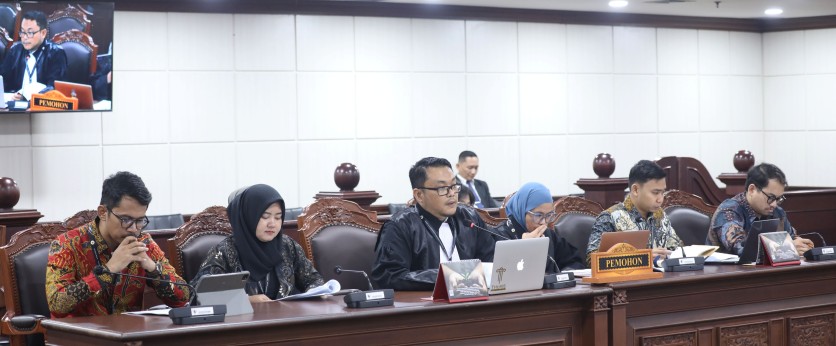
The Petitioners of Case No. 265/PUU-XXIV/2026 presenting their petition against the Election Law and the Regional Election Law alongside their legal team, Monday (7/20/2026). Photo by MKRI/Panji.
JAKARTA (MKRI) — The Association for Elections and Democracy (Perludem) alongside electoral activists and practitioners Irmalidarti, Kahfi Adlan Hafiz, Mikewati Vera Tangka, Umi Rifdiyawati, Maryanti Hermina Adoe, and Yessy Y. Momongan have filed for the material review of Article 10 paragraph (7), Article 22 paragraph (1), Article 52 paragraph (3), Article 55 paragraph (3), Article 59 paragraph (4), Article 92 paragraph (11), Article 155 paragraphs (4) and (5), and Article 164 paragraph (2) of Law No. 7 of 2017 on General Elections (Election Law), as well as Article 16 paragraph (3), Article 19 paragraph (1), and Article 21 paragraph (1) of Law No. 10 of 2016 on the Second Amendment to Law No. 1 of 2015 concerning the Stipulation of Government Regulation in Lieu of Law No. 1 of 2014 on the Election of Governors, Regents, and Mayors as Law (Regional Election Law).
The preliminary hearing for Petition No. 265/PUU-XXIV/2026 took place on Monday, July 20, 2026. Through their counsel, the Petitioners presented their constitutional arguments before a panel chaired by Constitutional Justice Enny Nurbaningsih, arguing that the challenged provisions fail to require the inclusion of women in election management bodies.
Article 10 paragraph (7) of Law No. 7 of 2017 provides: “The commissionership composition of a KPU, Provincial KPU, or Regency/City KPU shall take into consideration women’s representation of at least 30 (thirty) percent.”
Article 22 paragraph (1) of Law No. 7 of 2017 provides: “The President shall establish a selection committee consisting of no more than 11 (eleven) members, taking into consideration women’s representation of at least 30% (thirty) percent.”
Article 92 paragraph (11) of Law No. 7 of 2017 provides: “The composition of the membership of Bawaslu, a Provincial Bawaslu, a Regency/City Bawaslu, a District Panwaslu, and an Overseas Panwaslu shall take into consideration women’s representation of at least shall 30 (thirty) percent.”
“The phrase ‘take into consideration’ carries significantly weaker normative force than phrases such as ‘shall include,’ ‘must consist of,’ or ‘at least,’ as used in provisions concerning affirmative action for women’s representation among election participants,” said Haykal, one of the Petitioners’ counsel.
The Petitioners argued that the ineffective implementation of a statutory provision is not merely a matter of legislative drafting theory, but also raises a constitutional issue. “The failure of a statutory provision to operate effectively, as described above, is not merely a matter of legislative theory; it directly gives rise to a question of the constitutionality of the provision that must be resolved,” he explained.
Based on those arguments, the Petitioners requested the Constitutional Court to adopt a constitutional interpretation of the challenged provisions to ensure the inclusion of women in election management bodies. “The composition of the membership of the KPU, Provincial KPU, and Regency KPU shall include women’s representation of at least 30 percent,” said Sri Afrianis, another member of the Petitioners’ legal team, while reading one of the requested remedies (petitums).
After hearing the Petitioners’ presentation, Constitutional Justice Arsul Sani advised them to strengthen their legal standing, particularly that of the Perludem foundation, by citing previous Constitutional Court decisions recognizing Perludem’s standing to file constitutional petitions. “With respect to legal standing, I have one observation. In principle, all of you have adequately explained your legal standing. However, it would strengthen your case if you also referred to the Court’s previous decisions. Perludem has filed petitions before the Court many times and has already been recognized as having legal standing. It would be helpful to cite those decisions,” he said.
Regarding the substance of the petition, Justice Arsul also encouraged the Petitioners to participate in the legislative amendment process, emphasizing that lawmaking begins at the planning stage rather than the deliberation stage. “In my view, you should continue engaging with the House of Representatives because the legislative process does not begin with deliberation—it begins with planning. It is at that planning stage that you should present your proposals, even before there is an academic paper or a bill,” he added.
Constitutional Justice Ridwan Mansyur further advised the Petitioners to elaborate more thoroughly on how the challenged statutory provisions conflict with the constitutional provisions invoked as the basis for review. “At first glance, you have done a good job of identifying the constitutional provisions serving as the benchmarks for review. However, you have not yet fully explained the causal verband between the challenged provisions and those constitutional norms. Please develop that analysis further,” he said.
Finally, Constitutional Justice Enny Nurbaningsih advised the Petitioners to explain more comprehensively why affirmative action should also apply to positions filled through a selection process, noting that the Court’s previous decisions concerned positions filled through elections. “The inspiration for this petition appears to come primarily from Decisions 169-128 (No. 169/PUU-XXII/2024 and No. 128/PUU-XXIV/2026), and now you seek to extend those rulings. However, remember that those cases concerned elected officials, whereas the positions at issue here are largely selected officials. You therefore need to develop a strong constitutional argument explaining why the same affirmative action principles should apply to selected officials,” she stated.
Before adjourning the session, Justice Enny informed the Petitioners that they may revise the petition and submit the revised petition only once by 12:00 WIB on Monday, August 3, 2026, either online or offline.
Explore Case No. 265/PUU-XXIV/2026 (in Indonesian).
Author : Ilham Wiryadi Muhammad
Editor : N. Rosi
PR : Andhini S. F.
Translator : Yuniar Widiastuti (NL)
Disclaimer: The original version of the news is in Indonesian. In case of any differences between the English and the Indonesian versions, the Indonesian version will prevail.
Monday, July 20, 2026 | 18:04 WIB 27