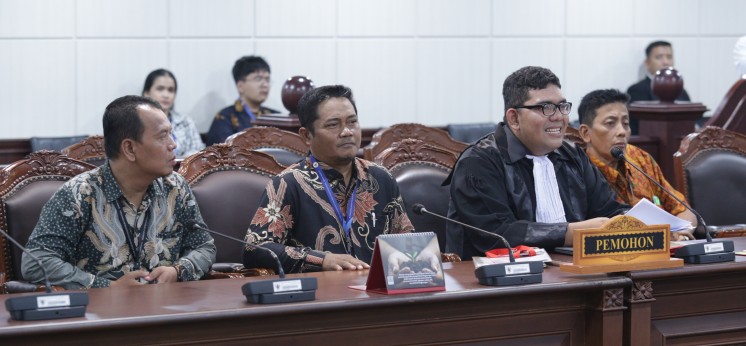
The Petitioners of Case No. 261/PUU-XXIV/2026 and their legal counsel presenting their petition against Law No. 6 of 2014 on Villages, Tuesday (7/14/2026). Photo by MKRI/Bayu.
JAKARTA (MKRI) — The Constitutional Court held the preliminary hearing for the material review of Article 31 paragraph (3) of Law No. 6 of 2014 on Villages on Tuesday, July 14, 2026. The Case No. 261/PUU-XXIV/2026 was filed by Sukarno, Matori, and M. Faizin.
Article 31 paragraph (3) of the Village Law provides, “Further provisions on the procedure for simultaneous village head elections referred to in paragraphs (1) and (2) shall be regulated by or pursuant to a Government Regulation.”
Michael Velando, counsel for the Petitioner, argued that Article 31 paragraph (3) of the Village Law, which delegates its implementation to Government Regulation No. 16 of 2026, has resulted in provisions that create injustice and discrimination against village officials who intend to run for village head in response to community aspirations. Under the regulation, village officials are required to resign after being officially designated as candidates for village head, whereas civil servants and incumbent village heads seeking to run for village head are only required to take a leave of absence.
“This constitutes discrimination against village officials, in that Article 42 paragraph (4) of Government Regulation No. 16 of 2026, which implements Article 31 paragraph (3) of Law No. 6 of 2016 on Villages, discriminates against village officials who wish to run for village head,” said Velando, who attended the hearing together with the three petitioners.
The Petitioners further argued that the provision is discriminatory because it imposes different legal requirements on persons in comparable situations. “Village officials who wish to run for village head in response to the aspirations of the community are required to resign once they are designated as candidates, whereas civil servants and incumbent village heads who seek to run for village head are only required to apply for a leave of absence,” Velando explained.
In response to the Petitioners’ explanation, Constitutional Justice Adies Kadir offered several recommendations, noting first that the format of the petition did not comply with Constitutional Court Regulation No. 7 of 2025. He further emphasized that the Constitutional Court has the authority to review statutes against the 1945 Constitution, not regulations subordinate to statutes.
“Please revise the subject matter of your petition. The Constitutional Court reviews statutes against the 1945 Constitution. Government regulations are not reviewed here—they fall within the jurisdiction of the Supreme Court,” he stated. He further advised the Petitioners to clearly explain the causal relationship between the challenged statutory provision and the alleged constitutional harm.
Next, Constitutional Justice Liliek P. Adi noted an error in the Petitioners’ citation of the relevant statute and reminded them to exercise greater care in drafting their petition. “Please pay close attention to accuracy in drafting. Statutory citations must not contain typographical errors. Make sure whether you intend to refer to Law No. 6 of 2014 or Law No. 6 of 2016,” he cautioned.
He also advised the Petitioners to be more precise in drafting every aspect of the petition, including their legal standing, the challenged provisions, and the substance of their constitutional arguments. “Most importantly, the substance of the petition must clearly demonstrate the constitutional harm allegedly suffered by the Petitioners. For example, whether, in their current capacity as village officials, they are actually prevented from becoming village heads,” Justice Liliek remarked.
Finally, Deputy Chief Justice Saldi Isra reminded the Petitioners that if the issue they were challenging lay in the government regulation, then judicial review should be sought before the Supreme Court, noting that statutes commonly delegate technical implementing provisions to government regulations.
“You must first clarify whether your principals believe their constitutional rights have been harmed by the government regulation or by the statute. If it is the government regulation, then the proper forum is the Supreme Court. If, however, you wish to challenge the statutory delegation in Article 31 paragraph (3), bear in mind that almost all statutes delegate technical matters to government regulations. If such delegation were eliminated, statutes would no longer be able to do so. The real issue you have identified is a provision in the government regulation that allegedly violates your constitutional rights. If that is the case, then this is not the proper forum,” he explained.
Before adjourning the hearing, Deputy Chief Justice Saldi informed the Petitioners that they may revise the petition and must submit it to the Court, either offline or online, no later than 12:00 WIB on Monday, July 27, 2026.
Explore Case No. 261/PUU-XXIV/2026 (in Indonesian).
Author : Ilham Wiryadi M.
Editor : Lulu Anjarsari P.
PR : Raisa Ayuditha M.
Translator : Yuniar Widiastuti (NL)
Disclaimer: The original version of the news is in Indonesian. In case of any differences between the English and the Indonesian versions, the Indonesian version will prevail.
Tuesday, July 14, 2026 | 16:29 WIB 24