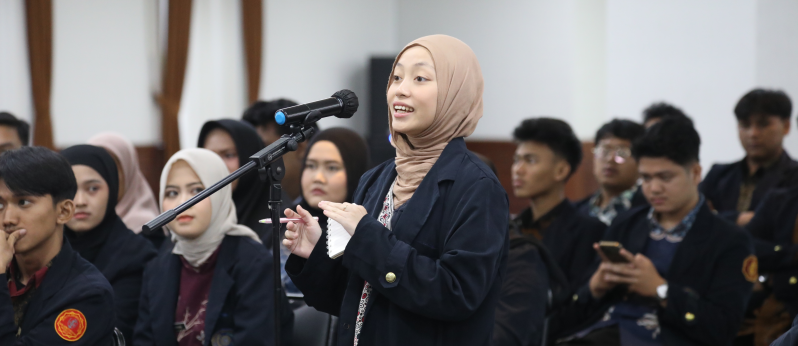
A student from the Faculty of Law of Muhammadiyah University of Tangerang (FH UMT) expresses her views during a visit to the Constitutional Court on Thursday morning, 7/9/2026. Photo by MKRI/Fauzan.
JAKARTA (MKRI) — Forty students, accompanied by four lecturers from the Faculty of Law of Muhammadiyah University of Tangerang (FH UMT), visited the Constitutional Court (MK) on Thursday morning, July 9, 2026. Held in the Auditorium of Building I of the Court, the visit sought to broaden the students’ knowledge of Constitutional Court procedural law and afford them an opportunity to observe a hearing firsthand. Associate Legal Counselor Ina Zuchriyah served as the speaker, while Senior Legal Counselor Erna Hasanah moderated the session.
Ahmad, the lecturer in charge of the Constitutional Court Procedural Law course, said the visit formed part of an effort to enrich the students’ understanding of proceedings before the Constitutional Court, which could not be fully acquired through classroom instruction alone.
“Our opportunities to explore the practical dynamics of proceedings before the Constitutional Court have so far been very limited. Classroom instruction has primarily focused on the judicial review of laws against the 1945 Constitution, while the Court’s other constitutional powers have not yet been examined in depth,” he said.
Ahmad explained that the Constitutional Court Procedural Law course at the UMT Faculty of Law also incorporates moot court exercises. Through these exercises, the students not only study legal theory but also prepare court documents and assume the roles of various parties and participants in proceedings before the Constitutional Court.
“Our students will draft petitions and Government statements and assume the roles of justices, petitioners, Government representatives, witnesses, and experts. A visit to the Constitutional Court is therefore highly valuable, as it enables them to gain a firsthand understanding of courtroom practice,” Ahmad explained.
In her presentation, Ina Zuchriyah explained the position of the Constitutional Court within Indonesia’s constitutional system, including the requirements for serving as a constitutional justice. She stated that constitutional justices must be at least 55 years old upon appointment, are nominated by the President, the House of Representatives (DPR), and the Supreme Court, and serve a five-year term for each period. They are subject to a mandatory retirement age of 70 or a maximum tenure of 15 years.
“Please feel free to ask any questions. Perhaps some of you will aspire to become constitutional justices one day,” Ina said, drawing an enthusiastic response from the students.
Ina also elaborated on the fundamental distinctions between the Constitutional Court and the Supreme Court. She explained that the Constitutional Court is a state institution established pursuant to the amendments to the 1945 Constitution and serves as the guardian of the constitution through its authority to review the constitutionality of laws. The Supreme Court, meanwhile, stands at the apex of the judicial system, adjudicates cases at the cassation and judicial reconsideration levels, and oversees the courts under its jurisdiction.
“Constitutional Court decisions are final and binding; therefore, no appeal or cassation is available. The Supreme Court, by contrast, operates within a tiered judicial system, beginning with courts of first instance and continuing through appellate courts, cassation, and judicial reconsideration,” Ina explained.
Ina further explained that the Constitutional Court has four constitutional powers and one constitutional obligation: reviewing laws against the 1945 Constitution; adjudicating disputes over the authority of state institutions; resolving disputes over general election results; deciding on the dissolution of political parties; and ruling on the DPR’s opinion concerning alleged violations by the President and/or Vice President in impeachment proceedings.
On the occasion, Ina also outlined the mechanism for enforcing the Code of Ethics and Code of Conduct for Constitutional Justices through the Constitutional Court Honorary Council (MKMK). She explained that before the MKMK was established as a permanent body, ethical oversight was conducted by an ad hoc Honorary Council of Constitutional Justices whenever allegations of violations of the justices’ code of ethics and code of conduct arose.
“The MKMK was established as a preventive and continuous ethical oversight mechanism. Its members comprise a former constitutional justice, an academic, and a community leader who possess integrity and are committed to safeguarding the honor of the judiciary,” Ina explained.
Through the visit, the students gained insight not only into the structure, powers, and procedural law of the Constitutional Court but also into the practical administration of constitutional adjudication. The experience provided them with a valuable foundation for a more comprehensive study of constitutional law and Constitutional Court procedure.
Author: Fauzan Febriyan
Editor: Tiara Agustina
Translator: Shane L. Sineri/Yuanna Sisilia
Disclaimer: The original version of the news is in Indonesian. In case of any differences between the English and the Indonesian versions, the Indonesian version will prevail.
Thursday, July 09, 2026 | 15:20 WIB 24