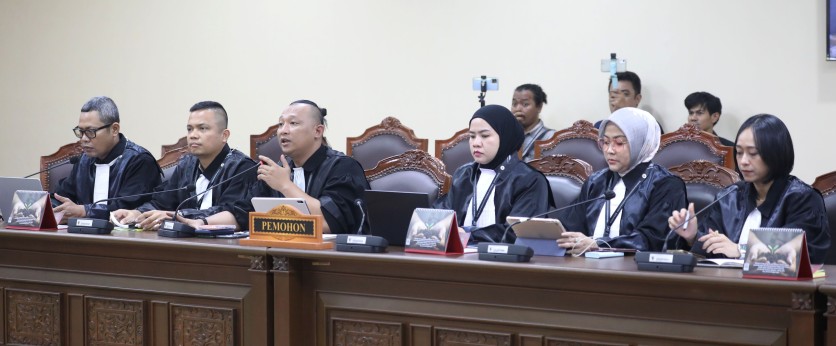
Petitioners attending the preliminary hearing on the judicial review of Law No. 5 of 2026 on the Indonesian National Police (Police Law) to deliver their petition on Thursday (9/7). Photo by MKRI/Panji.
Jakarta (MKRI) - The Constitutional Court (MK) held a preliminary hearing on Thursday, July 9, 2026, to examine a formal judicial review of Law No. 5 of 2026 on the Third Amendment to Law No. 2 of 2002 on the Indonesian National Police (Police Law). Petition No. 258/PUU-XXIV/2026 was filed by Syamsul Jahidin, Singgih Tomi Gumilang, Kharisma Jomenta Surbakti, Dimas Yoga Pratama, and Stepanus Febyan Babaro.
The panel hearing was presided over by Deputy Chief Justice Saldi Isra, accompanied by Justices Adies Kadir and Liliek Prisbawono Adi, to examine the Petitioners’ petition. Before the panel, the Petitioners presented their arguments regarding the constitutional harm they claimed had arisen from the enactment of the Police Law.
Singgih Tomi Gumilang explained that, as Indonesian citizens, the Petitioners are legal subjects directly bound by all provisions of the Police Law. As a logical consequence of being subject to those legal provisions, the Petitioners possess a constitutional right to participate meaningfully in the legislative process, as guaranteed by Article 28C paragraph (2) of the 1945 Constitution of the Republic of Indonesia and Article 96 of the Law on the Formation of Laws and Regulations.
“All of the Petitioners are directly bound by every provision of the Police Law and therefore have a constitutional right to participate meaningfully in its enactment,” Singgih stated.
The Petitioners argued that the absence of meaningful public participation in the amendment to the Police Law reflected autocratic legalism and abusive lawmaking, concepts derived from abusive constitutionalism, which essentially legitimize the use of law for undemocratic purposes and allow legislation to be enacted recklessly, contrary to democratic values and not for the public interest.
The Petitioners further contended that the legislative process for the Police Law failed to satisfy the requirement of meaningful public participation under Article 96 of the Law on the Formation of Laws and Regulations in conjunction with the General Elucidation of Law No. 13 of 2022. They argued that the legislative process did not fulfill the three cumulative rights required by law: the right to be heard, the right to have one's views considered, and the right to receive an explanation of the views submitted.
Based on those arguments, the Petitioners requested the Court to declare the enactment of the Police Law unconstitutional.
“Declare that the enactment of Law No. 5 of 2026 on the Third Amendment to Law No. 2 of 2002 on the Indonesian National Police (State Gazette of the Republic of Indonesia of 2026 No. 63, Supplement to the State Gazette of the Republic of Indonesia No. 7181) does not comply with the constitutional requirements for lawmaking under the 1945 Constitution and therefore has no binding legal force,” Kharisma Jomenta Surbakti said while reading the petition’s petitum.
The Petitioners also requested the Court to declare that Law No. 2 of 2002 on the Indonesian National Police should be reinstated.
Time Limit for Formal Judicial Review
In response to the petition, Justice Adies Kadir advised the Petitioners to clarify that their petition had been filed within the statutory time limit for filing a formal judicial review. “The Petitioners must explain when the law was promulgated, when the petition was submitted to the Court, and then conclude that the petition was filed within the 45-day time limit,” Justice Adies said.
Justice Adies further advised the Petitioners to discuss meaningful public participation separately from the issue of the filing deadline. He also reminded them to distinguish between a formal review and a substantive review, emphasizing that they need not elaborate extensively on constitutional harm arising from the substance of the Police Law.
“Accordingly, the explanation of legal standing should not focus excessively on harm caused by the contents or substance of the Police Law. Rather, it should address harm arising from the legislative process that is alleged to be inconsistent with the 1945 Constitution,” Justice Adies stated.
Justice Liliek Prisbawono Adi also advised the Petitioners to improve their explanation of legal standing. “The Petitioners’ legal standing should be refined so that it clearly forms the basis of their standing before the Court,” Justice Liliek said, while reminding them to explain the connection between the legislative process being challenged and the constitutional harm they claimed to have suffered.
“The most important point is the direct connection between the Petitioners and the enactment of this law. The Petitioners must also explain whether the meaningful participation they sought to exercise was not accommodated during the legislative process,” Justice Liliek added.
Finally, Deputy Chief Justice Saldi Isra, who chaired the hearing, stated that the Applicants must demonstrate the efforts they had actually undertaken during the deliberations on the amendment to the Police Law. “When the proposal to amend Law No. 2 of 2002 was introduced, what concrete actions did Mr. Jahidin take? Please explain that so the Court can assess the connection between the legislative process and the alleged violation of constitutional rights,” Deputy Chief Justice Saldi said.
Deputy Chief Justice Saldi further requested the Petitioners to identify the specific procedural defects in the legislative process that allegedly caused their constitutional harm. “There are five stages: first, the submission of the bill; second, deliberation; third, joint approval; fourth, ratification; and fifth, promulgation. The petition should explain at which of these five stages the procedural defect occurred,” Deputy Chief Justice Saldi said.
He explained that each of those stages consists of more detailed procedures. Therefore, if the Petitioners allege a formal defect, the petition must specify precisely where the defect occurred and support the allegation with evidence. “That is what you must explain to us; what is the evidence?” Deputy Chief Justice Saldi said.
Before closing the hearing, Deputy Chief Justice Saldi informed the Petitioners that they may submit one revised petition, either electronically or in person, no later than Wednesday, July 22, 2026, at 12:00 noon, Western Indonesian Time.
Case tracking: Petition No. 258/PUU-XXIV/2026 (in Indonesian)
Author: Ilham Wiryadi Muhammad.
Editor: N. Rosi.
Translator: Rizky Kurnia Chaesario
Disclaimer: The original version of the news is in Indonesian. In case of any differences between the English and the Indonesian versions, the Indonesian version will prevail.
Thursday, July 09, 2026 | 15:53 WIB 10