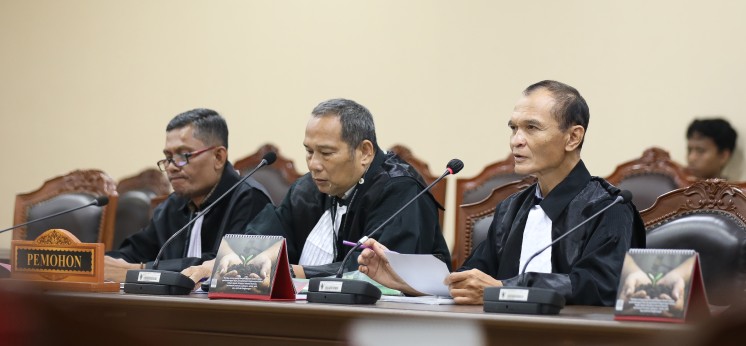
Petitioner and his legal counsel attending the preliminary hearing on the material review of Law No. 18 of 2008 on Waste Management on Tuesday (7/7) at the Courtroom. Photo by MKRI/Ifa.
Jakarta (MKRI) - Dudy Mempawardi Saragih, a retiree, has filed a petition for material review of Article 11 paragraph (1) letter b of Law Number 18 of 2008 on Waste Management (Waste Management Law) to the Constitutional Court (MK). The Petitioner, who is also an advocate, claims to have suffered constitutional harm due to the absence of a national standard guaranteeing the availability of complaint channels for waste accumulation in every region.
“The absence of a national legal guarantee under the Waste Management Law has placed the Petitioner’s right to exercise oversight in a condition of fragile legal uncertainty,” said the Petitioner’s legal counsel, Agung Tresno Wibowo, during the preliminary hearing of Petition No. 255/PUU-XXIV/2026 on Tuesday, July 7, 2026, in the Courtroom in Jakarta.
As a result of Article 11 paragraph (1) letter b of the Waste Management Law, which the Petitioner argues is abstract and contains no obligation to establish a nationally standardized complaint mechanism, the Petitioner claims to have suffered a violation of his constitutional rights through exposure to the risks posed by illegally accumulated waste in areas that he usually passes while exercising in the morning and enjoying the mountain scenery, weather permitting. According to the Petitioner, the absence of a national complaint mechanism to which the government is obliged to respond deprives him of a legal instrument to immediately restore his right to a clean, healthy, and hygienic environment.
In practice, the Petitioner noted that the Provincial Government of West Java has demonstrated political will by facilitating complaints about waste accumulation through the Sapawarga application, pursuant to the Governor of West Java's Decree Number 188.44/Kep.026.PPD/2019. However, the complaint submitted by the Petitioner through Sapawarga was redirected to SP4N-LAPOR, which is managed by the Ministry of Administrative and Bureaucratic Reform.
According to the Petitioner, the transfer of his complaint from Sapawarga to SP4N-LAPOR demonstrates that, in the absence of an explicit provision concerning “citizens’ complaints regarding waste accumulation” in Article 11 paragraph (1) letter b of the Waste Management Law, his constitutional rights remain uncertain and unprotected. The absence of an imperative operational norm, he argued, caused his complaint to be redirected and become entangled in the handling of general public complaints, while the accumulation of waste threatening his health continued without concrete action.
The Petitioner argued that this violates the guarantees of legal certainty and the right to a healthy environment as provided in Article 28D paragraph (1) and Article 28H paragraph (1) of the 1945 Constitution of the Republic of Indonesia. Article 11 paragraph (1) of Law Number 18 of 2008 provides that every person has the right to: “(a) receive proper and environmentally sound waste management services from the Government, regional governments, and/or other responsible parties; (b) participate in decision-making, implementation, and oversight in the field of waste management; (c) obtain correct, accurate, and timely information regarding the implementation of waste management; (d) receive protection and compensation for the adverse impacts of final waste processing sites; and (e) receive guidance in order to carry out proper and environmentally sound waste management.”
According to the Petitioner, the phrase “oversight in the field of waste management” in Article 11 paragraph (1) letter b of the Waste Management Law creates genuine legal uncertainty. He argued that the right of oversight is illusory and cannot be effectively exercised because the law does not require a “citizen complaint mechanism for waste accumulation” to be responded to immediately by state authorities.
The Petitioner further stated that he has no certainty, nor any official information, regarding whether provincial or regency/municipal governments outside West Java accept similar complaint applications. According to the Petitioner, this lack of transparency and certainty is not the result of his own negligence but is a direct consequence of the absence of a national standard mandated by Article 11 of the Waste Management Law.
The absence of such a national legal guarantee, the Petitioner argued, places the exercise of his right of oversight in a state of fragile legal uncertainty. As a result, the constitutional right to a clean and healthy environment depends on what he described as a “geographical luck factor.”
According to the Petitioner, if he is in a digitally advanced region such as West Java, his rights are facilitated. However, if he is in another region where the status of digital services is unknown, those rights become speculative. Likewise, if he travels, relocates, or changes domicile outside West Java, he immediately loses legal certainty regarding where and how to report illegal waste accumulation that he encounters.
Accordingly, the Petitioner requests the Court to declare Article 11 paragraph (1) letter b of the Waste Management Law contrary to the 1945 Constitution of the Republic of Indonesia and without binding legal force insofar as it is not interpreted to mean: “Including the right to submit complaints regarding unmanaged waste accumulation, the obligation of regional governments to follow up such complaints, and the obligation to provide legal protection so that complainants cannot be subject to criminal prosecution or civil lawsuits.”
The petition was heard by a panel of justices chaired by Deputy Chief Justice Saldi Isra, with Justices Adies Kadir and Liliek Prisbawono Adi sitting on the panel.
During the advisory session, Justice Adies questioned whether the issues raised by the Petitioner concerned the constitutionality of the statutory provision itself or merely its implementation. He noted that the Petitioner had already submitted a complaint through the Sapawarga application, but it had been redirected to SP4N-LAPOR.
“My question is, where is the constitutional harm if this technical issue has already been resolved?” Justice Adies asked.
Before closing the hearing, Deputy Chief Justice Saldi informed the Petitioner that he had 14 days to revise the petition. The revised petition, in both electronic and hard-copy form, must be submitted to the Court no later than Monday, July 20, 2026, at 12:00 noon Western Indonesian Time, either electronically or in person.
Case tracking: Petition No. 255/PUU-XXIV/2026 (in Indonesian)
Author: Mimi Kartika
Editor: Lulu Anjarsari P.
PR: Andhini S.F.
Translator: Rizky Kurnia Chaesario
Disclaimer: The original version of the news is in Indonesian. In case of any differences between the English and the Indonesian versions, the Indonesian version will prevail.
Tuesday, July 07, 2026 | 14:55 WIB 36