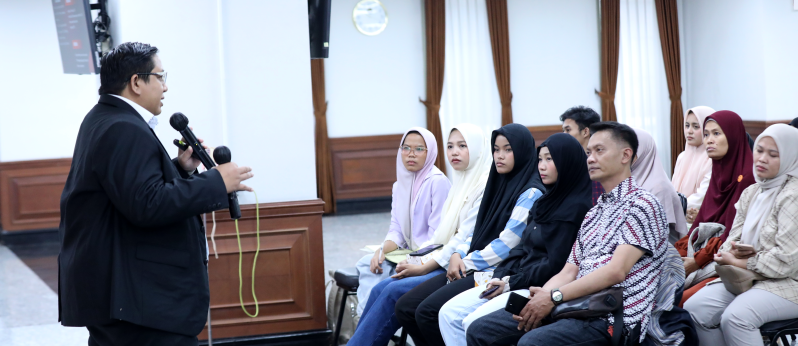
Court Legal Counsellor Achmad Junaedi as speaker during a session on Civics with students from La Tansa Mashiro University (Unilam). Photo by MKRI/Fauzan.
JAKARTA (MKRI) – Students from La Tansa Mashiro University (Unilam) visited the Constitutional Court (MK) on Tuesday, June 30, 2026 for a practical Civics class. The students were accompanied by the Rector of Unilam, KH Soleh, and their supervising lecturers.
The students visited the Court to broaden their knowledge, understanding, and practical experience regarding Indonesia's constitutional system, specifically to gain insight into the duties, functions, and authority of the Court, as well as the practical aspects of administering constitutional justice.
Unilam Rector KH Soleh appreciates the opportunity the Constitutional Court has granted students to learn firsthand about constitutional adjudication. He hopes this experience will complement the theoretical understanding students have gained during their coursework on campus.
“I hope the students have the opportunity to learn from the material the speakers will present. Thank you to the Constitutional Court for hosting us. Hopefully, all the students will make the most of this opportunity to gain a better understanding of Indonesia’s constitutional system,” said Soleh in his remarks at the event, which was held in a hybrid format at the Constitutional Court’s Building I Hall.
During the presentation session, Court Legal Councellor Achmad Junaedi explained the fundamental differences between the Constitutional Court (MK) and the Supreme Court (MA) regarding their respective authorities, procedural laws, and the subject matter of the cases they handle. He emphasized that the two institutions serve distinct functions, thereby complementing each other within Indonesia's judicial system.
“The Supreme Court and the Constitutional Court possess distinct authorities. Because their authorities differ, so do their duties and procedural laws. The Supreme Court handles concrete cases such as criminal, civil, and administrative law matters and reviews regulations subordinate to statutes for consistency with the statutes themselves. Meanwhile, the Constitutional Court reviews statutes for consistency with the Constitution,” explained Jun, the familiar nickname of Jun Junaedi.
He added that the Constitutional Court doesn’t impose criminal penalties on individuals, unlike the courts under the Supreme Court. The Constitutional Court's rulings focus on constitutional issues, such as striking down statutory provisions that conflict with the 1945 Constitution of the Republic of Indonesia.
“The Constitutional Court doesn’t issue rulings sentencing individuals to five or ten years in prison. Constitutional Court rulings involve striking down laws, interpreting statutory provisions, or in cases involving election result disputes, annulling General Elections Commission (KPU) decisions, in accordance with the authority granted by the Constitution,” explained Jun.
Furthermore, Jun explained that the oversight mechanism for Constitutional Court Justices is carried out by the Constitutional Court Ethics Council (MKMK). However, he clarified that the MKMK is not a state institution established directly by the 1945 Constitution; rather, it was created pursuant to statutory provisions and operates within the internal structure of the Constitutional Court. This differs from the Supreme Court (MA), where judges under its jurisdiction are overseen by the Judicial Commission.
On that occasion, Jun also reminded the students that the existence of the Constitutional Court is a consequence of the amendments to the 1945 Constitution, which established the Constitution as the supreme law. Consequently, the Court serves as the guardian of the constitution, ensuring that every law and action taken by state officials remains consistent with constitutional values and protects the constitutional rights of citizens.
To conclude the visit, following a discussion session about the Constitutional Court (MK), the students were taken on a tour of the Constitutional History Center (Puskon MK). Puskon MK serves as a hub for documentation, education, and information regarding Indonesia's constitutional history and practices, while also showcasing the Court's historical collections and important archives. Puskon MK is located on the 5th and 6th floors of the Court's Building I.
Author : Fauzan F.
Editor : N. Rosi.
Translator : Donny Yuniarto
Disclaimer: the original version of the news is in Indonesian. In case of any differences between the English and the Indonesian versions, the Indonesian version will prevail.
Tuesday, June 30, 2026 | 13:50 WIB 36