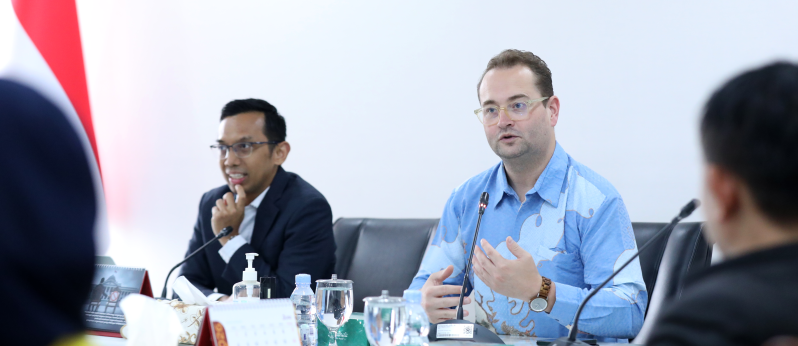
Sascha Hardt delivering his presentation at the Law Beyond Borders discussion, a collaborative event with Maastricht University, at the Constitutional Court on Tuesday (6/30/2026). Photo by MKRI/Fauzan.
JAKARTA (MKRI) — In an effort to broaden understanding of constitutional issues around the world, the Constitutional Court (MK) collaborated with Maastricht University to hold a Law Beyond Borders discussion on Tuesday, June 30, 2026, at Building I of the Constitutional Court. The event featured Maastricht University Assistant Professor of Comparative Constitutional Law Sascha Hardt, who delivered a presentation titled “Free Parliamentary Mandate: Lessons from the European Parliament.”
According to Hardt, a free mandate is a principle under which members of parliament have the autonomy to act according to their conscience, without being bound by instructions, promises, or directives from their political parties or constituents.
“Constitutional law scholars consider the mandate of legislators axiomatic in a democracy. It is one of the fundamental elements of a functioning democratic system,” Hardt told participants attending the discussion both in person and online.
Hardt explained that elected representatives act independently and are, in principle, free from binding instructions. Under the principle of a free parliamentary mandate, members of parliament nevertheless bear political responsibility to their parties and may face consequences for departing from the party line.
“However, these are not legal consequences. You cannot be held legally liable, nor are you legally obliged to follow any instruction on how to act in parliament,” he said.
He further asserted that members of parliament should exercise their own judgment in advancing the public interest.
“That is their job and their duty, and it is now widely regarded as one of the defining tenets of democracy,” Hardt said.
Hardt added that safeguarding a free mandate requires adequate legal protection for parliamentarians. At the same time, such protection must be balanced against the imperatives of accountability, transparency, integrity, and fairness.
“A free parliamentary mandate is essential to a democratic system, but it must never become a shield for unlawful conduct. It must not be used to conceal corruption, self-enrichment, favoritism, or nepotism,” he explained.
He acknowledged that efforts were still underway to identify an appropriate means of reconciling these competing imperatives, including through the establishment of institutions capable of preventing potential violations.
Hardt also examined how members of parliament in Indonesia may be subject to sanctions imposed through internal parliamentary mechanisms. He observed that the free mandate is constitutionally recognized in nearly all the countries he had studied.
“If you do not follow your party’s instructions, the party cannot revoke your mandate. You can retain it at least until the next election. I understand, of course, that the situation may be different in Indonesia. That is particularly interesting because it raises a genuine question about the very idea of a free mandate: to whom does the mandate belong? In Europe, the general answer is that the mandate is personal,” Hardt explained.
In his opening remarks, Head of the Public Relations and Protocol Bureau Pan M. Faiz said the discussion sought to address a fundamental question in constitutional democracy: when the interests of the two diverge, which should a member of parliament prioritize, the political party or the constituents?
According to Faiz, the question is not confined to Europe, which forms the focus of Hardt’s research, but is equally pertinent to Indonesia.
Author: Ilham W.M.
Editor: Lulu Anjarsari P.
Translator: Yuanna Sisilia
Disclaimer: The original version of the news is in Indonesian. In case of any differences between the English and the Indonesian versions, the Indonesian version will prevail.
Tuesday, June 30, 2026 | 19:21 WIB 11