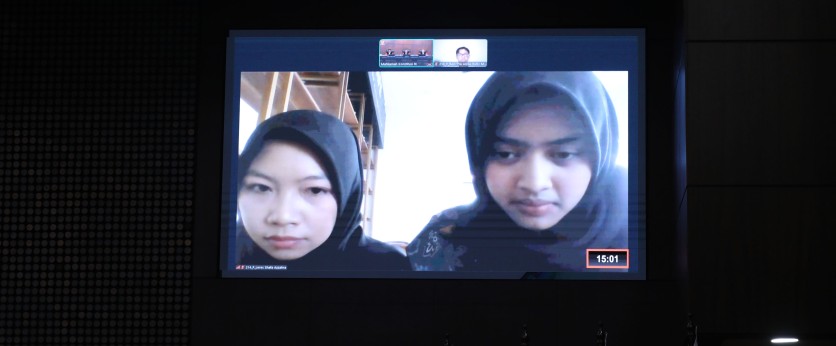
The Petitioners of Case No. 214/PUU-XXIV/2026 presenting their petition against Law No. 13 of 2003 on Manpower, Wednesday (6/24/2026). Photo by MKRI/Panji.
JAKARTA (MKRI) — Aisya Nayla Bihesthi Zewar, Leres Shafa Azzahra Anshori, Lourensya Varaniko, Aulia Mirza Nabilla, Brillian Fairuz, and Pascal Ibnu Kusuma (Petitioners I-VI, respectively) are challenging Law No. 13 of 2003 on Manpower before the Constitutional Court. The preliminary hearing for Case No. 214/PUU-XXIV/2026 took place on Wednesday, June 24, 2026 in one of the Court’s panel courtrooms. At the hearing, the Petitioners argued that Article 22 of the Manpower Law is against Article 27 paragraph (2) and Article 28D paragraphs (1) and (2) of the 1945 Constitution.
Article 22 of the Manpower Law provides: “(1) Internship shall be carried out based on an internship agreement made in writing between the participant and the employer. (2) The internship agreement as referred to under paragraph (1) shall at least have stipulations explaining the rights and obligations of both the participant and the employer as well as the period of internship. (3) Any internship administered without an internship agreement as referred to under paragraph (2) shall be declared illegal and as a consequence, the status of the internship’s participants shall be upgraded to that of the workers/ laborers of the enterprise [which employs them as interns].”
The Petitioners have a legal interest in challenging the provision on the rights of internship participants. In this regard, university students who have completed at least four semesters under the curriculum are required to undertake an internship program at a company, law firm, or government institution as a graduation requirement. This requirement is also based on Article 3 paragraph (7) of the Rector of Universitas Negeri Surabaya Regulation No. 18 of 2023 on the Implementation of the Merdeka Belajar-Kampus Merdeka Program, in conjunction with the Regulation of the Minister of Education, Culture, Research, and Technology on the Implementation of Student Internships.
The Petitioners further argue that, as active students participating in internships, they do not receive adequate rights as internship participants due to the absence of a minimum allowance standard during the internship period. They stated taht this situation directly legitimizes inhumane compensation, resulting in the deprivation of their right to a decent livelihood. In fact, Article 13 paragraph (2) of Minister of Manpower Regulation No. 6 of 2020 concerning the Implementation of Domestic Internships expressly provides: “The allowance referred to in paragraph (1) letter d shall include transportation expenses, meal allowances, and incentives for internship participants.” Accordingly, the Petitioners contend that the absence of such a standard creates a loophole enabling companies to use student interns as substitutes for skilled workers in order to reduce labor costs without any mandatory fair remuneration.
Based on these arguments, the Petitioners request that the Court declare Article 22 of Law No. 13 of 2003 on Manpower contrary to the 1945 Constitution, particularly Article 27 paragraph (2) and Article 28D paragraphs (1) and (2), and conditionally unconstitutional, such that it has no binding legal force unless interpreted to mean: “Every internship program, including those involving students, must guarantee legal certainty regarding the rights of internship participants, including the provision of fair remuneration that at a minimum takes into account a just and proportionate minimum allowance standard based on the workload, working hours, and contributions of the internship participant.”
Legal Standing
Constitutional Justice M. Guntur Hamzah advised that the Petitioners pay closer attention to their legal standing in relation to the challenged provision. “If you have previously participated in an internship, state that fact and explain how the challenged provision has actually caused you harm. The issue of allowances is regulated in a ministerial regulation. You want that norm to be elevated into a statutory provision, but it does not currently exist in the statute. How, then, do you claim that you have been harmed? That must be explained so that this petition satisfies the qualifications required of a petitioner,” he explained.
Before adjourning the session, Chief Justice Suhartoyo announced that the Petitioners would have 14 days to revise the petition. The revised the petition must be submitted to the Court’s Registrar’s Office no later than 12:00 WIB on Tuesday, July 7, 2026. The Court will then schedule a second hearing to examine the revisions to the petition.
Explore Case No. 214/PUU-XXIV/2026 (in Indonesian).
Author : Sri Pujianti
Editor : Lulu Anjarsari P.
PR : Raisa Ayuditha M.
Translator : Yuniar Widiastuti (NL)
Disclaimer: The original version of the news is in Indonesian. In case of any differences between the English and the Indonesian versions, the Indonesian version will prevail.
Wednesday, June 24, 2026 | 16:53 WIB 39