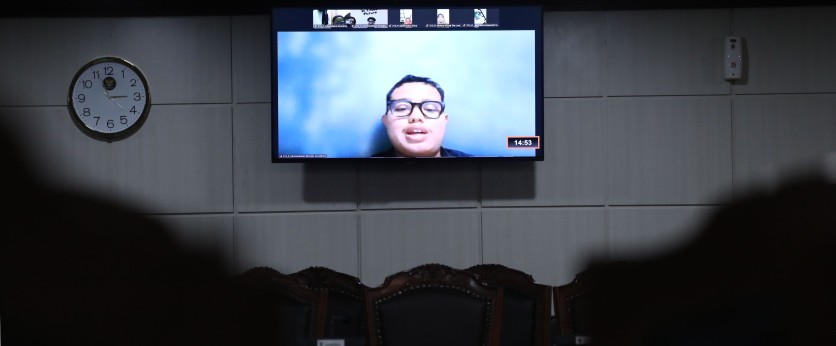
The Petitioner of Case No. 219/PUU-XXIV/2026 Muhammad Reihan Alfariziq presenting his petition against Law No. 7 of 2017 on General Elections, Wednesday (6/24/2026). Photo by MKRI/Panji.
JAKARTA (MKRI) — Law student of Universitas Muhammadiyah Yogyakarta (Muhammadiyah University of Yogyakarta) Muhammad Reihan Alfariziq has filed for the material review of Article 475 paragraph (2) of Law No. 7 of 2017 on General Elections. The Petitioner challenges the phrase “only be lodged against the vote counting results” in the provision. In practice, however, in adjudicating general election results disputes (PHPU), the Constitutional Court also examines the relationship between the electoral process and vote-counting results where such process significantly affects the determination of votes obtained by election participants.
“This discrepancy between the broader constitutional formulation and the narrower statutory formulation could potentially create legal uncertainty regarding the scope of the Constitutional Court’s authority, particularly because in practice the Court has expanded the meaning of the provision by also reviewing procedural violations that affect election results,” the Petitioner said at the preliminary hearing for Case No. 219/PUU-XXIV/2026 on Wednesday, June 24, 2026, which he attended remotely.
Article 475 paragraph (1) of the Election Law provides: “In disputing the results of a Presidential Election, a Presidential Candidate Ticket may submit an objection against KPU’s official presidential election vote counting results to the Constitutional Court at the latest 3 (three) days after the establishment of presidential election results by the KPU.” Paragraph (2) of the article provides: “The objection as referred to in paragraph (1) shall only be lodged against the vote counting results affecting the election of a Presidential Candidate Ticket into power, or affecting whether a Presidential Candidate Ticket makes it to the second round of a given Presidential Election.”
According to the Petitioner, this provision is contrary to Article 28D paragraph (1) of the 1945 Constitution. In the context of resolving election result disputes, legal certainty requires clarity regarding the scope of the Constitutional Court’s authority in examining and adjudicating election result disputes.
However, the Petitioner argues that there is an inconsistency between Article 475 paragraph (2) of the Election Law, which limits the object of a dispute to “only vote-counting results,” and the Constitutional Court’s constitutional practice, under which it has, in various decisions, also assessed procedural violations that affect election outcomes. This inconsistency could potentially create legal uncertainty for disputing parties as well as for citizens generally.
Textually, Article 475 paragraph (2) of the Election Law limits the object of a presidential election results dispute (PHPU Pilpres) solely to “vote-counting results,” a phrase that literally refers to quantitative, numerical vote totals. Meanwhile, in its decisions concerning the 2009, 2014, 2019, and 2024 presidential election disputes, the Constitutional Court consistently examined not only the quantitative aspects of vote counting but also procedural violations that were structured, systematic, and massive (TSM), insofar as such violations were proven to have affected the election results.
In Decision No. 01/PHPU-PRES/XVII/2019, the Constitutional Court affirmed that its authority is not limited merely to reviewing numerical figures or vote tabulation results but also assessing other matters related to election stages concerning the determination of valid votes and election outcomes. According to the Petitioner, the inconsistency between the narrowly framed statutory provision and the Constitutional Court’s constitutional practice, which has effectively broadened its meaning, creates serious legal uncertainty for disputing parties—including candidate pairs, political parties, and voters—because they lack certainty as to whether claims concerning procedural violations will be accepted or rejected by the Court.
In fact, during the 2019 and 2024 presidential election dispute proceedings, differing interpretations of the Constitutional Court’s authority became one of the principal issues contested by the parties, with each side presenting constitutional law experts who offered conflicting views, further illustrates this uncertainty. Some experts argued that the Court is authorized only to review numerical vote counts, while others maintained that it is authorized to assess structured, systematic, and massive violations. According to the Petitioner, this constitutes concrete evidence that Article 475 paragraph (2) of the Election Law is vague and open to multiple interpretations.
Nevertheless, by textually limiting the object of disputes to “vote-counting results,” Article 475 paragraph (2) of the Election Law creates uncertainty as to whether procedural violations proven to affect election outcomes may be reviewed by the Constitutional Court. On the one hand, if the Court adopts a literal interpretation of Article 475 paragraph (2), procedural violations could not be examined even where they are proven to have significantly altered election results.
The Petitioner argues that the provision fails to provide a constitutional guarantee that the people’s votes will be fully protected from flawed electoral processes. Therefore, according to the Petitioner, a constitutional interpretation is necessary to ensure that the phrase “only be lodged against the vote counting results” is construed systematically, teleologically, and consistently with the 1945 Constitution, so as to encompass the relationship between the electoral process and vote-counting results where the process significantly affects the determination of election participants’ votes.
In the petitums, the Petitioner requests that the Court declare the phrase “only with respect to vote-counting results” in Article 475 paragraph (2) of the Election Law contrary to the 1945 Constitution and conditionally unconstitutional insofar as it is not interpreted to mean: “The objection as referred to in paragraph (1) shall concern not only vote-counting results but also the electoral process insofar as it affects the determination of the elected Candidate Ticket or the determination of whether a Candidate Ticket proceeds to the subsequent stage in the Presidential Election.”
The petition was heard by a panel chaired by Deputy Chief Justice Saldi Isra, accompanied by Constitutional Justices Adies Kadir and Liliek Prisbawono Adi. In his advisory remarks, Deputy Chief Justice Saldi stated that the Petitioner should more clearly explain the connection between his legal standing as a voter and the paradigm governing the resolution of disputes concerning the determination of presidential election results, and how that connection gives rise to constitutional injury.
“Why does the provision that you are challenging have a causal relationship with the injury, or potential injury, to your constitutional rights?” he asked.
Before adjourning the session, Deputy Chief Justice Saldi announced that the Petitioner would have 14 days to revise the petition. The softcopy or hardcopy of the revised the petition must be received by the Court no later than 12:00 WIB on Tuesday, July 7, 2026.
Explore Case No. 219/PUU-XXIV/2026 (in Indonesian).
Author : Mimi Kartika
Editor : Lulu Anjarsari P.
PR : Raisa Ayuditha M.
Translator : Yuniar Widiastuti (NL)
Disclaimer: The original version of the news is in Indonesian. In case of any differences between the English and the Indonesian versions, the Indonesian version will prevail.
Wednesday, June 24, 2026 | 16:01 WIB 29