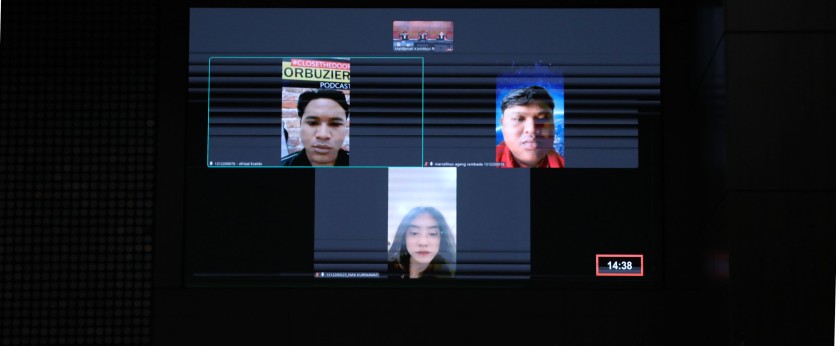
Petitioners delivering the main points of the petition on the judicial review of the TNI Law online on Tuesday (23/6). Photo by MKRI/Panji.
Jakarta (MKRI) – Three university students, Afrizal Evaldo Maulana, Fani Kurniawati, and Marcellinus Ageng Sembada, have filed for a material review of Law No. 34 of 2004 on the Indonesian National Armed Forces, as amended by Law No. 3 of 2025 on the Amendment to Law No. 34 of 2004 on the Indonesian National Armed Forces (TNI Law), to the Constitutional Court (MK). The preliminary hearing of Case No. 211/PUU-XXIV/2026 was presided over by Chief Justice Suhartoyo on Tuesday, June 23, 2026, at the Plenary Courtroom.
At the start of the hearing, Chief Justice Suhortoyo asked to clarify on two petitions, Petition Nos. 210/PUU-XXIV/2026 and 211/PUU-XXIV/2026, submitted by the Petitioners because they had the same objects. In response, Afrizal, representing the Petitioners, declared that his party withdrew Petition No. 210/PUU-XXIV/2026. He admitted to having sent the wrong document and would proceed with Petition No. 211/PUU-XXIV/2026.
“Petition No. 210/PUU-XXIV/2026 has been declared to be withdrawn, and we have responded to that, so there is no need to send a letter to the Court. All agreed to withdraw the petition, and this will be reported to the Justices’ Deliberation Meeting,” said Chief Justice Suhartoyo.
The Petitioners argued that the enactment of Article 47 paragraph (2) of the TNI Law is in contradiction with Article 1 paragraph (3), Article 27 paragraph (1), Article 28D paragraph (1), and Article 30 paragraph (3) of the 1945 Constitution of the Republic of Indonesia. Afrizal mentioned that the norm being tested has the potential to create unequal treatment in accessing certain government positions, because it allows active-duty soldiers to hold civilian positions that belong to civil service. This condition, Afrizal added, has the potential to reduce the principle of equality of citizens before the government, as guaranteed in Article 27 paragraph (1) of the 1945 Constitution.
Furthermore, the Petitioners believe that expanding the scope of civil service positions for active-duty soldiers could blur the line between the national defense functions of the Indonesian National Armed Forces (TNI) and the governmental functions of the civil service (ASN). Such ambiguity could lead to legal uncertainty in the administration of government, which would be contrary to Article 28D paragraph (1) of the 1945 Constitution.
“Declares that Article 47 paragraph (2) of Law No. 34 of 2004 on the Indonesian National Armed Forces, as amended by Law No. 3 of 2025 on the Amendment to Law No. 34 of 2004 on the Indonesian National Armed Forces, is inconsistent with the 1945 Constitution of the Republic of Indonesia; and declares Article 47 paragraph (2) of Law No. 34 of 2004 on the Indonesian National Armed Forces, as amended by Law No. 3 of 2025 on Amendment to Law No. 34 of 2004 on the Indonesian National Armed Forces, has no binding legal force,” said Afrizal as he read the petitioners’ petitum, which was conveyed online from Surabaya.
Refer to PMK No. 7 of 2025
During the advisory session, Justice M. Guntur Hamzah stated that the Petitioners need to further study the Constitutional Court Regulation No. 7 of 2025 on the Procedure of Judicial Review of Laws (PMK No. 7 of 2025). “The petition has not referred to PMK No. 7 of 2025, although the writing indicates judicial review. Furthermore, the Petitioners’ legal standing must be explained by each of the three Petitioners. What is the interest, the harm, and the experience? If they share the same characteristics, only as university students, then complete the explanation on the constitutional harm clearly regarding the applicable norm,” stated Justice Guntur.
Meanwhile, Justice Daniel Yusmic P. Foekh advised the Petitioners to elaborate on their interests and the rationale behind filing the petition. “How can they describe the constitutional harm? This serves as the entry point to the substance of the petition. This petition also fails to outline how the five requirements for constitutional harm are met, which must be elaborated upon in this petition. Furthermore, the argument needs to be developed by drawing comparisons with other countries regarding the position of the TNI in holding such civilian offices,” said Justice Daniel.
Chief Justice Suhartoyo reiterated that petitioners must outline in their pleadings the conflict between the challenged provisions and the Constitution. “Furthermore, the relief sought is contradictory, so what is there for the Constitutional Court to assess if no alternative relief is proposed?” emphasized Chief Justice Suhartoyo.
Before adjourning the hearing, Chief Justice Suhartoyo announced that the Petitioners would be given 14 days from the end of today’s hearing to revise their petition. The revised petition must be submitted no later than Monday, July 6, at 12:00 noon Western Indonesian Time. The Court will then schedule the next hearing to hear the main points of the petitioners’ revised petition.
Case tracking: Petition No. 211/PUU-XXIV/2026 (in Indonesian)
Author: Sri Pujianti.
Editor: N. Rosi.
PR: Fauzan F.
Translator: Rizky Kurnia Chaesario
Disclaimer: The original version of the news is in Indonesian. In case of any differences between the English and the Indonesian versions, the Indonesian version will prevail
Tuesday, June 23, 2026 | 16:17 WIB 7