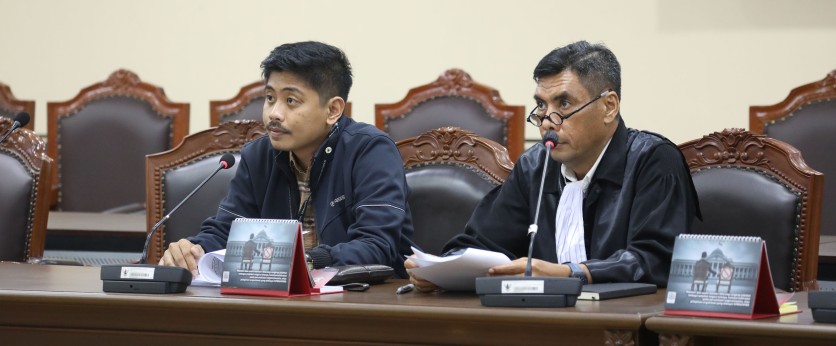
Petitioner Yovi Andrea Bachtiar presenting the revisions to his petition against the Criminal Procedure Code (KUHAP) alongside counsel Buce Abraham Beruat, Monday (6/22/2026). Photo by MKRI/Panji.
JAKARTA (MKRI) — The Constitutional Court held the second hearing for the material review of Law No. 20 of 2025 on the Criminal Procedure Code (KUHAP) on Monday, June 22, 2026 in one of the Court’s panel courtrooms. At this hearing, Jovi Andrea Bachtiar presented the revisions to Petition No. 176/PUU-XXIV/2026.
Before a panel chaired by Constitutional Justice Enny Nurbaningsih, legal counsel Buce Abraham Beruat stated that the Petitioner had revised the sections on the Petitioner’s legal standing and posita (grounds for the petition).
“The Petitioner requests that the Court declare that Article 285 paragraph (1) of Law No. 20 of 2025 on the Criminal Procedure Code (KUHAP) unconstitutional and has no binding legal force insofar as it is not interpreted to mean: ‘An appeal may be filed with the high court by the Defendant, the Defendant’s Advocate, or the Public Prosecutor, except where the district court has acquitted the Defendant,’” said the Petitioner while reading his petitums (requests).
Also read: Prosecutor’s Authority to File Appeal Called into Question
At the preliminary hearing on Monday, June 8, 2026, the Petitioner stated that Article 285 paragraph (1) of the KUHAP contradicts Article 28D paragraph (1) of the 1945 Constitution. At the hearing, the Petitioner’s counsel Buce Abraham Beruat argued that the challenged provision grants the public prosecutor the opportunity to file an appeal. He believes this not only contradicts the lawmakers’ intent when drafting the KUHAP, which replaced Law No. 8 of 1981 on Criminal Procedure, but also violates human rights and the citizens’ constitutional right of freedom from fear of criminalization by law enforcement officers who act arbitrarily. Therefore, the public prosecutor, he contended, should not be granted the right or authority to appeal an acquittal rendered by a district court at first instance.
He further explained that, as a matter of law, the public prosecutor has already been vested with authority from the moment a notice of commencement of investigation (SPDP) is received, enabling them to monitor the progress of a case being handled by investigators. Moreover, they are authorized to review case files submitted by investigators, provide instructions regarding any faults in those files, and coordinate with investigators to ensure that such flaws are remedied.
In short, given these authority and rights, the public prosecutor should already possess sufficient confidence in any case brought before the district court for trial. Consequently, if a defendant is acquitted by the district court, the public prosecutor should be prohibited from filing an appeal.
Explore Case No. 176/PUU-XXIV/2026 (in Indonesian).
Author : Sri Pujianti
Editor : N. Rosi
PR : Fauzan F.
Translator : Yuniar Widiastuti (NL)
Disclaimer: The original version of the news is in Indonesian. In case of any differences between the English and the Indonesian versions, the Indonesian version will prevail.
Monday, June 22, 2026 | 17:20 WIB 16