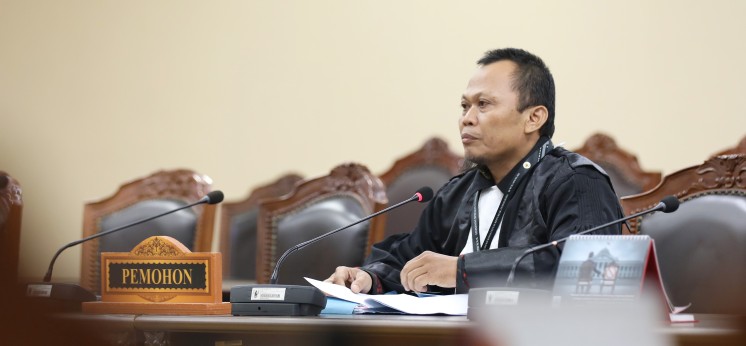
Warsito Ahmad Qodlofi, Petitioner's Legal Counsel, delivering the main points of his petition at the preliminary panel hearing for the judicial review of Law No. 35 of 2009 on Narcotics, Thursday (6/18/2026). Photo by MKRI/Ifa.
JAKARTA (MKRI) – Setiawan has filed a petition for a material review of Article 76 paragraph (2) of Law No. 35 of 2009 on Narcotics (Narcotics Law) to the Constitutional Court (MK). According to him, the norm grants investigators the authority to extend an arrest for 3x24 hours after the end of the arrest period, which violates his constitutional rights as guaranteed by Article 28D paragraph (1) and Article 28G paragraph (1) of the 1945 Constitution of the Republic of Indonesia (UUD NRI).
"There's a risk of discrimination, Your Honor. There's no equality, as the 1945 Constitution guarantees us constitutional rights to fair legal certainty and equal treatment before the law," said the Petitioner's Legal Counsel, Warsito Ahmad Qodlofi, during the preliminary hearing for Petition No. 205/PUU-XXIV/2026 on Thursday, June 18, 2026 in the Courtroom in Jakarta.
In the case experienced by Petitioner, the main objective of the arrest, namely to ensure the whereabouts of the Petitioner and place the Petitioner in the control of investigators, has actually been achieved since the Petitioner was successfully arrested and secured by law enforcement officers. However, based on the provisions of Article 76 paragraph (2) of the Narcotics Law, the Petitioner can still be subject to an extension of arrest for the next 3x24 hours, only based on the unilateral authority of the investigator without any clear parameters regarding the objective need for the extension.
According to Petitioner, such conditions create legal uncertainty and open the space to excessive deprivation of liberty. However, at this stage, the Petitioner's status remains as a suspect and, based on the presumption of innocence, should be treated as someone who has not been proven guilty under the law.
In addition, Article 76 paragraph (1) of the Narcotics Law has essentially given investigators very broad authority to make arrests for 3x24 hours, a period of time that is much longer than the general provisions in criminal procedure law. However, the provisions of Article 76 paragraph (2) of the Narcotics Law again provide additional authority in the form of extending the arrest for another 3x24 hours, so that overall, a person can lose their freedom for up to 6x24 hours only based on the investigator's administrative decision.
According to Petitioner, such broad authority without adequate judicial oversight mechanisms has the potential to lead to arbitrary actions, open up space for abuse of power, and place suspects in a position vulnerable to physical and psychological pressure during the period of arrest. In the Petitioner's own experience, the extension of the arrest has resulted in the loss of personal freedom, disruption of family relationships, a decreased sense of security, and injury to the Petitioner's honor and dignity as a human being and citizen whose constitutional rights must be protected by the state.
Article 76 paragraph (2) of the Narcotics Law states, "The arrest as referred to in paragraph (1) may be extended for a maximum of 3x24 (three times twenty-four) hours." Meanwhile, the Petitioner in his petitum requested the Court to declare Article 76 paragraph (2) of the Narcotics Law as contradictory to the 1945 Constitution of the Republic of Indonesia and not legally binding insofar as it is interpreted to mean that a suspect who has been successfully arrested and is in the custody of investigators can still be subject to an extension of arrest for 3x24 (three times twenty-four) hours or to state that Article 76 paragraph (2) of the Narcotics Law remains constitutional insofar as it is interpreted to mean that an extension of arrest cannot be applied to a suspect who has been successfully arrested and is in the custody of investigators.
The petition was heard by a Panel of Justices presided over by Deputy Chief Justice Saldi Isra, and by Constitutional Justices Adies Kadir and Liliek Prisbawono Adi as members of Panel. During the advisory session, Deputy Chief Justice Saldi stated that Petitioner needed to study Constitutional Court Regulation No. 7 of 2025 on Procedures for Judicial Review (PMK 7/2025) to prepare a petition for judicial review at the Constitutional Court.
Petitioner must then explain the constitutional rights infringement caused by the validity of the article being reviewed, along with supporting evidence. Next, the Petitioner must outline the conflicting arguments between the article being reviewed and the articles in the 1945 Constitution of the Republic of Indonesia that serve as the touch article or basis for the review.
"Please, would you please explain why Article 76 paragraph (2) (Narcotics Law) conflicts with Article 28D paragraph (1) (1945 Constitution), and why it conflicts with Article 28G paragraph (1) (1945 Constitution). Well, that's not yet available, sir. This is still all about legal standing, and there are no reasons for conflict," Deputy Chief Justice Saldi said.
Before closing the hearing, Deputy Chief Justice Saldi stated that Petitioner has 14 days to revise the petition. The revised petition can only be submitted once, either in softcopy or hardcopy, and must be received by the Court no later than Wednesday, July 1, 2026, at 12:00 p.m. WIB.
Track case No. 205/PUU-XXIV/2026
Author : Mimi Kartika
Editor : N. Rosi
PR : Fauzan
Translator : Donny Yuniarto
Disclaimer: The original version of the news is in Indonesian. In case of any differences between the English and the Indonesian versions, the Indonesian version will prevail.
Thursday, June 18, 2026 | 16:18 WIB 23