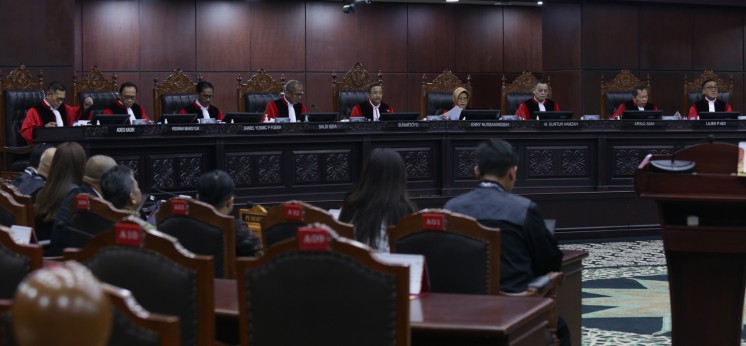
Ruling hearing for Case No. 152/PUU-XXIV/2026, the material review of Law No. 18 of 2003 on Advocates, Wednesday (6/17/2026). Photo by MKRI/Bay.
JAKARTA (MKRI) – Yayang Nanda Budiman's petition for a material review of Law No. 18 of 2003 on Advocates (Advocates Law) is inadmissible. This is the Constitutional Court's (MK) Decision No. 152/PUU-XXIV/2026, which was delivered during a hearing on Wednesday, June 17, 2026, in the Plenary Courtroom of the Constitutional Court, Jakarta.
In its considerations, Court found that Petitioner failed to specifically explain his constitutional loss. According to the Court, the Petitioner failed to explain any ethical issues experienced by the Petitioner or his fellow advocates as a result of the norm being challenged.
"In fact, in the hearing on May 7, 2026, the Court had provided advice regarding the legal allegations that the Petitioner should describe at least one of the ethical violations currently being experienced by other fellow advocates and be subject to ethical sanctions regarding the perceived unclear petition of a quo norm," said Chief Justice Suhartoyo read out the Court's legal considerations.
Also read:
Advocates Demand Clarification of Criteria for “Improper” Conduct
Petitioner Adds Articles of Constitution to Challenge Advocate Law
For additional information, Petition No. 152/PUU-XXIV/2026 was filed by an advocate named Yayang Nanda Budiman. He challenged the phrase "inappropriate" in Article 6 letter b of the Advocates Law. Article 6 letter b of the Advocates Law reads, "Advocates may be subject to action for the following reasons: …, b) acting or behaving inappropriately towards their opponents or colleagues."
In the first hearing at the Court on Thursday, May 7, 2026, Petitioner argued that the norm lacks clear boundaries, thus leading to multiple interpretations. Petitioner stated that as an advocate, his daily duties are never free from argumentative dynamics with fellow advocates on opposing sides. Advocates' struggles for their clients' interests often lead to assertive, harsh, and even high-pitched communication as part of their professional strategy. With the advancement of communication technology, differences of opinion frequently arise on social media, both in written and audio-visual forms.
According to Petitioner, Article 6 letter b of the Advocates Law doesn’t provide a clear definition of "inappropriate" conduct, thus potentially giving rise to subjective and multiple interpretations, both by the complainant, the Advocates' Organization, and the Advocates' Honorary Council. Consequently, any form of legal debate between advocates has the potential to be interpreted as "inappropriate." Therefore, Petitioner believes there should be clear, measurable, and objective boundaries for behavior considered "inappropriate."
Therefore, in the petitum, Petitioner requests the Court to declare Article 6 letter b of the Advocate Law as contradictory to the 1945 Constitution of the Republic of Indonesia (UUD NRI) and doesn’t have conditional binding legal force as long as it is not interpreted as, "Advocates can be subject to action on the grounds of: ... b) acting or behaving inappropriately which objectively and measurably constitutes a violation of moral norms, decency, or public order, and meets the qualifications of violations as expressly regulated in the Advocate Code of Ethics against opponents or colleagues in the profession."
Track case No. 152/PUU-XXIV/2026
Read Decision No.152/PUU-XXIV/2026 (in Indonesian)
Author : Ilham Wiryadi Muhammad
Editor : N. Rosi
PR : Andhini S.F.
Translator : Donny Yuniarto
Disclaimer: The original version of the news is in Indonesian. In case of any differences between the English and the Indonesian versions, the Indonesian version will prevail.
Wednesday, June 17, 2026 | 18:39 WIB 10