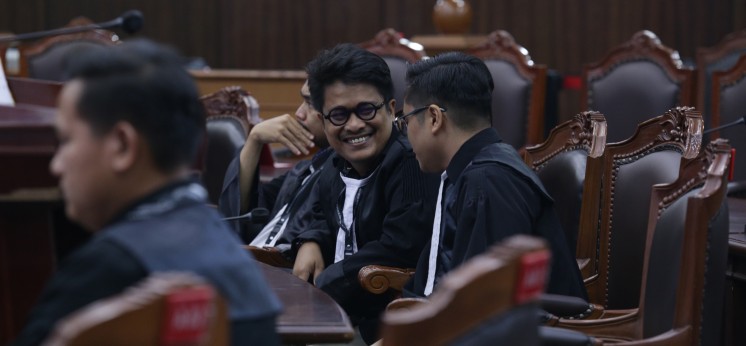
Petitioner attending the Decision Pronouncement Hearing of Case No. 168/PUU-XXIV/2026 on the material review of Law No. 2 of 2024 on Jakarta Special Province on Wednesday (17/6). Photo by MKRI/Bay.
Jakarta (MKRI) – The Constitutional Court (MK) rejected the petition on a material review of Article 11 paragraph (3) of Law No. 2 of 2024 on Jakarta Special Province (DKJ Law) in its entirety. Decision Pronouncement Hearing of Case No. 168/PUU-XXIV/2026, filed by Suriaman Panjaitan, was held on Wednesday, June 17, 2026, at the Plenary Courtroom.
Reading out the Court’s legal considerations, Justice Daniel Yusmic P. Foekh stated that the norms in Law No. 2 of 2024 are not changed or further regulated by Law No. 151 of 2024; the enactment remains based on the Presidential Decree on the capital city relocation from Jakarta Special Capital City Province to Capital City of Nusantara, including the status of governor, DPRD, DPR RI, and DPD RI, with regard to Jakarta Special Region status.
“Therefore, as long as the Presidential Degree has not yet been issued, the specific norms on Law No. 2 of 2024 are not yet effective (suspended effectiveness). Hence, the Jakarta Special Region maintains the status, function, and role of the state’s capital city,” Justice Daniel said.
Jakarta, National Economic Center
Moreover, Justice Daniel added that, from a de jure perspective, Law No. 2 of 2024 has been issued, legalized, and has become part of the national legal system. More importantly, Law No. 29 of 2007 on Jakarta Special Capital City Provincial Governance as the Unitary State of the Republic of Indonesia Capital City has been voided and replaced by Law No. 2 of 2024. Therefore, Jakarta has been designated as a special province (DKJ) and is projected to become a national and global economic center.
However, in this regard, it is important for the Court to emphasize that the existence of a law within the hierarchy of legislation does not necessarily mean that all of its provisions can be effectively enforced if specific conditions apply to the law in question, including, in this case, Law No. 2 of 2024.
In this regard, Article 73 of Law No. 2 of 2024 explicitly states that the substantive provisions of Law No. 2 of 2024 concerning the relocation of the capital of the Unitary State of the Republic of Indonesia from the Special Capital Region of Jakarta to the Capital City of Nusantara shall take effect upon the issuance of a Presidential Decree. Since the aforementioned Presidential Decree has not yet been issued, the intended relocation of the national capital has not yet taken place. Consequently, the positions of the Governor, the Regional People’s Representative Council (DPRD), the House of Representatives (DPR RI), and the Regional Representatives Council (DPD RI) pertaining to the Special Capital Region of Jakarta remain in effect, and no shift has yet occurred. Thus, regarding the issue of the constitutionality of Article 11(3) of Law No. 2 of 2024, the Court finds that such a challenge is irrelevant.
“Based on the legal considerations set forth above, the Petitioner’s arguments regarding the review of Article 11, paragraph (3) of Law No. 2 of 2024 against Article 18B paragraph (1), Article 22E paragraph (1), Article 27 paragraph (1), Article 28C paragraph (2), Article 28D paragraph (1), Article 28D paragraph (3), Article 28G paragraph (1), and Article 28H paragraph (2), of the 1945 Constitution of the Republic of Indonesia is legally unfounded,” explained Justice Daniel.
Also read:
FKDM Chairman Questions the Impact of the Reduction in the Number of Jakarta Provincial DPRD Seats
FKDM Chairman Emphasizes Constitutional Harm from Reduction in the Number of Jakarta Provincial DPRD Seats
The Petitioner argued that Article 11 paragraph (3) of the DKJ Law is in breach of Article 27 paragraph (1), Article 28C paragraph (2), Article 28D paragraph (1), and Article 28H paragraph (2) of the 1945 Constitution. He added that due to the implementation of the tested provision, his constitutional right to receive special treatment is ultimately degraded. He contended that the norm removes the legal basis for a distinct number of members in the Jakarta Provincial DPRD (Regional House of Representatives), which previously guaranteed broader representation for the Petitioner through the 125% scheme.
Read in full: Decision No. 168/PUU-XXIV/2026 (in Indonesian)
Author: Sri Pujianti
Editor: Lulu Anjarsari P.
PR: Fauzan Febriyan
Translator: Rizky Kurnia Chaesario
Disclaimer: The original version of the news is in Indonesian. In case of any differences between the English and the Indonesian versions, the Indonesian version prevails.
Wednesday, June 17, 2026 | 20:02 WIB 8