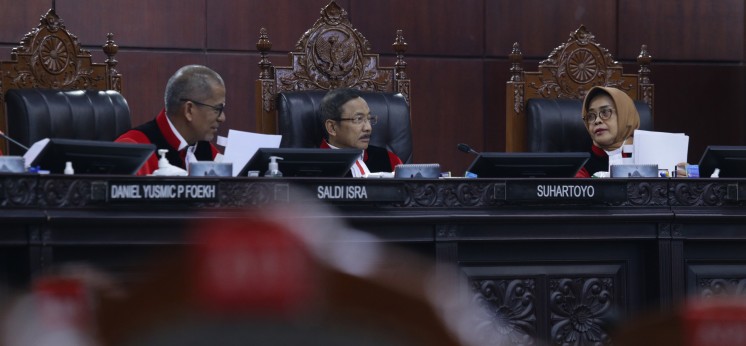
Decision Pronouncement Hearing of Case No. 142/PUU-XXIV/2026 on the material review of Law No. 17 of 2025 on the 2026 State Budget on Wednesday (17/6). Photo by MKRI/Bay.
Jakarta (MKRI) - As one of the parties authorized to propose the allocation of physical Special Allocation Funds (DAK), the phrase “and/or aspirations of members of the House of Representatives” in Article 12 paragraph (2) of Law No. 17 of 2025 cannot be interpreted as granting members of the House unrestricted authority. This is because the allocation of physical DAK must comply with and take into account national priorities, the state’s financial capacity, regional fiscal capacity, and regional performance.
These legal considerations on the material review of Law No. 17 of 2025 on the 2026 State Budget were read out by Justice Liliek P. Adi on the petition filed by five law students comprising Bernita Matondang (Petitioner I), Attaubah (Petitioner II), Edmon Derson Simamora (Petitioner III), Inggret Adu (Petitioner IV), and Devi Wulandari (Petitioner V) on Wednesday, June 17, 2026.
Moreover, Justice Liliek stated that the planning and budgeting of physical DAK has been further regulated by the Regulation of the Minister of Justice No. 25 of 2024 on the Management of Physical Allocation Funds (PMK No. 25 of 2024). However, without intending to assess the legality of the regulation, the Court stands that the physical DAK conveyed by the Leaders of the Budgeting Agency of the House of Representatives, Ministries, and the National Planning and Development Agency, in Article 12 paragraph (2) of Law No. 17 of 2025, also emphasizes that the physical DAK allocation is carried out based on good financial governance.
“This emphasis can be understood as an effort to ensure that the management of state finances is carried out in a transparent and accountable manner, with the aim of maximizing the people’s prosperity,” Justice Liliek stated.
Measures to Prevent Pork Barrel Spending
In its legal considerations, the Court also stated that although Article 12 paragraph (2) of Law No. 17 of 2025 has set the regulations to allocate physical DAK, with the phrase “take into account national priorities, the state’s financial capacity, regional fiscal capacity, and regional performance, as well as good financial governance,” other measures need to be in place to prevent physical DAK allocation from becoming somewhat like a pork barrel, as the Petitioners’ argued.
In this regard, Justice Liliek added, members of the House prioritize proposing the allocation of physical DAK as long as they are intended for development in the respective member’s electoral district. These additional requirements or new guidelines are necessary because the management of physical DAK is carried out through affirmative action policies.
“Moreover, members of the House of Representatives are bound by an oath or pledge to champion the aspirations of the people they represent in order to achieve national objectives for the benefit of the nation and the state. Although the Physical DAK is an affirmative action policy, it must still be accounted for in accordance with the provisions on state financial management set forth in Article 23E of the 1945 Constitution of the Republic of Indonesia,” said Justice Liliek.
Based on the aforementioned legal considerations, the Petitioners’ argument regarding the phrase “and/or the aspirations of members of the House of Representatives” in Article 12 paragraph (2) of Law No. 17 of 2025, that it should be declared contrary to the 1945 Constitution of the Republic of Indonesia and lacks binding legal force, is unfounded and must therefore be declared legally unreasonable.
“Adjudicate, reject the Petitioners’ petition in its entirety,” Chief Justice Suhartoyo pronounced the verdict.
Also read:
Highlighting Transparency and Accountability of Special Allocation Fund in 2026 State Budget Law
Reiterating Background for Transparency and Accountability Review of Special Allocation Funds
During the preliminary hearing on Wednesday, April 29, 2026, the Petitioners stated that the article contradicts Article 28D paragraph (1), Article 28H paragraph (1), and Article 23 paragraph (1) of the 1945 Constitution of the Republic of Indonesia
Article 12 paragraph (2) of the 2026 State Budget Law reads, “The allocation of physical Special Allocation Funds as referred to in paragraph (1) letter a shall be determined based on proposals from regional governments and/or the aspirations of members of the House of Representatives in advocating regional development programs, taking into account national priorities, the financial capacity of the state, the fiscal capacity and performance of the regions, as well as sound state financial governance.”
The Petitioners argue that the enactment of Article 12 paragraph (2) of the Law a quo, particularly the phrase “aspirations of members of the House of Representatives,” without clear legal limits and parameters, creates the potential for a shift in the basis for budget allocation from an objective needs-based approach to an unmeasurable approach. This, in turn, opens the door to systemic deviation in the management of state finances.
In the petitum, the Petitioners request the Court to declare that the phrase “aspirations of the member of the House of Representatives” in Article 12 paragraph (2) of the 2026 State Budget Law is inconsistent with the 1945 Constitution of the Republic of Indonesia and has no binding legal force insofar as it is not interpreted as aspirations that may only be used when based on development planning that is objective, measurable, accountable, and integrated into the national development planning system.
Case tracking: Petition No. 142/PUU-XXIV/2026 (in Indonesian)
Read in full: Decision No. 142/PUU-XXIV/2026 (in Indonesian)
Author: Sri Pujianti.
Editor: N. Rosi.
PR: Andhini SF.
Translator: Rizky Kurnia Chaesario
Disclaimer: The original version of the news is in Indonesian. In case of any differences between the English and the Indonesian versions, the Indonesian version will prevail.
Wednesday, June 17, 2026 | 20:49 WIB 8