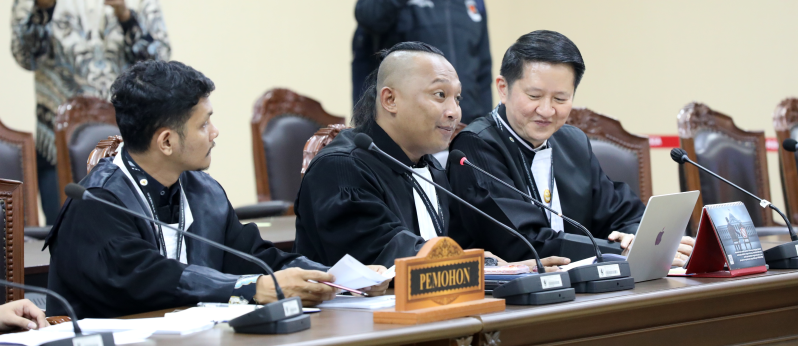
Legal counsel Syamsul Jahidin and colleagues attending the Petition Revision Hearing of Case No. 75/PUU-XXIV/2026. Photo by MKRI/Fauzan.
Jakarta (MKRI) – The Constitutional Court (MK) held a continued hearing on a case filed by Henoch Thomas (Petitioner I) and Syamsul Jahidin (Petitioner II) on Wednesday, June 17, 2026. The second hearing on the material review of Law No. 30 of 2004 on Notary, as amended by Law No. 2 of 2014 on the Amendment to Law No. 30 of 2004 on Notary, was scheduled to hear the main points of the revised petition.
On the hearing of Case No. 175/PUU-XXIV/2026, presided over by Deputy Chief Justice Saldi Isra, Jahidin mentioned that he had improved the posita related to the norm in Article 66 paragraphs (1), (3), and (4), which he believed to have created legal uncertainty within the society. However, when reading out the revision, Deputy Chief Justice Saldi questioned the legitimacy of the revised documents submitted online via email on 11.04 and 11.06 Western Indonesian Time (WIB). “We confirm that it is not the attachment, so we read out the 11.06 WIB version, and the 11.04 version has the wrong attachment,” explained Jahidin.
In response, Deputy Chief Justice Saldi reminded that, based on the Court’s procedural law, only the first revised document received by the Court is considered the revised petition. Therefore, the Petitioners were asked to read out the document submitted on 11.04 WIB. However, representing the petitioners, Jahidin asserted that his party will refer back to the first document submitted for the first hearing.
“With your permission, Your Honor, we’d like to return to the Preliminary Hearing, because we sent it at 11:06 WIB and we immediately clarified the matter,” Jahidin stated firmly.
Following the petitioners’ statement, Deputy Chief Justice Saldi stated that, under the Court’s procedural law, the Petitioners would refer to the petition read at the first hearing. “Therefore, the document will be conveyed to the Justices' Deliberation Meeting, and we will approve evidence P-1 – P-3, additional P-15, and all of these are hereby declared complete and valid,” Deputy Chief Justice Saldi stated.
Also read:
Advocates Question Notary Ethics Council's Authority
During the preliminary hearing on Thursday, June 4, 2026, Jahidin stated that, from a constitutional perspective, the norms may deviate from the principles of constitutional supremacy and due process of law. These provisions confer quasi-judicial authority on the Notary Ethics Council (MKN) without any appeal mechanisms or legal control over its decisions. Therefore, MKN appears to assume the role of deciding whether an investigation is legitimate, which should be within the judiciary's scope. Such arrangements may cause authorities to overlap, weakening the checks-and-balances system provided for in the 1945 Constitution.
Jahidin further stated that the enactment of Article 66 paragraph (1) of the Notary law indicated that MKN approval may constitute a real case of constitutional noncompliance if left unchecked. There are several constitutional norms that are violated, including the right to justice and judicial independence, and administrative mechanisms notifications. Therefore, respect for constitutional supremacy can be maintained without ignoring the protection of the notary.
Based on such arguments, the Petitioners requested the Court to declare the phrase in Article 66 paragraph (1) stating that “For the purposes of judicial proceedings, investigators, public prosecutors, or judges, with the approval of the Notary Ethics Council, are authorized to” of the Notary Law conditionally unconstitutional and has no legally binding force as long as it is not interpreted as “Article 66 paragraph (1) reads, ‘For the purposes of judicial proceedings, investigators, public prosecutors, or judges, with the notification to the Notary Ethics Council, are authorized to’”.
In addition, they also requested the Court to declare Article 66 paragraph (4), which states, “If the Notary Ethics Council does not provide an answer within the period referred to in paragraph (3), the Notary Ethics Council shall be deemed to have granted the request for approval,” unconstitutional and not legally binding.
Case tracking: Petition No. 175/PUU-XXIV/2026 (in Indonesian)
Author: Sri Pujianti
Editor: Lulu Anjarsari P.
PR: Andhini S.F.
Translator: Rizky Kurnia Chaesario
Disclaimer: The original version of the news is in Indonesian. In case of any differences between the English and the Indonesian versions, the Indonesian version will prevail.
Wednesday, June 17, 2026 | 14:27 WIB 13