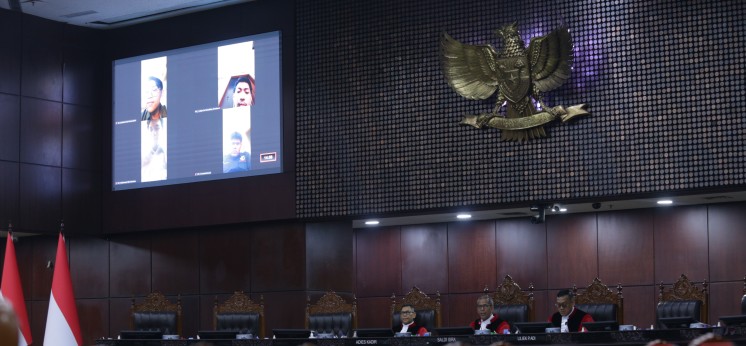
The Petitioners attending the preliminary hearing for the review of the Road Traffic and Land Transportation Law for Case No. 187/PUU-XXIV/2026, Wednesday (6/10/2026). Photo by MKRI/Bayu.
JAKARTA (MKRI) — Muhammad Farhanudin Ubaidillah, Aditya Dwi Ramadhan, Ananda Romzul Hilmi Argi, and Muhammad Hifmi Maulana (Petitioners I-IV) have filed for the material review of Law No. 22 of 2009 on Road Traffic and Transportation (LLAJ Law) to the Constitutional Court. The preliminary hearing for Case No. 187/PUU-XXIV/2026 took place in one of the Court’s panel courtrooms on Wednesday, June 10, 2026.
At the first hearing of the petition, Aditya, representing the Petitioners, argued that Article 47 paragraph (1) of the Road Traffic and Transportation Law (UU LLAJ) is contrary to the 1945 Constitution. Article 47 paragraph (1), which provides that, “Vehicles consist of: a. Motor Vehicles; and b. Non-Motor Vehicles,” allegedly infringes the Petitioners’ constitutional rights because it does not categorize the legal status of electric bicycles as either motor or non-motor vehicles. As a result, the provision has created a legal vacuum that directly affects the legal certainty that the Petitioners are entitled to as citizens.
Petitioner I, an Indonesian citizen and an active student at the Faculty of Law of the Universitas 17 Agustus 1945 in Surabaya, uses an electric bicycle for daily travel to campus. In practice, he has experienced legal uncertainty because electric bicycles have not been categorized under the challenged provision. The provision only classifies vehicles as either motor or non-motor vehicles without clarifying the legal status of electric bicycles, which in reality possess characteristics that differ from both conventional bicycles and fuel-powered motor vehicles.
“The Petitioners request that the Court declare that Article 47 paragraph (1) of Law No. 22 of 2009 on Road Traffic and Transportation is contrary to the 1945 Constitution and conditionally unconstitutional insofar as it is not interpreted to mean that electric bicycles constitute a separate category of vehicle based on technical specifications relating to speed and motor power, and must be regulated proportionately to the level of risk they generate,” Aditya stated while reading the Petitioners’ petitums at the hearing, which he attended virtually.
The Petitioners further requested that the Court order the legislature to regulate the classification of electric bicycles either within Law No. 22 of 2009 on Road Traffic and Transportation or through a separate statute within a maximum period of two years from the date the judgment is pronounced.
Constitutional Harm
In his advice, Constitutional Justice Adies Kadir stated that the Petitioners’ legal standing requires further development and clarification. “For Petitioners I, II, III, and IV, it must be explained whether the alleged harm is actual or potential. It should not merely be assumptive or hypothetical. In addition, the challenged provision must be placed in context so that the alleged normative conflict becomes apparent. Furthermore, the urgency of including electric bicycles within the Road Traffic and Transportation Law must be explained and elaborated upon in the petition,” he advised.
Constitutional Justice Liliek P. Adi subsequently noted that the Petitioners should clarify petitums 2 and 3. “With regard to the references to technical specifications and proportionality, what exactly do those terms mean? This should be clarified in petitums 2 and 3 so that the petition is not deemed vague,” he explained.
Meanwhile, Deputy Chief Justice Saldi Isra advised the Petitioners to examine the challenged provision more carefully. “Please consider whether electric bicycles may already be accommodated within the category of special vehicles. It is possible that they have already been covered. If the provision were interpreted in the manner you request, it could eliminate the existing classification between motor vehicles and non-motor vehicles,” he stated.
At the end of the session, Deputy Chief Justice Saldi Isra announced that the Petitioners would have 14 days to revise the petition. The revised the petition must be submitted to the Court no later than 12:00 WIB on Tuesday, June 23, 2026. The Court will then schedule a second hearing to examine the revisions to the petition.
Explore Case No. 187/PUU-XXIV/2026 (in Indonesian).
Author : Sri Pujianti
Editor : Lulu Anjarsari P.
PR : Fauzan Febriyan
Translator : Yuniar Widiastuti (NL)
Disclaimer: The original version of the news is in Indonesian. In case of any differences between the English and the Indonesian versions, the Indonesian version will prevail.
Wednesday, June 10, 2026 | 16:01 WIB 9